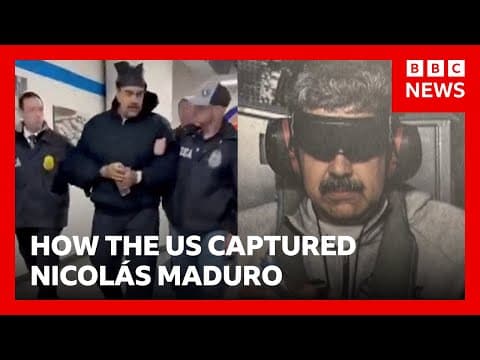
[0:03]Hello, I'm Lucy Hawkings, good to have you with us. Nicholas Maduro has arrived in New York, hours after President Trump announced the US had captured Venezuela's President after launching strikes on the country. A social media page run by the White House posted this video. You can see here. It shows Mr. Maduro entering the Drug Enforcement Administration headquarters in New York. It was posted alongside the comment Perp Walk. That's an expression for the public display of an alleged perpetrator of a crime by law enforcement officials. Mr. Maduro and his wife Celia Flores had been flown to an air base outside New York after being captured in the capital Caracas. He was then transferred to Manhattan where he was indicted on drug trafficking and weapons charges. US reports say he is spending the night at the notorious Metropolitan detention center in Brooklyn. Now that's a facility that has handled many high-profile cases including rapper R Kelly, the Jeffrey Epstein associate Gilaine Maxwell and most recently, Sean Diddy Combs. Mr. Maduro had been taken to Guantanamo Bay in Cuba before being flown to New York. US officials releasing this photo you can see of him here on board the USS Iwojima as it headed to Cuba. Due to make his first federal court appearance we understand on Monday. In the coming hours here on BBC News, we will bring you all the latest reaction and analysis from our expert guests and the BBC's range of correspondents here and abroad. So we can't start our coverage with our World News correspondent, Joe Inwood.
[1:35]It was a sight not seen since the Cold War. A Latin American city under US fire. In the dead of night, bases across Venezuela were struck in a huge coordinated strike. Terrified people, some thinking it was an earthquake, soon realized they were under attack. But this was not designed to be the start of a prolonged campaign, but rather cover for an operation to capture Venezuela's President. A few hours later, this extraordinary image was released by President Trump. Nicholas Maduro, who just a few hours before had ruled over tens of millions of people, in US custody on board the USS Iwo Jima. It was dark, and it was deadly. But captured along with his wife, Celia Flores, both of whom now faced American justice.
[2:34]For more than a decade, Nicholas Maduro had ruled over Venezuela. He had overseen an authoritarian regime. Just over a year ago, he claimed victory in highly disputed elections. In recent months, his forces had been on high alert, a response to the ramping up of pressure from the US. That pressure took the form of a massive build-up of forces in the Caribbean. The US had always insisted it was about combating drug smuggling, but few thought that was credible, and yesterday it was confirmed, their aim was regime change. We demand the immediate liberation of President Nicholas Maduro and his wife, Celia Flores. The only president of Venezuela, President Nicolas Maduro. But that will not happen. The US says Nicholas Maduro and his wife will face federal charges in New York, where they arrived yesterday afternoon. According to President Trump, the US is now in charge of Venezuela. We're going to run the country until such time as we can do a safe, proper, and judicious transition. So we don't want to be involved with having somebody else get in and we have the same situation that we had for the last long period of years. Many people, including Nicholas Maduro, have always insisted this was about Venezuela's vast oil reserves. That view will not have been changed by this announcement. We're going to have our very large United States oil companies, the biggest anywhere in the world. Go in, spend billions of dollars, fix the badly broken infrastructure, the oil infrastructure, and start making money for the country. Even before the US announced its temporary takeover, there had been condemnation from many quarters. Protesters gathered outside the White House.
[4:40]But inside Venezuela, the shock of the night soon turned to fear for what might come next. Look, you see the streets empty. People are in their own thing, buying things to go back home. A lot of uncertainty in the entire country for everyone. You, me, someone walking. What will happen tomorrow? What will happen in the next hour? Nobody knows, but well, it's an enigma that we are living right now. Late last night, the convoy carrying Nicholas Maduro and Celia Flores arrived at the Drug Enforcement Agency offices in New York, where they will be charged with multiple offenses. As for what comes next for Venezuela, that is far less certain. The US has said it will run the country. How they plan to do that is not yet clear. These photos were taken as the operation to capture Nicholas Maduro took place. It is hard to overstate the importance of these events. It feels like the world is at a turning point. The question is, in which direction? Joe Inwood, BBC News. BBC Mundo reporter Daniel Pardo sent us this update from Cacuso, which is on the border of Venezuela and Colombia. Behind me you have a huge presence of Colombian authorities. You have the Ministry of Defense, you have people from the presidency, from the military, from the police, from the local regions here and they're discussing what to do next. And they're thinking about two different lines. First of all, they're thinking in terms of humanitarian uh schemes. They want to prevent people not from coming to Venezuela but help them uh come to Colombia. Bear in mind that Colombia is the most affected country in the region from what happens in Venezuela. 1/3 of the 8 million Venezuelans who fled the country during the economic and political crisis are here in Colombia. So there's huge concern in the country for what comes next. And then the other line that they're trying to tackle is the arm groups that are settled here. Bear in mind that in this border, which is huge and very perilous, um you have arm groups from the guerrillas of Colombia, from paramilitaries and from drug dealers. All of those groups right now are trying to fill in the vacuum power that came out uh of Venezuela's and Maduro's capture. So it's very likely that we're going to see an increase of violence in this region and this is what the Colombian authorities are trying to um build up for. There is so much interest in the journey that Nicholas Maduro took to New York after his capture. It was around 3,300 kilometers or 2,100 miles. And the BBC News live page has this map which shows you the journey flown out of the capital Caracas on a US helicopter in the early hours of Saturday morning. And taken aboard a US warship at an unknown location in the Caribbean Sea. Later, flown to Guantanamo Bay, US Naval Base in Cuba. Then transferred to another plane to head to Stewart Air Force base in New York State's Orange County. Maduro then transferred by helicopter to New York City. So we're showing you that just to give you a good idea of one of the things that's on the BBC News live page at the moment while we're logging on to take a look, keeping up to date with all the developments with analysis from correspondence and people right around the region and the world. One of our experts is our Latin America online editor Vanessa Buschliter who is with me now. And Vanessa, firstly, to reflect on the people of Venezuela today. How are they feeling? Absolutely well, there's still many people who don't really know what is going on. I mean, the news of course in Venezuela has been highly censored, so a lot of the people who can't access foreign news sites, um have been just listening to Venezuelan radio, and Venezuelan radio has been playing music, and has been playing cartoons, and what they have heard of course is the Vice President Delcy Rodriguez uh taking over power. She was given that job of interim president by the Supreme Court of Venezuela and the Supreme Court has put her in charge. But these people who have been afraid many cases to leave their homes, don't really know what's happening on the ground. Some have ventured out to get medicine, to get uh food basics, but many shops have been closed uh because shopkeepers were afraid to open up. And so they've there have been long queues forming of those who did dare to venture out. So when President Trump says the dictator and terrorist Maduro is finally gone in Venezuela, people are free. They are free again. That is not how people are obviously feeling. What are the expectations that they also have of Dolce Rodriguez? What do we know about her and what she might do now? Well, Delcy Rodriguez has been a Maduro loyalist. She was his vice president, and uh she has been somebody who has always praised the Bolivarian Revolution. The political movement that Maduro and uh his predecessor Hugo Chavez uh backed. And uh she is seen as somebody who has been a hardliner, who has held many different posts because Maduro only trusted a handful of people. Those people who were in his inner circle of trust have held different positions in the government over the years. And Delcy Rodriguez is one of them. She is highly ambitious and it is conceivable that after the strikes that the US carried out, she was basically given the choice of either facing more strikes. We know that Trump said that a second wave of strikes had been planned and then wasn't carried out or work with the Americans. Trump told us that Delcy Rodriguez had been willing to work with the Americans, but she then came out and gave quite a combative press conference, denouncing the seizure of President Maduro as a kidnapping and saying it was highly illegal. What role for the opposition now? Because we spoke a lot after I'd interviewed Maria Corina Machado and Oslo just a few weeks ago. Where she told me, very clearly, I've got a plan. I'm ready to rule and come back, you know, it is my team that rightfully should be in power in Venezuela right now. And yet President Trump was incredibly dismissive of her last night. That's right, and Maria Corina Machado and her team had published an open letter just hours before President Trump spoke. And in that letter she said that the hour of freedom had come and that it was time for her and Edmundo Gonzalez, the man who stood in for her when she was barred from running for president. And the man that she says and voting tally suggests won that election last year in July 2024. She said it was time for the two of them to return of the country and to assume power. So when Trump talks about a transitional situation that would then lead to new elections, are there many people who are going to say we've had the elections already? We don't need to have another set of elections. Absolutely right. I think those millions of Venezuelans who cast their vote in July 2024 and many of them cast their vote for Edmundo Gonzalez, they want to see that vote honored. They do not want to see new elections. Also there has been a history of many of the elections being conducted in Venezuela not being free and fair. So they fear that that could happen again. So they want to see the 2024 result honored. And in terms of the region, what is the feeling at the moment about the way that President Trump talks about ownership of the region at the moment and what his plans are and where he sees America's role? I think there's huge concern, concern and shock because this is unprecedented. Many say that this is the end of the rule of law. And they of course also fear what might happen in their countries. Mexico, for example, has come under criticism for the amount of fentanyl that flows into the US from that country. And I'm sure that its president, President Claudia Sheinbaum will be worried about any possible strikes happening in her country. And Trump did also mention Cuba. And of course Marco Rubio has a very keen interest in Cuba and the US has long denounced the regime in Cuba and would see, I'm sure would want to see regime change there. And in a discussion as well around the fact that President Trump pardoned the president of Honduras as well and there's been a lot of criticism of that. Absolutely, that came as a complete surprise because the president, former president of Honduras, Juan Orlando Hernandez was sentenced to a lengthy prison term because he was found guilty of being a narco terrorist. The exact word that Trump uses for Maduro. So many are questioning why did he pardon Juan Orlando Hernandez and then go after Nicolas Maduro. Still so many questions, but great to have you with us, Vanessa, thank you very much.


