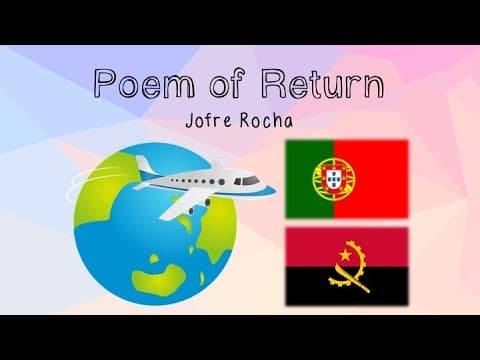
[0:03]Hello everyone. The following presentation is a summary and analysis of the poem titled Poem of Return by Jofre Rocha. This is the fourth poem on the new list of Grade 12 English Home Language Poetry for 2023 and the next few years. The following information is some background to the poet Jofre Rocha to provide some context to the poem. Robert de Almeida wrote his literature using the pseudonym Jofre Rocha. He was born in Angola in 1941. He was a member of the People's Movement for the Liberation of Angola (MPLA). Rocha was an activist who fought to liberate Angola from Portuguese rule during the Angolan War of Independence. He was detained by police twice and for his own safety, he went into exile in Lisbon. Once Angola achieved independence, he served in various ministerial positions from 1996 to 2008. This poem was written in Portuguese and translated into English.
[1:20]Let us take a look at the summary of this poem. The speaker contemplates his upcoming return to his home country. The poem is written from the perspective of an exile. This is someone who has had to flee their country of birth. In the poem, he describes his 'host country' as a 'land of exile and silence'. He lists the things he missed while he was away and expresses his guilt. He is not a hero and should not be treated as one. He asserts that the real heroes are the ones who fought against oppression. The poet writes about lost opportunities, mourning and sadness brought by colonialism, exile and war.
[2:15]Let us read through the poem. When I return from the land of exile and silence, do not bring me flowers. Bring me rather all the dews, tears of dawns which witnessed dramas. Bring me the immense hunger for love and the plaint of tumid sexes in star-studded night. Bring me the long night of sleeplessness with mothers mourning, their arms bereft of sons. When I return from the land of exile and silence, no, do not bring me flowers. Bring me only, just this, the last wish of heroes fallen at day-break with a wingless stone in hand and a thread of anger snaking from their eyes. The first two lines of the poem read, When I return from the land of exile and silence, do not bring me flowers. Consider the words when I return. Taking into account the context of the poet, we can interpret this as the speaker has not yet left Portugal for Angola. He refers to Portugal as the land of exile and silence, which suggests that being away from his home country is quite an isolating and lonely experience for the speaker. His instruction to the reader is do not. The diction here creates a commanding and assertive tone. The instruction is not to bring him flowers. Flowers are generally associated with celebration and in this instance, he does not see himself as a hero deserving of any sort of praise or celebration. We can say that the speaker is feeling a sense of guilt for fleeing his country during a time of unrest, whilst the majority of others had to stay behind to fight the colonialist system. You will notice that the rest of the poem lists all the things the poet has missed about home, and what he would rather have than flowers. The speaker is looking for something more meaningful than mere flowers. In Line 3, rather than flowers, the speaker requests, Bring me rather all the dews. In nature, dew refers to tiny drops of water that form on cool surfaces at night. However, figuratively, here the dews refers to the moisture of Angolan people's tears. Another interpretation of this word could also be a pun or a play on the word 'dues' - what the Angolan people deserve or are owed.
[5:14]In Line 4, rather than flowers, the speaker wants the tears of dawn which witnessed dramas. As I just mentioned, the dews figuratively can refer to the tears of the Angolan people. Each new day in Angola starts with 'tears' from the 'dramas' (colonisation, exile, loss, violence and trauma) of guerrilla warfare that ordinary people have to face every day.
[5:54]In Lines 5 and 6, rather than flowers, the speaker requests the immense hunger for love and the plaint of tumid sexes in star-studded night. Note the repetition of the instruction bring me. A repetition of a set of words in poetry is called anaphora.
[6:16]The speaker requests that he is brought the immense hunger for love. Rather than flowers, he wants human connection he has missed - love from friends, family and his longing for his home country.
[6:35]Along with a hunger for love, the speaker requests the plaint of tumid sexes. A plaint is a plea or a cry of longing or yearning. The word tumid means a kind of swelling. In this case, it is a swelling of desire. The word sexes refers to acts of romance and intimacy.
[7:05]Note that the word is not in its singular form, but rather it is in plural. We can interpret this as a reference to the many people who are able to make love in a star-studded night, in other words, a night filled with stars up ahead. In these lines, we can say that the poet has a moment of heightened awareness of his isolation. His yearning for home and belonging is intense and brought to a climax as he is excluded from the beauty of being intimate with a loved one. In Line 7, the speaker requests that he is brought the long night of sleeplessness. The idea that the night is described as long could be a reference to how the pain and anguish of the guerilla warfare in Angola has continued for an extended period of time. Not only is the night long, but it is also filled with sleeplessness. Not being able to sleep is sometimes associated with a worried mind, and in this case, people are worried about the safety of their loved ones in this time of war and unrest. These long nights of sleeplessness are filled with mothers mourning. Many mothers would be grieving for their sons who are at war, in prison or in exile. These mothers' arms are described as bereft of sons. The word bereft means deprived or lacking of something. In this case, mothers have been deprived or robbed of their sons due to the war and political unrest. What we can deduce from the speaker is that rather than receiving flowers upon his return from exile in Portugal to Angola, he would rather want to connect with and understand those who have suffered because of the conflict. Lines 9 to 11 read, When I return from the land of exile and silence, no, do not bring me flowers. Bring me only, just this. Note the double negative in the beginning of Line 10. This double negative is a wholehearted emphasis on how the speaker does not feel deserving of flowers, celebration or the title of a hero upon his return. This diction creates an authoritative, forceful tone. Note the anaphora, the repetition of the command bring me. The speaker requests only just this. There is redundancy here, meaning the unnecessary use of words. The words 'only just' could have been left out. However, this redundancy emphasizes his insistence of only wanting one thing.
[10:20]Take note that Lines 9 and 10 are a repetition of the first two lines of the poem. We can say that this emphasizes that the poet's return to Angola is not something to be celebrated. Being away in exile was possibly not a pleasant personal experience for the speaker. However, he does acknowledge that his hardship is nothing like those people who were left behind in Angola. We can assume that the reason why he does not want flowers and a celebration upon his return is because he feels a sense of guilt at being able to escape the war and political unrest. Because of his feelings of guilt, he only feels the need to acknowledge the people left behind's pain and hardship.
[11:20]In the last three lines of the poem, the speaker has requested the last wish of heroes fallen at day-break with a wingless stone in hand and a thread of anger snaking from their eyes. The last wish of heroes fallen was most probably to see a changed and free country. The heroes fallen refers to those who died fighting in the Angolan war for a better future. These heroes are described as fallen at day-break. Day-break or the early morning sunrise, could symbolize a new beginning. However, those who fought and died for change will not get to experience the change. These fallen heroes are described as having a wingless stone in hand.
[12:15]We can liken this stone to a weapon of war. However, because this weapon is wingless, it has no power. In the context of the history of Angola, there was support for the guerrillas from Cuba and Russia, which resulted in Angolan soldiers being largely under-resourced. Despite having a wingless stone in hand, these fallen heroes have also a thread of anger snaking from their eyes. Even though their anger is merely a thread, and might seem weak, their anger turns into a snake. We can associate an angry snake with danger and purpose. This will be an eventual demand for justice and freedom. Their anger will snake from their eyes, possibly suggesting at the moment it only reflects a small part of the anger these fallen heroes truly feel. The speaker does not want flowers when he returns to Angola, but rather what the soldiers and the oppressed were fighting for. The fallen soldiers' sacrifices need to be acknowledged and remembered because unlike the speaker, they are not able to return home.
[13:42]This is a poignant poem about the return from exile, and what should be celebrated is rather sadness and mourning. The themes evidence in this poem include yearning, loss due to war, lost opportunities, colonisation and exile, anger, and sadness and mourning. The tone throughout the poem includes sadness, loss, guilt, regret and anger. With regards to the form and structure of this poem, we can note that this poem has 14 lines. However, it does not conform to the strict form of an Italian Sonnet. There is a clear division between stanzas 2 and 3, separating the octave from the sestet. There is no rhyme scheme, no iambic pentameter and unlike a sonnet, this poem is written in free verse.
[14:53]Thank you for watching this presentation on Poem of Return by Jofre Rocha. Please be sure to subscribe to my YouTube channel and to give my Instagram and TikTok pages a follow at english_is.love for more English content.


