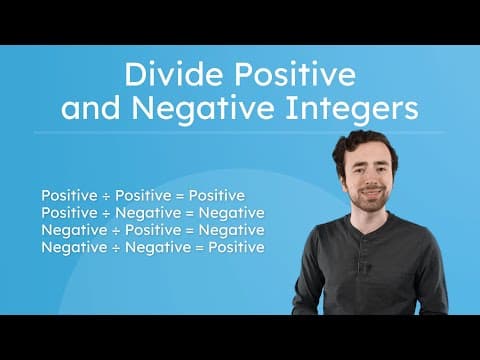
[0:01]Hey everyone, it's Justin again. In this video, we're going to practice dividing with positive and negative integers. So, let's get into it. In today's lesson, we'll review the connection between multiplication and division. We'll apply the rules for multiplying with positives and negatives to division, and then we'll review how to divide larger numbers. Finally, we'll go over how to write remainders when numbers don't divide evenly.
[0:30]Let's start by reviewing the relationship between multiplication and division. You should have already completed your pre-activity, which is part of your PDF. If you haven't done that yet, please finish it now and come back when you're done. You can always ask a parent for help if you need help finding the pre-activity.
[0:49]So, to help you understand the relationship between multiplication and division, it might help to think about addition and subtraction. If I start with nine and add three, we get 12. And if we start with 12 and subtract three, we get back to nine. Adding and subtracting are "inverse operations." They "undo" each other. Let's see how that connects to multiplication and division. If I have four groups with three stars each, then I know I can multiply three by four, and it tells me that I have 12 stars total. And then I can do the inverse operation. If I have 12 stars and want to divide them into four equal groups,
[1:43]I can use division to find that 12 divided into four equal groups gives me three items in each group. Just as 3 * 4 is 12, 12 divided by 4 is 3. Multiplication and division are also inverse operations. They "undo" each other. Now that we've seen the relationship between multiplication and division, let's review the rules for dividing with positive and negative integers. So, because multiplication and division are inverse operations, it shouldn't surprise you that they follow the same rules when it comes to dividing with positive and negative numbers. When we divide two negatives or two positives, we get a positive number. When we divide one negative number and one positive number, we get a negative result. But guess what? We can make this even simpler. When you are multiplying or dividing, if the two numbers have the same sign, then the result will be positive. If the signs are different, then the result will be negative.
[2:54]Pause the video here and complete these division problems in the guided practice in your PDF. Okay, let's see how you did. Pause this video again to check your work and fix any errors you might have.
[3:16]Before we go any further, we need to review some important vocabulary you'll use when you're dividing. Let's review division with larger numbers. We need to find the quotient of -12,584 and -52. And I think Mia has a reminder here for us.
[3:37]Right, quotient means the result of a division problem. And what type of result will we get if we're dividing two negative numbers? Positive or negative? Right, the result will be positive. So, we can ignore these negative signs here. We know we'll have a positive answer. One method to divide, especially with larger numbers, is called long division, which we'll review here together today. Now, it's perfectly fine if you've learned a different method as long as you remember how to use it and you consistently get the right answer. So how do we set up a long division problem? Let's review some vocabulary. Remember, order matters in division, so we need to be sure to keep things straight. When we divide, the first number is called the dividend. The second number, the one we're dividing by, is called the divisor, and the result, as we just saw, is called the quotient. When we set up a long division problem, the dividend goes here, inside the division sign. The divisor goes here on the outside, and the quotient will be written on top of the division sign once we find it out. All right, now we're ready to divide. Let's go through the process of finding that quotient. Remember, we'll take our divisor and start trying to divide it into the dividend starting at the left. Will 52 divide into one? No, it won't, so we include the next place value. Will 52 divide into 12? Still no, so we increase again. Will 52 divide into 125? Yes, it will. How many times? We can do some estimating here. 52 is close to 50, and 50 will divide into 100 twice, so 52 should divide into 125 twice as well. That two goes up here. It needs to go right over the one's digit of 125. It's important to keep your place values lined up here. Some students like to put zeros here to show that 52 didn't divide into one or 12, and that means that our two will go in the next spot. Some students like to use graph paper or turns their lined paper on its side so that you have guide lines like this. Whatever method you use, be careful and be sure your place values are all lining up. Okay, now remember that this is the standard division algorithm that many students use. If you use something else and still get correct answers, that's great, but let's finish this problem using this method now. 52 divides into 125 two times. Two goes here on the top. Then we multiply 2 * 52 to get 104, which goes here directly under 125. Then we subtract 125 - 104 to get 21. Now we'll bring down our eight here to get 218, and then we repeat this process with our next place value. Divide 52 into this new result 218. Again, we can estimate. 50 will go into 200 four times, so we put that four here directly over the eight. Then we multiply 4 * 52 to get 208. 218 - 208 is 10. Then we bring down that four. We're almost done. Now it's time to divide again. 52 goes into 104 twice, so we put that two here on top. Then multiply 2 * 52 and put the answer 104 here. Subtract again, and what do we get? Zero. And now there's nothing to bring down, and we can't repeat our process. So we need to look at the rest of our final subtraction. What does it mean when this final subtraction results in a zero? That's right. It means that we have no remainder and we don't need to repeat our process. Now, remember that these were negative numbers to begin with. So, -52 divides into -12,584 exactly 242 times. Nice work.
[8:22]Great job so far. You probably noticed that the problem we just completed had no remainder, but that doesn't always happen. Sometimes our divisor does not divide evenly into the dividend. So, the last thing to go over today is a refresher about two of the ways we can write remainders. Here's the problem 23 divided by 4. You can see that four divides into 23 five times, but four won't divide into three, so we have a remainder of three. Sometimes we write this entire quotient as five or three, but there is a more advanced way to write this remainder. Understand this, let's take a look at a visual representation. We're starting with 23 and breaking it up into equal groups of size four. We can see that 23 divides into five equal groups with some left over. So how many are left over? There are three, which was our remainder when we subtracted. We can think of our answer as five groups with three-fourths of a group left over. And we're going to express that answer by writing a mixed number, which, remember, is a whole number and a fraction together. The number of groups is written as a whole number. Those three that were left over, remainder, will always go in the numerator of the fraction. The total number of items in each group, the divisor, will always go in the denominator, and we write our answer 5 and 3/4. Note that we can also write remainders as decimals, but we'll review that later when we cover decimals. For now, if you have a remainder, please write it as a fraction. Well, you've now completed the pre-video activity, watched this video, and completed your guided practice. Your next step is to complete a few more division activities in your PDF, and at that point, you should be ready for your practice game. Great work on all this division. I'll see you next time. Hey


