[0:04]There are all kinds of benefits that come from nature being part of our existence as opposed to separate. It's something that is alive and that keeps going. It gives dignity to one's existence. So it's not about, you know, changing the world, it's about actually having a quarter turn to saying, oh yeah, we are part of nature and that is actually good. And not only is it good, it makes me feel more complete. We are part of a bigger system.
[0:57]My name's Yo-Yo Ma. I'm a human being first, a musician second, and a cellist third. Well, uh, it is a pleasure to have all three of you here. Uh, and you're known as a musician, a cellist, but I want to talk to you about the core of you as a human being because it's informed your work. So let's start at the beginning, you came from a musical family. Tell me about your parents. Well, my father was born in Southern China in Ningpo in 1911 and in 1936, he left to go to Paris to get his PhD in musicology, composition, and violin. So my father experienced World War II in China with the Japanese invasion. And then he was in Paris when the Nazis came. My mother was born in 1924. She had to shave her hair as a teenager because when the Japanese invaded, um, you know, threat of abuse and rape and all of that, you know, she witnessed people, um, you know, burning furniture to have firewood and literally people having something to eat on the street and having the food snatched away because there was starvation. So you can understand that both my parents came from unstable environments. How did they meet each other? They met in France. My mother was a singer and so she studied voice, left at the last moment in 1949, uh, was on a boat that my father's sister, my aunt was on that same boat and then as expats they met and, you know, and then got married. My sister was born in 1951. And what I found out recently was that they were set to go back to China, except that I was born and they didn't have a ticket for me, and they stayed in France. And then in 1962, somehow from literally a salary of like $20 a month, they had saved enough money to go on a transatlantic trip bringing my sister, my mother, me to the states. We took a train trip from New York to Rochester, to Chicago, to Berkeley, California, then went back through the Rockies, you know, went to Denver. You're seven years old. I'm seven years old, my sister was 11. She played a Mendelssohn concerto with the Denver Symphony Orchestra. So she was a good violinist. And then we came back to New York, were set to go back to France forever, that was going to be our one trip to see family. And my sister and I played a concert some place on the Upper West side in Manhattan to which a Franco-American lady came because she had founded a school that needed a music teacher. She had heard about my father, came to the concert two hours early to see what happened backstage, behind the scenes and asked my father at the end of the concert to say, please come and teach at our school. So it was by that fluke serendipity, had we not given that concert on the Upper West side, I would have grown up in France. So you were on stage, Leonard Bernstein was there. You did an on air performance. So this is, okay, in my own mind, this is what makes America special. So within a year of my arriving in the states, I had Tiger parents who took me to play for the brother of my father's violin teacher in China, Ma Sihu, who knew Alexander Schneider, who was the violinist of the Budapest Quartet, took me to play for him, who then said, you should play for Pablo Casals. And Pablo Casals heard me play and said, kids really talented and he's the one who said, I'm a human being first, a musician second and cellist third. I heard that as a nine-year-old and I thought that was like a great line because I could tell my parents is, excuse me, I'm a human being first. And so he was asked to participate in the first live television telecast of an event that featured the National Symphony with Danny Kay conducting the orchestra to raise money for what became the future Kennedy Center because Washington did not have a performing art center. And Casals said, said, you know, I don't want to be part of this, I'm staying in Puerto Rico, but I just heard this kid, so have him play. So that's when my sister and I played on stage with Leonard Bernstein introducing the two of us. Now, here's a cultural heritage you can all understand, as you listen, a seven-year-old Chinese cellist playing old French music for his new American compatriots. Welcome, Yo-Yo Ma and Hu Cheng.
[7:16]These opportunities are crazy. Do you believe that there is a larger guiding force that made that happen? Do I believe in faith, destiny and higher powers? I like Einstein's way of saying that I believe in the mysterious of things that we could never understand and in things that are truly beyond humans to ever be able to comprehend. You know, as a result, I'm fascinated by what we can explore in the universe, in the macro world, in the micro world, in the quantum world, things that seem so contradictory to what our intuitions can tell us. But I also believe that accidents change lives. And, um, so an example of that is as a result of my moving around coming from three different cultures, uh, I grew up really confused. And growing up being born 10 years after World War II, and in Paris, you could really still feel the effects of World War II. I grew up asking myself, what happened? Why did it happen? How could people be so unbelievably cruel to one another? And I grew up with people saying, never again and then seeing that it happens over and over again. I think since a very early age, I just really wanted to understand. I wanted to understand who I was, who we are as human beings and why we do the things that we do. How we invent things and also how we destroy things. Did you have these conversations with your parents? No, because in an Asian family, uh, it's a top-down situation. There's no dialogue, there's monologue. You know, it's like I say and you do, right? It's not like no wise and, you know, it's like the two-year-old that says, why Daddy, why does this happen? No, that doesn't, that doesn't happen. So the common thread between your parents, your sister, you became music. Yes, it was absolutely something that we all sort of did and agreed on. The difference is my father, my mother, and my sister all sort of thought, okay, music was the thing. I'm the youngest child.
[10:14]By that time, you know, you, you're, you're kind of sort of believe, but you're questioning a lot more, you know, a bit of a rebel.
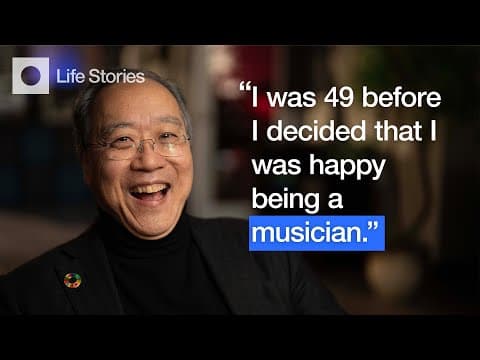
[10:27]And so I went through many iterations of thinking and asking myself, what could I have done if I were not a musician? Would you believe that I was 49 before I decided that I was happy being a musician because I started at such an early age? I'd kind of fell into it. I didn't ever say, this is the thing I want to do because that, you know, makes the world sync for me. You actually got your degree in anthropology. Well, what was interesting about, uh, first of all, going to college rather than, uh, a conservatory, which might have been a more natural course, is that my sister went to college and I thought, gee, you know, she escaped. And I went to visit her in a dorm and thought, wow, this is great, you know, freedom. And so that was my version of freedom to go away from home and to go to college. I ended up being a music major. Anthropology was my passion. Why? Because it was the first subject that I encountered that could actually try to explain value systems to me coming from different cultures, to study early cultures, you know, to study the San, the Co from the Kalahari Desert and to realize that here are people who never were violent, they talked through their problems. But then you take it to studying the different values of the countries that I knew of, to say, okay, well, this is French culture, this is German culture, this is American culture. Suddenly, it gave me the tools to look at what was otherwise an incredible mishmash of confusing messages. And this has been a lifelong passion as a musician trying to figure out what is the soul of a country. So if you go to Argentina and you say, okay, well, tango is actually the soul of the music of a country that somehow it expresses all the contradictions of that country. But then you come to America and says, well, what is the soul of America? You ask through music, what is it? Then you see like another spectrum of incredible varieties and how these varieties and contradictions mix to get to what is American? So that became a mission to try to figure out why people act the way they do. That started a whole series of questioning of how humans and societies, what's the relationship, what are the obligations, who are we as human beings, the enlightenment, all the things that we're kind of descended from that actually made us create our modern world and deepen our knowledges, but in some ways separated us in terms of almost building a tower Babel without a common language. And how can we get back to a common language while appreciating all the different forms that have evolved since the last couple hundred years? And you have made it your mission to use music as a common language. You speak through your music and you're having different conversations. Absolutely, I think you cannot be a musician unless you're a life learner. I mean, because if you're a live performer, you're constantly testing out in real time on an audience to see, you know, is it working? You're actually exploring the imagination and essentially testing out theory to practice. You are both the experimenter and the experimented and you're using yourself as much as possible to test out how something that is, you know, theoretically a good aesthetic. Here's a song, here the lyrics, I think it'll work. You don't know whether it works, right? Filmmakers have to do that, you know, you test it out with an audience and say, well, nobody got that joke. Can't do that with a live performance, what you're doing, it happens in real time. Right, but then afterwards, you say, okay, well, did that work? You know, what went wrong, what were those circumstances and you're constantly as sentient beings using your senses and your memory and your exploratory capabilities to try and figure out how something is received. And you know that everybody hears, feels and sees differently and yet we are constantly also establishing something in common.
[15:37]What a lovely segue. You have embarked on something called our common nature. Can you describe what that project is and what you hope it can accomplish? Artists and scientists and indigenous people generally agree that we humans are part of nature. And Andy Goldsworthy, the wonderful nature artist, says, we are nature, and if we feel disconnected from nature, it's because we're disconnected from ourselves. The physicist, Richard Feynman would say, nature has the greatest imagination, but she guards her secrets jealously. You know, the Wabanaki and Maine say, well, of course, we're part of nature, you know, our job, our purpose, our meaning is to welcome the sun every morning. They show gratitude. They thank the moon, they thank the stars, they thank the trees. And I think about that process, it puts my problems in perspective. So gratitude as we're part of something bigger than ourselves, that's nothing new. It's actually something we know, but that often we don't practice. So our common nature, it's about our human nature and the nature that is our planet, our universe. We are symbiotically attached. You know, the cello's there, I'm activating some sounds. If I'm a good cellist, the cello is part of me, right? It's like what I think, it goes. But if I'm drawing from something, the sounds are affected by what I'm seeing and imagining. So therefore, you're creating a much larger circle. There are lots of things that we're figuring out. I'm not saying, this is true, we must all believe in that, but there's enough evidence and proof that, you know, there's this alignment and that we need to figure it out because by figuring it out, we can probably chart a better course for our future. And often, if I'm playing outdoors, right? As I did in Athens at one of those incredible theaters, that's right by the Acropolis, you know, I'm playing something and suddenly there are some cicadas making their sounds. And suddenly at the end of the piece, I keep going because I'm imitating the cicadas. And and they're listening to the sounds and there's kind of like, you know, a duet going on with nature that's unexpected that that became part of the performance and everybody thought something special had happened. I certainly did because it had never happened before. And suddenly, you know, we are more at one with a larger circle of nature and human nature. You've talked about the places on the planet that you've been to, you were designated a title as a UN Messenger of Peace. How did that manifest? What did you do, what do you do? Well, it's funny, because for the longest time, I had no idea. It's a great titular honor, but without sort of saying, you must do this, this, this. And so I did ask the Secretary General Kofi Annan and says, you know, what do you want me to do? And he said, just do what you do. And for the longest time, I didn't understand that either. I once did something at the Kennedy Library and Senator Kennedy suddenly said, oh, in his, you know, great booming voice and Yo-Yo Ma and here's someone who believes in public service. And I thought about this, but gradually it entered into my psyche and says, yes, that is what music should be. It's a public service and that means you need to go wherever it is needed. Where can music be useful? And in that sense, the same thing for what that means for peace. There's something in life and the universe that seeks equilibrium. When are you happiest? When everything's in balance, right? Your family's well, you know, your friends are well, you're giving to the community, you feel special because you've just done something you're really proud of, someone acknowledged it, you just helped someone that needed some help and, you know, you feel, oh, I had a good day, everything's in balance, I've kind of put a little bit of everything into my day. That's the same thing about peace. Is when everything is more or less in equilibrium, not just between enemies. It's in ourselves and just starting where you are. Now what I try and do as a performer, and I can tell you every time I perform before I play, I ask myself, okay, am I prepared? Am I prepared, what's missing? Because guess what, something's always missing and I need either reflection time or friends or colleagues to remind me what's missing. Because the thing that's missing is what's going to lead to a description or dissemination of something that will be in equilibrium. And if people feel that, the message will be better received. So I do that myself, but I also try and, you know, spread that idea so that it can exist in others. Let's finish with the future. I'm 69 years old. We've just reached a quarter of a century into our new century, our new millennium. And when I go around my community around the country around the world, I'm thinking, what's missing? If I read the newspapers, if I read social media, whatever I do, what's missing is actually just a natural kind of humanism and wisdom that we actually already possess. We all are wise of to a certain extent. We know kids are wise, adults are wise, we actually know what's important, but we also have habits that prevent us from doing what is important. And so what I'm thinking is, wait a minute, we don't need to reinvent the wheel, but let's look at actually what we know, and we do know our globe better in so many ways, we're networked. In some ways it's distended, our populations made, you know, the rich richer and all that stuff. Yes, but we also have the good news part. From the digital native generation, which is, according to my iPhone, 16 years old. Right? It's 16 years old, and people who grew up with that actually know their pure group around the globe so much better than you and I did in our generation. That, that is a fact. Now, suppose we over the next 25 years, can actually earn the trust of of this generation. And actually say, well, what kind of world do you want to build that we would all want to live in past my prime time and expiration date, not me doing it, but working together massively, collaborating. Why can't we actually combine to say, let's find the thing that's missing, which is this humanism that's based on kindness and common care and invention and capitalism and whatever it is that makes us both competitive and collaborative, which is what nature does. I want to put the music I play to work to try and say, let's think about it, let's talk about it, let's actually discuss this and see what you and I can come up with that actually leads us in a way that we can all believe in and trust because the onus is on us to survive and thrive, or not. And it's, you know, no planet B, it's our planet, it's our home and we can actually think about it as one home for the first time.


