[0:00]Let me ask you something. When was the last time you died? No, no, don't look at me like that. I'm serious. Because if I told you that most of the atoms in your body right now were not there a year ago, you'd have to admit that the you from last year is gone, physically gone. And yet here you sit thinking you're the same person. So which is it? Are you alive or are you the ghost of someone who already vanished? By the end of this talk, I want you to see something that most people never think about. I want you to understand what physics actually says about dying. And I think you'll find it says something quite surprising. Not comforting in the way a preacher might comfort you, but surprising in the way that only the truth can be. Let's start with something simple. Let's start with a candle. You light a candle, the flame flickers. It burns for an hour, two hours, and then it goes out. Now, I ask you, where did the candle go? You might say, well, it melted. But that's not really an answer, is it? The wax is mostly gone. The wick is a little stub of char. Something happened to all that stuff. Where is it? Here's where it gets beautiful. The wax was made of long chains of carbon and hydrogen atoms. When the flame burned, those atoms didn't disappear. They couldn't. They combined with oxygen from the air and floated away as carbon dioxide and water vapor. Every single atom of that candle is still out there, right now, drifting around the room or out the window, mixing into the atmosphere. The candle is gone, yes, but not one atom of it has been destroyed. Not one. This is the first law of thermodynamics, and it is one of the most fundamental facts in all of physics. Energy cannot be created or destroyed. It can change form, it can move from one place to another, but the total amount, it stays exactly the same, always. Now, you might say, fine, Feynman, that's a nice trick with a candle. But what about me? What about a person? And this is where it gets really interesting. You are made of atoms, about seven octillion of them, give or take. That's a seven followed by 27 zeros. It's a number so large that if you tried to count them, one per second, it would take you longer than the age of the universe. And those atoms, every single one of them, were here long before you were born, and every single one of them will be here long after you are gone. Let me put it another way. The carbon atoms in your muscles were once inside a star. Not poetically, not metaphorically, literally. The carbon in your body was forged in the nuclear furnace of a star that lived and died billions of years before the earth even formed. Here's how that works. In the early universe, right after the Big Bang, there was almost nothing but hydrogen and a little helium, that's it. No carbon, no oxygen, no iron, no calcium, none of the stuff you're made of. So where did it come from? It came from stars. When a star like our sun burns, it's smashing hydrogen nuclei together to make helium. That's fusion. But in bigger stars, heavier stars, the process goes further. Helium nuclei smash together to make carbon. Carbon and helium fuse to make oxygen. And it keeps going, up through neon, silicon, all the way to iron. Layer after layer, like an onion of elements, each one cooked in a furnace hotter than the last. And then, when the star can't burn anymore, when it runs out of fuel and the core collapses, the whole thing explodes, a supernova. And in that explosion, all those elements, the carbon, the oxygen, the iron, they get flung out into space. They drift through the galaxy for millions of years. They mix with clouds of gas. And eventually, they get pulled together by gravity to form new stars, new planets, and on at least one of those planets, new people. So there's a very real sense in which you are stardust. Every atom of calcium in your bones was manufactured in a dying star. The iron in your blood, same thing. The oxygen you're breathing right now was cooked up in a stellar core and scattered across the cosmos in an explosion so violent, it briefly outshone an entire galaxy. Now wait, let's be careful here. Let's think about this more slowly because there's something even stranger going on. Those atoms that make up your body right now? They're not staying put, they're passing through you. There's a beautiful experiment, and I love this one. Scientists tagged phosphorus atoms with a radioactive marker and tracked them through the bodies of rats. What they found was remarkable. The phosphorus in the brain of a rat, and also in mine and yours, is not the same phosphorus as it was two weeks ago. In just 14 days, half of it has been swapped out, replaced by new phosphorus atoms from the food the rat ate. And this is not just phosphorus. This is everything. The atoms in your brain, your muscles, your skin, your bones. They are constantly being removed and replaced. You eat a potato. The atoms from that potato get broken down, carried through your blood, and built into your tissues. The old atoms get carried away, exhaled as carbon dioxide, flushed out, sweated off, given back to the world. What this means is staggering if you think about it carefully. The atoms that are in your brain right now, the ones doing the thinking, the ones processing these very words, they are not the same atoms that were there a year ago. They are quite literally last week's potatoes. And yet you remember what happened a year ago. You remember your childhood. You remember your name. So what is this mind of ours? What are these atoms with consciousness? I'll tell you what they are. They are a pattern, a dance. The atoms come into your brain, dance a dance, and then go out. They're always new atoms, but always doing the same dance, remembering what the dance was yesterday. This is what you are. Not a collection of stuff, a pattern, a configuration, a way that matter has organized itself temporarily, beautifully, into something that can look up at the stars and wonder. Now, I want to pause here and explain this as simply as I can, because this is the key idea. Imagine a wave in the ocean, you see it rolling toward the shore. You might think, there goes that water, moving across the sea. But that's not what's happening at all. The water isn't traveling. Each little bit of water just moves up and down in place. What travels is the shape, the pattern. The wave is not a thing, it's a behavior that matter is doing. You are like that wave. The atoms are like the water. They come in, they move around, they leave. But the pattern, the shape of you, the way you talk, the way you think, the way you laugh, that keeps going, for a while. Now, let me come to the misconception, the big one, the one that most people carry around without even knowing it. Most people think that when you die, something is destroyed. They think that the matter, the energy, the stuff you're made of, it just vanishes, poof, gone. And this is completely wrong. Nothing is destroyed. Nothing. Not one atom, not one calorie of energy. When a person dies, the atoms that made up their body return to the earth. They get taken up by grass, by trees, by worms, by bacteria. They enter the soil. They dissolve into water, they float into the air, and those atoms go on to become parts of other living things, other structures, other patterns. The energy is the same way. Every bit of chemical energy stored in your muscles, your fat, your tissues, it gets released. It becomes heat. It becomes the energy of decomposition. It feeds other organisms. It enters the great cycling of energy that has been going on since the universe began. From the point of view of physics, death is not destruction, it is reorganization. It's the end of one pattern and the dispersal of the components to make new patterns. That is all it is. Now, some of you might say, well, fine, man, that's all very clever, but the pattern is the part I care about. I don't care that my atoms survive, I care that I survive. Now I understand that. I do. I'm not going to stand here and tell you that physics removes the sting of death. It doesn't. The loss of a pattern, the loss of a person, that is real. That is as real as anything in the universe. But I want you to hold two ideas in your mind at once. The first idea is that the pattern, the person, is temporary. It emerges, it dances, and it dissolves. That is the nature of every complex structure in the universe. From stars to snowflakes to civilizations. The second idea is that the components are not temporary. The atoms are older than the mountains, older than the Earth, older than the Sunday. They were forged in stars that exploded before our solar system was a cloud of dust, and after you're gone, those atoms will go on. They will be part of the soil, the rain, the air, and eventually, other living things. Perhaps other beings who will sit and wonder about their own existence, just as you are doing right now. Let me try a thought experiment. Let's follow a single carbon atom. This carbon atom was made inside a massive star, let's say 10 times the mass of our sun, about 5 billion years ago. The star exploded. The atom drifted through space. It got caught up in the cloud of gas and dust that eventually collapsed to form our solar system. It ended up on Earth, buried in limestone for a few hundred million years. Then a volcanic eruption released it as carbon dioxide. A plant absorbed it during photosynthesis. A rabbit ate the plant. The rabbit died and decomposed, releasing the atom back to the soil. A tree absorbed it. The tree was cut down and burned. The atom went back into the atmosphere. Another plant grabbed it. A cow ate that plant. You ate the cow. And now that carbon atom is sitting in a cell in your left hand. When you die, that atom will leave your body. It will enter the soil. It will be absorbed by a blade of grass. A sheep will eat the grass. A child will drink the sheep's milk. And the atom that was once in a star, once in limestone, once in a rabbit, once in you, will be part of a child who has no idea where it came from. That atom has done this dance 10,000 times. It doesn't know and it doesn't care, but it keeps going. Now here's the part that gives me a real thrill when I think about it. The first law of thermodynamics tells us that energy is conserved. It cannot be created or destroyed. And there is a related fact about matter, courtesy of nuclear physics and the understanding we gained in this century. Under ordinary conditions, atoms are not created or destroyed either. They are rearranged. The number of carbon atoms on Earth has been roughly the same for billions of years. They just keep cycling through rocks, through air, through water, through living things. So in a very deep and literal sense, nothing that you are made of will ever be lost. It will change form. It will be rearranged. It will become something else, but it will not cease to exist. I should be careful and say something here about the second law of thermodynamics, because people sometimes get confused. The second law says that the entropy of a closed system tends to increase. In plain language, that means things tend to go from ordered to disordered. A sandcastle falls apart. A hot cup of coffee cools down. A living body decays. This is real, and it's important. The second law is the reason that complex patterns like you and me don't last forever. It takes energy to maintain the pattern, to keep the dance going, to fight the natural tendency toward disorder. When you die, that fight stops and entropy wins. The pattern dissolves. But notice what the second law does not say. It does not say that matter or energy is destroyed. It says that organization is lost. The stuff is still there. It's just reshuffled into a less organized arrangement. The atoms of a decomposed body are still atoms. The energy of a cool-down fire is still energy. It's just spread out, diluted, harder to use for anything useful. And here is one more thing I want you to think about, because I think it's the most astonishing fact in all of science. The universe is about 14 billion years old, give or take. For most of that time, there was no one around to look at it. No eyes, no brains, no thoughts. Just hydrogen and helium, collapsing into stars, exploding, making heavier atoms, collapsing again. For billions and billions of years, the universe was just matter, doing what matter does, blindly, stupidly, each atom minding its own business. And then, somewhere on a small rocky planet, orbiting an ordinary star in an ordinary galaxy, some of those atoms arranged themselves into a pattern that could think, that could wonder, that could look up at the night sky and ask, what is all this? Why is there something instead of nothing? You are the universe looking at itself. You are atoms that have arranged themselves into a configuration so complex, so extraordinary, that the configuration can contemplate its own existence. That has never happened before in 14 billion years of cosmic history, as far as we know, except here, except now, except in things like you and me. And yes, the pattern is temporary. It will end. The dance will stop. But the fact that it happened at all, that atoms could arrange themselves into something that feels joy, and wonder, and grief, and love, that is not diminished by the fact that it's temporary. If anything, it's made more remarkable. I have no patience for the idea that knowing the science takes the beauty out of a flower or the mystery out of life or the meaning out of death. It does the opposite. When you understand that every atom in your body was cooked in a star, that your consciousness is a pattern held together by electrochemical signals in a lump of matter that was once scattered across a galaxy, and that every bit of you will go back to the Earth and the sky and the ocean to become part of other things, other patterns, other dances, how can that be anything but magnificent? We are not separate from the universe. We are the universe, temporarily organized, briefly aware. And when the organization ends, the components return to the pool from which the next pattern will be drawn. So, is death the end? From the point of view of the pattern, yes, the dance stops. From the point of view of the atoms, the energy, the fundamental stuff of reality? No. It's not even a pause, it's just a change of partner. I don't know what happens to consciousness when the brain stops. Nobody does. Physics doesn't have a complete theory of consciousness, and anyone who tells you otherwise is selling you something. What physics can tell you, and tell you with absolute certainty, is that not a single atom of your body will be destroyed. Not a single joule of energy will vanish. Everything you are, in the physical sense, will continue, in a different form, in a different pattern, but it will continue. And there's one more thing. Every person who has ever lived, every person who has ever loved you, every person whose atoms have passed through you and yours through them, They are all woven into the same great fabric of matter and energy that makes up this universe. The atoms in your right hand may have once been in the body of a farmer in ancient Egypt. The oxygen you just exhaled may end up in the lungs of someone a thousand years from now. We are all connected, not by sentiment, but by physics, by the simple, stubborn, beautiful fact that atoms endure. So the next time someone asks you what happens when you die, you can tell them what physics says, the candle goes out, yes, but every atom of the candle is still here. The flame is gone, but the heat it produced is still warming the room, warming the air, dissipating out into the world, joining the immense ocean of energy that has been flowing through this universe since the beginning of time. Nothing's lost, nothing. The dance changes, the music plays on. Now, I want to hear from you. Here's a question worth thinking about. If every atom in your body gets replaced over the course of a few years, and you are really a pattern, not a thing, then what exactly makes you you? Write down your best answer. I'd love to know what you come up with.
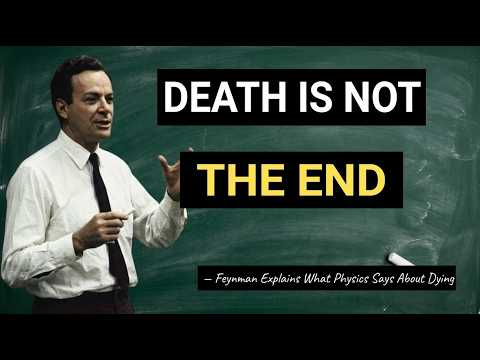
Death Is Not The End — Feynman Explains What Physics Says About Dying
Feynman Explains
17m 55s2,969 words~15 min read
YouTube auto captions
Transcript source
YouTube auto captions
This transcript was extracted from YouTube's auto-generated caption track. The transcript below is server-rendered so it can be read, searched, cited, and shared without opening the original YouTube player.
Pull quotes
[0:00]Because if I told you that most of the atoms in your body right now were not there a year ago, you'd have to admit that the you from last year is gone, physically gone.
[0:00]By the end of this talk, I want you to see something that most people never think about.
[0:00]Not comforting in the way a preacher might comfort you, but surprising in the way that only the truth can be.
[0:00]They combined with oxygen from the air and floated away as carbon dioxide and water vapor.
Use this transcript
Related transcript hubs
Watch on YouTube
Share
MORE TRANSCRIPTS


