[0:00]This video is brought to you by Captivating History. If the roaring twenties was one long party, the Great Depression was the ultimate hangover. The decadence and flamboyance that characterized the previous decade came crashing down after October 29th, 1929. Now known as Black Tuesday, billions of dollars invested in the stock market were wiped out in a single day. The aftermath of this event rippled throughout the world, having unprecedented effects on the decades to come. At the epicenter of the crash, lives were affected across the board. The first four years saw a quarter of the US workforce lose their jobs. People lucky enough to have employment didn't necessarily have financial security, as even those in the top professions saw a 40% drop in their income. Wages and hours were slashed, and families were forced to cut back in many ways. World War I and the Spanish Flu pandemic were within living memory for many people. Yet a return to a more frugal lifestyle took its toll on the population. The twenties had brought with it many advances in the way of life of the average American. By 1925, half of the American homes had electric power, and along with that, new domestic appliances, like refrigerators, were coming onto the market. Higher living standards meant that many people felt the need to keep up appearances. Despite the genuine threat of losing their homes or newly acquired automobiles. During World War I, America had contributed to the war effort with the National War Garden Commission. American citizens were encouraged to grow fruits and vegetables to allow more food to be exported to the Allied countries in Europe. People during the Depression almost certainly drew from this experience, creating kitchen gardens where possible. And some towns were allowed to convert vacant lots into communal gardens. Food had to be stretched as far as it could go, so cheap meals like mac and cheese, baked beans, potato soup and very basic cornbread were popular. Fashionable magazines of the time contained tips on making the most of your food budget with recipes for casseroles and chilies. Social activities were one of the first things to be cut back, and in the first five years of the Depression, more than one-third of American cinemas closed. Free forms of entertainment gained popularity. Church organized potlucks became common and were attended as a free social event, not just for the food. Board games brought people together, with neighbors meeting up to play cards and other games. Mini golf gained popularity as a cost-effective pastime, and over 30,000 mini-golf courses had been established by the 1930s. Listening to the radio became an increasingly prevalent pastime.
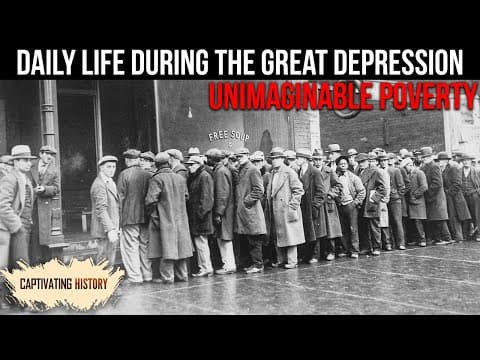
[2:54]The radio offered a way to keep up-to-date with current events. It was a form of escapism by listening to sports games, comedies, and soap operas. Music was a release and an inspiration of hope. Jazz, swing, and big band music were in style for dancing and listening. Despite the lack of work, more women joined the workforce than previously. Women took jobs as secretaries, nurses, telephone operators, teachers. While these careers were not seen as socially acceptable for men, some criticized women for taking jobs when many men were out of work. A few cities started to refuse to let married women become school teachers, as they felt that they would not be struggling as much as men. Of course, this was not always the case, as employers could pay women less, which helped keep staff costs down. Women may have felt more pressure to keep up appearances, but they suffered as much as anyone else during the Depression. The burdens of budgeting often fell to women. They would darn and patch old clothes, cook as economically as possible, and manage the food shopping. Budgeting on food often had dire repercussions for growing children. Deprived of dietary staples such as milk meant the cases of rickets and other diet-related illnesses rose. Children did not just suffer from a bad diet. Schools closed due to falling tax revenues, and thousands could not receive an education. Many of these children went out to work in sweatshops and other unregulated workplaces. Thousands of teenagers, disillusioned with life in America and not wanting to burden their family, rode the freight trains across the country searching for work and adventure. But this was not always the whimsical life that is imagined. Many of these vagabonds were jailed or worse, and from 1929 to 1939, nearly 25,000 trespassers were killed on railroad property. Before the Great Depression, welfare was something that many families would take pains to avoid, even if they needed it. The stigma attached to government welfare programs changed somewhat during the 1930s. Although families on welfare still felt it was a humiliating situation. One government caseworker in Chicago, Eileen Barth, had the job of assessing the claimant's financial position. Her supervisor told her that she had to see the poverty for herself, including checking how much clothing they had. During one visit, she had to ask an unemployed railroad man if she could look in his closet. She recalls, "I could see he was very proud. He was so deeply humiliated." This humiliation was too much for some people to bear. Another survivor called Virginia Durr, remembers, "People of pride went into shock and sanatoriums. My mother was one." But it was not just the mortification of asking for government handouts that affected citizens. The Great Depression forced many people into homelessness. During the early 1930s, insurance companies started to issue mortgages. These companies took advantage of borrowers, knowing that if they failed to keep up their repayments, they would have to hand over the ownership of their house. Those unable to keep up with property payments were evicted and ended up on the streets, sleeping in parks and even sewer pipes. Soon, shantytowns began to spring up, with people living in everything from old cars to piano boxes. Soup kitchens fed the people free or low-cost food. Lines of people waiting for this food became known as the bread line. And from this evolved the saying, "living on the bread line," describing people who lived on a low income. Family life was strained, and despite divorce rates dropping, abandonments increased. Men, feeling embarrassed and emasculated when they could no longer support their family, deserted them out of sheer desperation. These men would often resort to life on the streets. Known as hobos, around 300,000 people, mainly men, took to hitching rides on box cars, sleeping under bridges, or heading to the homeless shelters found in the big cities. The national suicide rate rose massively in 1933, as the psychological toll of the Great Depression ripped people's hearts and minds. This psychological impact was compounded by media reports of violent crimes, such as the bank-robbing spree of Bonnie and Clyde, or the kidnap and subsequent murder of Charles Lindbergh's young son. In reality, although violent crime increased during the first few years, after 1934, it fell dramatically, continuing to fall until the 1960s. While the economic storm raged, another kind of storm was ravaging farming communities. Drought hit the Southern Plains during the 1930s, and crops failed, exposing the over-farmed soil. The native grasslands had been plowed to plant wheat, and when the crops died, the dry earth that had previously been held in place by the roots began to blow away. Dust storms blew across the region, causing devastation. This environmental disaster compounded the economic one. If farmers could grow any crops at all, they had to be sold at such a low price, the families couldn't survive. Rented farms were repossessed, and many farmers were forced to give up their homesteads and move to California, hoping to work as day laborers. By 1940, around 65,000 people had migrated from Nebraska during the period known as the "Dirty Thirties." The climate on the Great Plains was also unpredictable, but the 1930s brought unprecedented weather conditions. During 1934, Nebraska experienced over twenty days at over one hundred degrees. The years that followed brought dust storms, floods, and more heat. Those who remained on the Plains put up with constant dust storms blowing through their towns. The dust killed crops, blacked out the sun, and was everywhere. People hung damp sheets up to catch dust, and windows were taped in an attempt to keep it out. Despite these measures, cups and plates had to be kept overturned until used. However, hardship breeds humor. Farmers would joke that a man hit by a raindrop had to be revived by throwing two buckets of sand in his face. And some local stores advertised, "Great bargains in real estate, bring your own container!" Despite the hardships and hunger plaguing the American people, in 1933, Franklin D. Roosevelt created the controversial Agricultural Adjustment Administration, the AAA. In the eyes of the government, the main issue was that farm goods were selling far too cheaply, which was undermining the economy. They felt that a surplus of crops and livestock contributed to the low price. So in a bid to tip the supply and demand balance, they paid farmers to leave a segment of their land unplanted and produce fewer crops and livestock. The operation began in spring, and the government paid farmers to plant fewer crops. Farmers were then subsidized, and plenty of agriculturalists in the Midwest benefited from this system. However, while these farmers were growing less food and receiving federal money to drive up the price of these commodities, many Americans could not feed themselves or their family. The AAA ended in 1936, but it was renewed and improved only a few years later. Still, this scheme and subsequent programs really only boosted larger and more productive farms. Small and tentative farms were unable to compete, which is a trend that continues in agriculture today. Many small homesteaders and farm laborers were forced to migrate from the rural countryside to the cities or give up their own small farms to work on the larger ones. Incredibly, despite all the suffering and hunger, the Great Depression decreased most mortality rates in America. Aside from suicide, other causes of death dropped. Cardiovascular and renal diseases stabilized in the first couple of years, while death from traffic accidents, tuberculosis, pneumonia and the flu declined. The average life expectancy for white people actually rose by six years between 1929 and 1933. While people of color had a lower life expectancy during the Depression, it rose more quickly and increased by about eight years. It seems that economic expansion is more detrimental to your health than economic decline. Researchers speculate that this is due to a higher smoking rate during economic upturns and a faster pace of life, causing more stress and less sleep than during a downturn. In all, life during the Great Depression was as varied as it is today. While some people took up mini golf and listened to the radio, others had dust for dinner. Some families struggled to pay the bills to keep their homes and cars. Others lost everything and were forced into homelessness. People went hungry as farmers planted less to get government subsidies. But throughout these struggles, many people formed close-knit communities that shared resources and helped each other throughout these challenging times. The bonds within neighborhoods provided strength and resilience to many, and shaped the attitudes of a generation of Americans. To learn more about the Great Depression, check out our book. The Great Depression: A captivating guide to the worldwide economic depression that began in the United States, including the Wall Street Crash, FDR's New Deal, Hitler's Rise and more. It's available as an ebook, paperback, and audiobook. Also, grab your free mythology bundle ebook while it's still available. All links are in the description. If you enjoyed the video, please hit the like button and subscribe for more videos like this.


