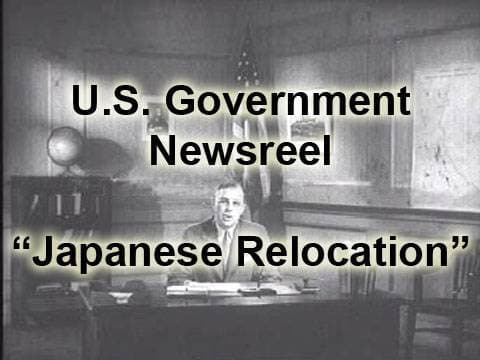
[0:00]Distributed and exhibited under the auspices of the War Activities Committee of the Motion Picture Industry, the United States Government presents Japanese relocation.
[0:08]Produced by Office of War Information, Bureau of Motion Pictures. Following the outbreak of the present war, it became necessary to transfer several thousand Japanese residents from the Pacific Coast to points in the American Interior.
[0:22]This is an historical record of the operation as carried out by the United States Army and the War Relocation Authority.
[0:28]The narrator is Milton S. Eisenhower, who was director of the War Relocation Authority during the initial period of the transfer.
[0:40]When the Japanese attacked Pearl Harbor, our West Coast became a potential combat zone.
[0:47]Living in that zone were more than 100,000 persons of Japanese ancestry, two thirds of them American citizens, one third aliens.
[0:56]We knew that some among them were potentially dangerous, but no one knew what would happen among this concentrated population if Japanese forces should try to invade our shores.
[1:09]Military authorities therefore determined that all of them, citizens and aliens alike, would have to move.
[1:15]This picture tells how the mass migration was accomplished.
[1:19]Neither the army nor the War Relocation Authority relished the idea of taking men, women and children from their homes, their shops and their farms.
[1:27]So the military and civilian agencies alike determined to do the job as a democracy should with real consideration for the people involved.
[1:36]First attention was given to the problems of sabotage and espionage.
[1:42]Now, here at San Francisco, for example, convoys were being made up within sight of possible access agents.
[1:50]There were more Japanese in Los Angeles than in any other area.
[1:54]In nearby San Pedro, houses and hotels occupied almost exclusively by Japanese were within a stone's throw of a naval air base.
[2:04]Shipyards. Oil wells.
[2:09]Japanese fishermen had every opportunity to watch the movement of our ships.
[2:14]Japanese farmers were living close to vital aircraft plants.
[2:18]So as a first step, all Japanese were required to move from critical areas such as these.
[2:24]But of course, this limited evacuation was a solution to only part of the problem.
[2:30]The larger problem, the uncertainty of what would happen among these people in case of a Japanese invasion, still remained.
[2:36]That is why the Commanding General of the Western Defense Command determined that all Japanese within the coastal area should move inland.
[2:45]Immediately the army began mapping evacuation areas and for a time encouraged the Japanese to leave voluntarily.
[2:52]The trouble for the voluntary evacuees soon threatened in their new locations, so the program was quickly put on a planned and protected basis.
[3:02]Thereafter, the American citizen Japanese and Japanese aliens made plans in accordance with orders.
[3:06]Notices were posted.
[3:10]All persons of Japanese descent were required to register.
[3:13]They gathered in their own churches and schools, and the Japanese themselves cheerfully handled the enormous paperwork involved in the migration.
[3:22]Civilian physicians made preliminary medical examinations.
[3:26]Government agencies helped in a hundred ways.
[3:30]They helped the evacuees find tenants for their farms.
[3:33]They helped businessmen lease, sell or store their property.
[3:37]All this aid was financed by the government, but quick disposal of property often involved financial sacrifice for the evacuees.
[3:44]Now the actual migration got underway.
[3:50]The army provided fleets of vans to transport household belongings.
[3:55]And buses to move the people to assembly centers.
[3:59]The evacuees cooperated wholeheartedly.
[4:02]The many loyal among them felt that this was a sacrifice they could make in behalf of America's war effort.
[4:11]In small towns as well as large, up and down the coast, the moving continued.
[4:24]Behind them they left shops and homes they had occupied for many years.
[4:42]Their fishing fleets were impounded and left under guard.
[4:47]Now they were taken to racetracks and fairgrounds where the army almost overnight had built assembly centers.
[4:52]They lived here until new pioneer communities could be completed on federally owned lands in the interior.
[5:00]Santa Anita Racetrack, for example, suddenly became a community of about 17,000 persons.
[5:08]The army provided housing, and plenty of healthful, nourishing food for all.
[5:15]The residents of the new community set about developing a way of life as nearly normal as possible.
[5:20]They held church services, Protestant, Catholic, and Buddhist.
[5:25]They issued their own newspaper, organized nursery schools and some made camouflage nets for the United States Army.
[5:35]Meanwhile in Arizona, Utah, Colorado, Wyoming and elsewhere, quarters were being built where they would have an opportunity to work and more space in which to live.
[5:46]When word came that these new homes were ready, the final movement began.
[6:13]At each relocation center, evacuees were met by an advanced contingent of Japanese who had arrived some days earlier and who now acted as guides.
[6:21]Naturally, the newcomers looked about with some curiosity.
[6:26]They were in a new area on land that was raw, untamed, but full of opportunity.
[6:33]Here they would build schools, educate their children, reclaim the desert.
[6:38]Their own physicians took precautions to guard against epidemics.
[6:42]They opened advanced Americanization classes for college students, who in turn would instruct other groups.
[6:51]They made a rough beginning at self-government. For a while, the army would guard the outer limits of each area, community life and security within were largely up to the Japanese themselves.
[7:03]They immediately saw the need for developing civic leaders.
[7:06]At weekly community meetings, citations were given to the block leaders who had worked most diligently.
[7:12]Special emphasis was put on the health and care of these American children of Japanese descent.
[7:38]Their parents, most of whom are American citizens, and their grandparents, who are aliens, immediately wanted to go to work.
[7:47]At Manzanar, they built a last house and began rooting guayule cuttings.
[7:51]The plants when mature will add to our rubber supply.
[8:04]At Parker, they undertook the irrigation of fertile desert lands.
[8:08]Meanwhile, in areas away from the coast and under appropriate safeguards, many were permitted to enter private employment, particularly to work in sugar beet fields where labor was badly needed.
[8:21]Now, this brief picture is actually the prologue to a story that is yet to be told.
[8:27]The full story will begin to unfold when the raw lands of the desert turn green, when all adult hands are at productive work on public lands or in private employment.
[8:38]It will be fully told only when circumstances permit the loyal American citizens once again to enjoy the freedom we in this country cherish, and when the disloyal we hope have left this country for good.
[8:53]In the meantime, we are setting a standard for the rest of the world in the treatment of people who may have loyalties to an enemy nation.
[9:02]We are protecting ourselves without violating the principles of Christian decency. And we won't change this fundamental decency no matter what our enemies do.
[9:10]But of course, we hope most earnestly that our example will influence the Axis powers in their treatment of Americans who fall into their hands.
[9:18]The end. Distributed and exhibited under the auspices of the War Activities Committee of the Motion Picture Industry.