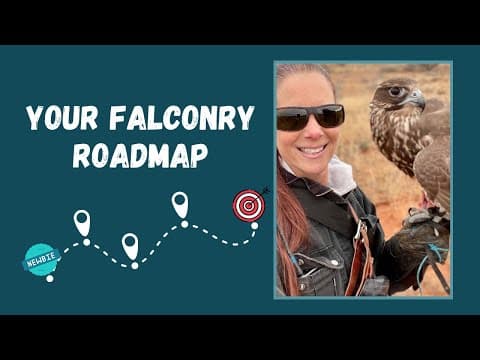
[0:00]Thinking about becoming a falconer? Not sure where to start? Not sure if it's for you? Watch this video and you will find out. Hi, I'm Dr. Michelle Loci. I'm a master falconer and the founder and executive director of the International Raptor and Falconry Center. A little over 22 years ago, I was you, wondering the same thing. In this video, we will cover what is falconry, a brief history, and how you can get started in your own journey to becoming a falconer. So what exactly is falconry? You might think it's just keeping a pet falcon or a hawk or hanging out with an owl. But actually, it is hunting, taking wild quarry using a trained raptor. Just without a gun. You're using your trained raptor, which is your partner, to successfully hunt your chosen game species. What I don't want to be confused with falconry is Raptor education, environmental educators that use live trained raptors to deliver their education. This is very important work, but it is not falconry. You must use your bird to hunt and catch game to be called falconer. But falconry is not just hunting. It's a culture. It takes discipline, and it is deeply rooted in tradition and it takes years to master. Falconry has existed for over 4,000 years, likely longer. In many cultures, falconry was more than hunting. It was status, diplomacy, and survival. Today, it is recognized by UNESCO, United Nations Educational, Scientific and Cultural Organization. It is a living cultural heritage and it still thrives today around the world. It is believed that it started somewhere in Central Asia. From there, it moved west and landed in the United States just less than 100 years ago. And really, it didn't get started in the United States until around the 1960s. It has grown since then. Traditionally, it has been mostly men in falconry, but that is changing. More and more women are joining the ranks of falconry. So what does it actually take to become a falconer? Well, it depends on where you live. Based on your country or the state you live in, if you're in the United States, you must look at your country's laws and your state laws. I'm going to give you a bit of an overview if you live in the United States. I'm actually located in Arizona. In the United States, it is illegal to possess any bird that is covered under the Migratory Bird Treaty Act, which is almost every native species in North America, which that includes the United States, Mexico, and Canada. You cannot possess a raptor without a federal and or state permit. The states govern the falconry regulations and oversee the falconry permit. The federal government still has the overarching authority. They set the basic regulations, but each state has the authority to make them stricter and unique to their state. So make sure you look at your specific state, and this agency that governs the falconry permit, is your state wildlife agency. So for me, Arizona, it is the Arizona Game and Fish Department. Go to their website and download the regulations. This should be the first thing you do before you do anything else. Hone over them very closely. You will need to know what the laws are and what it takes to be a falconer in your state or country. And there are permits required for each activity. I've listed them here. Obviously, we're just going to stick to the falconry permit. There are three classes of falconry permits in the United States, apprentice, general, and master. To become a falconer, you need to first be an apprentice for a minimum of two years. It cannot be any less than two years. Your sponsor can require that you do it longer if he or she believes that you need more time before passing you on to a general falconer. But they can't shorten the time, it's two years minimum. The biggest difference between these classes is really just time. And within each class, there are specific species that you are allowed to possess, how many are captive bred versus how many are taken from the wild. So that's really the only difference. And all falconers in the United States must pass a falconry exam with 80% or above. That is a state written test that each state writes specifically for their agency, so it's not a federal thing, it's a state thing. I took my test in Virginia over 20 years ago, and I used the California Hawking Club study guide. And it worked well for me. From what I understand, it's still quite a good resource, but make sure you have an overall well-rounded education, regardless of where you live, regardless of whether you need to take an exam or not, and regardless if there's any regulation or not. I'm going to caveat this with not all resources are good resources, and because you're new to this, you won't know the difference, but do your best. So look for books, videos, falconry groups, mentors, wherever you can glean good information. And it may take you a little while to figure out what is good information. It certainly took me a while. My first mentor wasn't my sponsor, but the first person that I really mentored under was horrible. And it didn't take me long to figure that out, and that is because I went out and I searched for different avenues of knowledge and wanted to expand what I knew. And I spent a lot of money doing it, I spent a lot of time doing it, and it was a real dedication, and I am very glad I did it. So, choose your resources wisely. Read them, watch them, listen to them, all with an open mind, use your critical thinking, and take what you can use. What you believe is to be a good source of information and throw away the rest. If it doesn't make sense or it doesn't seem like it's a good thing to do or your intuition is telling you that this might not be a good idea, listen, or at least reach out to somebody else. Most of what you're going to learn as a falconer is through true time tested experience and learning from somebody that knows what they're doing. So this is where we're going to get into in the United States, you must have a sponsor in order to become a falconer. This is a person that is at least a general falconer, preferably a master falconer with a lot of experience. I'm going to say if you're not in the United States and you don't require a sponsor or there are no permits that are required to own, fly or hunt with a raptor, such as in the UK, they don't have a permitting system. I'm going to say at the very minimum, you need to find a very good mentor, somebody that will guide you through all of this. Training, caring for and hunting with a raptor is not something that is intuitive. They are difficult to take care of, and they require very specific needs. And there's not a single set of books, videos, resources that can teach you everything you need to know. And what I'm going to tell you about finding a sponsor or a mentor is choose wisely. This person is going to be the foundation of your knowledge for your falconry journey that will last for the rest of your time. Don't choose based on convenience or because they're close by, or because you think they're cool, or you like their videos, or whatever your reason is, other than they're good. Make sure that they are knowledgeable. You don't want something that we will call here in the United States a paper sponsor. Which is somebody that just signs off on your permit without ever really spending any time with you or educating you or guiding you, and says, whoop, now you're a falconer. That is not what you want, because you will not be a good falconer.
[8:10]And if you're not going to be a good falconer, and say one day you want to sponsor or mentor somebody else in the future, you're going to create a lot of other not good falconers.
[8:24]When I went about it, I went straight to the top. When I wanted to learn about raptor care and management, I went to the Raptor Center. At the time, I was living in the Washington D.C. area. Obviously, that's far away from Minnesota, so I did have to hop on a plane, and I stayed in a hotel for five or six days. And that's on top of paying for the workshop. This was almost 20 years ago, and the investment was well worth it. What I learned in that five-day workshop all that time ago, I still fall back on today. So your foundation really does matter. And when it came to finding a sponsor, I went to a local, very well respected, knowledgeable falconer. I did have to drive an hour and a half, two hours. Also, I went to England for a couple of years and spent time with the International Center for Birds of Prey and Jemima Parry Jones. Those two years were priceless. So, in a nutshell, do not skimp on your falconry education. Your bird is depending on what you know. Now we're going to talk about species that are commonly used by new falconers. This can depend on what country you live in and what species are available. I'm going to talk about what we use in the United States and these species, regardless of where you live, are probably ideal species for a beginner to start with. Here in the United States, we commonly use the red-tailed Hawks and American Kestrel. They used to be our only choices, but that is changed in recent years. Now, depending on your state, apprentices can fly different species. For instance, here in Arizona, apprentices can also fly Harris Hawks. These are the three species that you would have to choose from, a red-tailed hawk, Harris hawk, or an American Kestrel. Though my apprentices actually have three choices. They can fly a male or female red tail, and I find a red-tail probably the best choice. More specifically, a female red-tail is probably the best choice of a maul. It is one of the most versatile species you can fly. You can fly a female red-tail pretty much on anything, jackrabbit, cottontail, squirrel. I do not advocate flying males of any species on squirrels because squirrels can be a dangerous game. They bite, so you need some big feet. And also red-tails can go after avian species such as duck, pheasant, even quail, if you have those available to you. And they're relatively easy to train. There is always an exception to the rule. They are hardy. They are pretty forgiving when it comes to weight management, but you still need to be diligent. The other choice is a male Harris hawk. I do not allow my apprentices to fly female Harris Hawks.
[10:59]Female Harris Hawks can be quite tricky, and if not done right, they can be downright dangerous. Some people believe that Harris Hawks are trained just as if they were a dark brown red-tail. They are not a dark brown red-tail. The other species that some apprentices may want to fly, but they will not fly if they are my apprentice, and that's an American Kestrel. And I'll tell you why. Watch these clips in a video that I did quite a few years ago, and they'll explain everything. I don't think a beginner falconer should ever fly a Kestrel, and any apprentice I have does not, that is not their choice. Um, if they want to fly a Kestrel and they don't want to fly anything else but a Kestrel, then they're going to find a different sponsor because it won't be me. And the reason behind that is, as you saw with Aylen, she is tiny. And she's already at 100, um, 100, well, right now she's at 120 grams, and that's her fat weight. 120 grams is not a lot of wiggle room. Are there some apprentices that have flown Kestrels and got, you know, great success and did really well with them? Absolutely. Can it be done? Absolutely. But you don't know who that person is. And um, you don't, you know, maybe you don't even know if you're that person if you're that new falconer. And with a very diligent sponsor and somebody that's very disciplined and has pretty good wits about them, can they do it? Yes. However, as a sponsor, I'm not willing to gamble on a bird's life that that person will be that person because even some experienced falconers have killed killed Kestrels. So, uh, they're not beginner birds. They're not easy. You have to have the right game, and you have to have the right, um, area to hunt. And where I'm going with this is I'm not, and this is getting I'm going to get probably bashed and attacked for this, but I'm not doing that. Now we're going to talk about equipment. This can be quite complicated and overwhelming. So I've made a list here with a gustimation of pricing just so you have a ballpark of what you're going to be in for financially. This could change at any time, obviously, and it also depends on where you get your equipment, what country you live in, or even if you make your own equipment. A lot of falconers do. I personally don't make my own equipment, even though I do know how to make them. The main reason is I just don't have time. And the other reason is, I don't really have the talent for making equipment. I know how to make them, I don't enjoy sewing, I don't enjoy making equipment, so I just don't. So I would rather spend my money on somebody that does enjoy it and is good at it, and I can do something else with my time. Somebody that is good at making equipment and enjoys it is going to produce good, safe, comfortable equipment for your bird, and that is important. One of the most important pieces of equipment that you're going to need is a glove. This is a piece of equipment that you really want good quality. You're going to spend a lot of time with your glove. And I get my gloves from Ashley Clark. Are they expensive? Absolutely. Are they worth it? Absolutely. But if I were you, as you're just starting out, maybe try one that's a little bit cheaper until you kind of get to know what you want in a glove. What's important to you? This is kind of a personal item, and you want it to be tailored to you because you do use a lot. I go through one glove a year. Also, you may need a hood for your bird. Not every bird needs a hood. I personally do not hood my Harris Hawks. I believe they do better when they're not hooded. But I do hood all of my falcons, with the exception of Kestrels, and red-tails, eagles, and other species that could require a hood. So that's just going to be something that you will need to decide with your sponsor or your personal preference. Hood making is a true art and a real craftsmanship. It is a skill. I personally don't have that skill. I have never made a hood nor do I want to. But, this is another piece of equipment that you do not want to skimp on and go cheap. It can be quite difficult to find a good hood that fits properly. A good fitting hood is incredibly important. The other things that you'll need are leash. I happen to be incredibly picky about my leashes, and I have yet to find a good leash that is made here in America. So, this is another piece of equipment I get from Ashley Clark. You'll need swivels, bells. I typically just use noble or crounce bells. Definitely want to creance because this is how you're going to train your bird. Probably, not sure I would make my own there either. Just because if you get it wrong and your bird gets cut loose with a long creance line, that is a death sentence. So, you're going to need a lure if you're going to use a lure. I suggest it, but that will be something you and your sponsor will have to have a chat about. It also depends on the bird you fly. With all my birds, regardless of species, they are all wed to the lure. I do this for several reasons, safety, insurance policy, and fitness. All my falcons are stooped to the lure as well, and that includes my Kestrels. You do want a game bag, because with any luck you're going to catch something and you're going to have to put it somewhere. Also, this is where you store things that you need in the field, tidbits and extra equipment and things like that. This is kind of a a personal piece of equipment. It's something that, you know, you're going to wear, it needs to be comfortable, it needs to fit you properly.
[16:29]So, just personal preference. There's no right or wrong. I personally don't like to wear vests just because they're not ever made for women. A lot of falconry equipment seems to be made for men, and women's bodies are made differently, and vests are one of those pieces of equipment. I do now wear a vest, but that's because I fly my birds on jackrabbits. So, I tried cramming our large jackrabbits into my bag that I had, and broke it. So I now wear a vest. You will need a scale. Oh, well, absolutely need to be of high quality and accurate so you can have good weight management. This is very important for the health of your bird and the success of your hunting. And once you do move on to a smaller bird such as a Kestrel, you definitely want a good accurate scale. So some other equipment that you will need is a bowperch or a block perch. If you plan on traveling with your bird or you need to bring your bird inside for whatever reason, bad weather, or if your bird gets sick, and you just want to keep an eye on it or socialized with your bird, you might want to get another one for the inside. These can get pretty expensive, especially the block purchase can get expensive because they're difficult to make. It just depends on what your preferences are and have a chat with your sponsor. I am not a fan of the tall round swivel perches. I think those are dangerous, and I do not recommend making your own out of PVC piping or some other crazy materials. I've seen some really bizarre homemade perches, and believe it or not, perches can be dangerous. So if you get it wrong, and you have an ill-made or ill-sized perch for your bird, you can have a big problem with broken legs, broken wings, feather issues, feet issues, getting trapped issues and tangled issues, and you just don't want to go too crazy and get some really weird perches. Just the simpler, the better, and high quality. Then you're going to have some supplies that you're going to need for your new bird. And a lot of this equipment that I'm talking about you will need to have for inspection if you're in the United States. So before you get your permit, you will have to have a falconry coordinator or a game warden come out and do a facilities inspection, and they will include your equipment. So you do want a giant hood. You can make them out of wood. I've done that. My first one was made out of wood. They do have their own issues, but that's just something you can do your homework on. You will need a bath pan. I just use one of the cement mixer containers that you can get at any home store. You're going to obviously need food. Good quality food is the most important part. Grocery store food is not ideal, so don't think about getting beef heart, or chicken livers, or gizzards, or anything like that. This will not be a good source of nutrition for a bird that is ultimately going to be a healthy athlete. Supplements is something you might want to consider. I do supplement my birds just because the food quality of what the food gets is not nutrient dense, even if you feed a whole food well-rounded diet. Probably still going to be deficient. I use provital. Let's talk about telemetry. This is going to be a spendy one. A lot of people think, yeah, well, you don't really need telemetry. And if you're flying a native species that can survive on its own, you're probably right. However, there's something about telemetry that gives you a real good peace of mind, and it lowers your stress. Also, for the safety of your bird, sometimes you want to find your bird pretty quick. Back in the old days, it used to be just radio telemetry, which was better than no telemetry. Now, there's GPS. GPS has its own issues, but at the end of the day, when you need to find your bird quick, Like, for instance, I have a male Harris hawk, Leroy. I couldn't get rid of him if I wanted to. I don't really generally use telemetry for him because I think he's going to run away from home. Where I hunt, there's a lot of other predators such as coyotes and mountain lions and bobcat and other things. So, when they do catch a rabbit or they're on the ground, I want to find these birds quick, and GPS allows that. I would never, ever fly a large falcon without GPS. Back in the day, before GPS, I was flying a my male saker falcon using radio telemetry, and had he had GPS on him, he probably would still be alive today. I flew him on a day that was a little bit windy, and then it got windier as the day went on, and basically, he was blown all over the place. And by the time I finally found him, he'd already been killed by a red-tail. So if you're going to use telemetry, and if you're going to put a backpack on, you're going to need a track pack. Which I recommend backpacks. All my birds wear backpacks if they tolerate them. I do have some birds that don't, and if you're going to use tail clips, for instance, for my female saker falcon, she wears a backpack and a tail clip because she flies with GPS and a radio transmitter. So I have two transmitters on her. Obviously, you're going to need batteries. You're going to need the type of tail mount, tail clips, or however you're going to mount the transmitter on the bird. I am not a fan of leg mounts, but if you're going to use a leg mount, make sure it's a proper and safe one. I do have a video that shows all the different methods of how to mount telemetry, where to put it, the pros and cons of each. And if you are going to make your own equipment, you're going to need to buy some kangaroo leather. You'll need a grommet setter, hole punch, grommets to be able to make your own anklets and jesses. So estimated start-up cost for your bird, may be around $3,000, depending on how savvy you are. And you need to factor in your monthly cost for food for one red-tail, probably around $75. May be less, especially if your bird's catching a lot of their own food. Can be down to zero. Back in the day, when I only had one or two birds, I would go years without buying food. I'm not so lucky anymore. Also, the cost of building your mews. And that will depend on lumber prices, and those can be pretty volatile here in the United States. And be prepared to have a little money set aside in case your bird needs to go to the vet. Especially if you are fortunate enough to be able to trap a wild bird. A lot of these birds come in with some issues. Certainly when they're hunting, they could get into accidents, injured, illnesses, things like that. Avian vets are expensive. They are a true specialty and the pricing reflects that. And I will say there is a difference between taking your bird to a vet that, quote unquote, sees birds and an avian vet. You want to take your bird to a certified avian vet. Trust me, there is a difference. And as I said before, you'll need to build a mews. This is the enclosure, the space where your bird will live. It must pass inspection here in the United States by your falconry coordinator before you get a permit. Also, my suggestion is, do not build anything until you have secured your sponsor or mentor, because a lot of people believe that it's just building a little shed structure. But there's a lot of nuance that goes into building these mews. I've seen some pretty dangerous situations. So it is very important how you build this. It is where your bird is going to spend all their time when they're not with you or out hunting and flying. So it needs to be safe, comfortable, and secure and healthy for them. Here, I'm just going to go over a little bit because I actually have a video that goes into great detail on these things to consider when building your bird's mews. It doesn't teach you how to build it as in the carpentry part of it, but it tells you the things to consider when you are building your bird's mews. You can probably find a lot of videos that can go into how to actually build one as in the hammer and nail part. But this video is why they're built the way they are. And these are pictures of some of my old mews that I've built over the years. Your sponsor may have something to say about what he or she wants you to build. And I have seen some new falconers that build mews and think bigger is better. If you're going to free loft a bird, you do not want bigger. The video will go into all the whys and explain all the theories behind it, so I'm not going to go into it too much here. So the large one that you see here is an eight foot by eight foot by eight foot high, and it's for a female Harris hawk that is tethered 24/7. She's a very dangerous bird and will never be free lofted as long as she needs to be handled every day. This is a side by side with a safety door in the middle, and the weathering yard is on the outside. Clearly, this one is still being reconfigured. It is since been finished. So there are a lot of things that you need to consider, vertical bars. Yes, it looks like a jail, but that's not why we do it. This is federal regulations, so your birds can't grab them. You cannot have any horizontal structures to where the bird can sit on them. All mews should be and must be predator proof. I'm still amazed to this day. I hear so many stories about predators or other dangerous animals getting into their bird's mews. That's all preventable with predator proofing. This is also covered in the video of how to do it. I go into pretty detailed on how to do all these things and what to think about when you are building your mews. Every single structure that my birds are in are predator proof. Now, your perches, I've already alluded to this before, but perches are very important. They're not somewhere for your bird to just sit and hang out. And some people think, okay, as long as they can sit and hang out, it's not that big a deal. But it is a big deal. You can have birds that have feet issues, feather issues, crashing. So perches are important, so make sure your perches are done correctly. I have a video for that as well. Also, your floor substrates, that is important too. You might think, well, it's just the bottom of the mews, so what's the big deal? It is a big deal. For instance, like sand, I hate sand. Yes, it's easy to clean up, and it might be cheap, but it's also dangerous. It harbors bacteria, it can get in your bird's food, it can get into your bird's nares. And also, think about what sand is as in sandpaper. It can dull your bird's talons. Your bird's talons are your bird's weapons. You do not want them to be dull. So just watch this video, it explains it a lot more. Weathering yard. This is one that I had for my first bird. So, this one was taken 20 years ago, and it was in Virginia. And they do require a weathering yard. Not all states require a weathering yard. Now, in my home state of Arizona, we don't require one. I still do recommend a weathering yard because your bird needs to get full spectrum sunlight, and your mews windows may not provide that. Just with, with your mews, you want your weathering yard to be predator proof and safe. Okay, let's talk about what it really means to be a falconer. I know I just described and defined what falconry is and talked about its history, but falconry is a lifestyle. It's something that you live every day. Yes, it's hunting, but unlike a gun, you can't go and put it in a gun case and lock it up and forget about it until you need it again. These birds are living beings and they have needs. They need to be fed, they need to be kept happy, healthy, stress-free, and that takes a little bit of work. So, these are the things that you need to consider when you decide if you want to take on a raptor. And in general, I will have to say as somebody that has managed and cared for all sorts of animals, such as horses, dogs, cats, birds are among the most difficult. They are messy, they are sensitive to nearly everything, such as aerosol toxins. So if you bring your bird in the house, like say you've got a small kestrel that you want to keep in the house because it's easier for weight management, you can't burn candles, Teflon, anything with silicone in it. They're just a whole different ball game. And if you're in the United States and you're lucky enough to trap a wild red-tail, or a wild Harris Hawk, or in the future, a kestrel, or some other species, such as a falcon or a goshawk. These are wild predators and they are always going to be predators, and they will always have that wild aspect to them. They're not pet parrots, and they really can't be treated as such. Should they be treated as well as you would any other family member? Absolutely. So they need to be top of mind. All my birds, when I make a decision, I keep their well-being in mind. If it goes against their well-being, the decision is no. So if you have two words to sum up being a falconer, it is time commitment and being disciplined. Lazy falconers don't make good falconers. Falconry is a daily commitment. Raptors need to be weighed, trained, cared for, flown, hunted. They don't take weekends off, so neither do you. But for those that have a call for it, there's nothing else like it. I'm not in the business of recruiting falconers. I don't believe everybody should be a falconer. However, falconry will challenge you, it will humble you for sure, and it will change how you see the world. It's not easy, but it's worth it. If falconry speaks to you, and you feel pulled to do it, then your journey starts here. Start reading, connecting with local falconers, watch videos, take classes, or workshops, or webinars, wherever you can find them. And falconry isn't just something you do. Being a falconer is something you become. Subscribe for more videos on falconry, husbandry, care and management, training, there's more coming.


