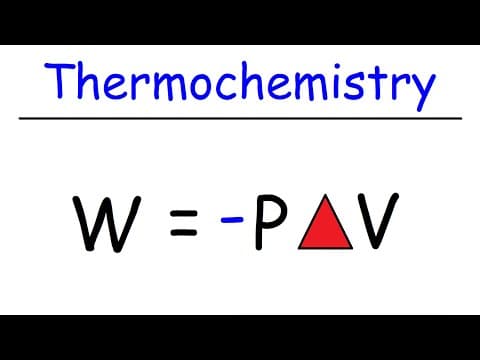
[0:00]In this video, we're going to work on some practice problems associated with thermochemistry. So let's start with this one. A gas absorbs 2,500 J of heat energy and expands from 3 L to 7 L at a constant pressure of 4 atm. How much work is done by the system? Well, let's get a visual. So let's say we have a flexible container with gas particles inside this container. So this is going to be the system. What's inside of the container. Everything outside of the container is going to be represented by the surroundings. Heat flows from the surroundings into the system. Now we know that heat energy flows from hot to cold. So a lot of thermal energy is going into the system. Anytime heat is absorbed by the system, Q is positive. And this is an endothermic process. That means that the surroundings is losing thermal energy. So the process is exothermic for the surroundings. Now what's going to happen? Whenever you heat a gas, a gas is going to expand. And this is indicated by the change in volume. The volume goes from 3 to 7 L. In order for the gas to expand, it has to exert a force on the container. And this force can be used to do work. It could be used to move a piston or move some type of machinery. Thus, when a gas expands, work is done by the system. If you want to do work on a system, you need to apply a force to compress the gas. But now let's work on this problem. So the gas absorbs 2,500 J of heat energy. That means that Q is positive. Now we want to calculate how much work is done by the system. And we could use this formula: W is equal to - P ΔV. Now, some things you want to know. When ΔV, well, let's start with ΔV. When ΔV is positive, that means that the gas is expanding. As it expands, it can apply a force on an object, and so work can be done by the system. When ΔV is positive, W is going to be negative. So W is negative when work is done by the system. As mentioned before, you need to perform work on a system when the gas compresses. The gas will compress if the change in volume is negative. If ΔV is negative, and this sign is negative, then W is going to be positive. So W is positive anytime work is done on the system.
[3:38]Now, I want to make sure you understand the concept, so I'm going to summarize it with a picture. So let's have two cylinders containing gas inside of it.
[4:03]So remember, when a gas expands, it can apply a force on an object and it can do work. So thus, ΔV is positive during gas expansion. And so because the system can do work, or work is done by the system, W is going to be negative during gas expansion. Now, during compression, you need to do work on a system. The only way the gas is going to compress is if you apply a force on it and you make it compress. In that case, the volume is decreasing. And so work is done on a system, thus W is positive. So make sure you understand that. When a gas expands, the volume increases, it can apply a force, work is done by the system. In order to compress a gas, you have to apply a force on it, so you need to do work on a system, thus the change in volume is negative and W is positive. So now that we've gotten that out of the way, let's move on to this problem. So as mentioned before, W is equal to - P ΔV. So the volume changes from 3 L to 7 L. So the change in volume is the final volume minus the initial volume, 7 - 3, so that's positive 4 L. So that's how much the gas expands. And it does so at a constant pressure of 4 atm. You can only use this equation if the pressure is constant. If it's not constant, well, that's going to be beyond the scope of this video. You're going into physics. But this we're going to work on this problem as it relates to chemistry. So let's use this formula to calculate how much work is done by the system. So P is 4 atm. ΔV is 4 L. So we're going to get -16 L times atm. Now, note that Q is in Joules. We want to convert this to Joules. So L times atm is a type of, it's a form of energy. Or rather, a type of unit of energy. It turns out that 1 L times 1 atm is equal to 101.3 J. That's the conversion factor that you need to be familiar with.
[6:49]So W is -1620.8 J. So thus, as you can see, during gas expansion, work is done by the system, W is negative. Now let's calculate the change in the internal energy of the system part B. ΔE is equal to Q + W in chemistry. In physics, it's ΔE is equal to Q - W. Now, you might be wondering why the confusion? Well, in chemistry, W is equal to negative P ΔV. In physics, W is equal to positive P ΔV. So even though these two signs are different, the equations for W are also different for chemistry and physics. So it's kind of like a double reverse where it works out to be the same. The end result is that for ΔE, Q is still, I mean, ΔE is still equal to Q - P ΔV. When you combine a negative and a positive, you still get a negative sign. So the end result is still the same, but the way of getting to the final equation is a little bit different. So you want to keep that in mind when dealing with chemistry or physics for this type of topic.
[8:24]So in this example, Q is positive 2,500 J, and W is -1620.8 J. Now, to illustrate what's happening here. Think of the internal energy of the system as the amount of money you have in a bank. The 2,500 J is basically the deposit. Imagine making a deposit of $2,500 into your account. Your account value is going to go up. In the case of this problem, the system receives 2,500 J of energy. So the energy in the system goes up. However, work is done by the system. Whenever you work out, you're expending energy, you're using up energy. In this case, when the system is doing work, it's using up energy in its stored account, so to speak, or in in the system. So this is basically like a withdrawal. And so we have 2,500 J of heat going into the system, but the system is burning 1620.8 J of energy by doing work to expand the gas. So now the net change in the energy of the system is going to be the difference between the two. So basically, the account value went up by 879.2 J. So when dealing with the concept of internal energy, think of energy that's flowing into the system and energy that's flowing out of the system. And you have to add or subtract those two values accordingly. So for this example, the system gained a net amount of 879.2 J of energy. We had more energy coming in than energy going out. Now, let's move on to number two. How much heat energy is absorbed by 70g of water if the temperature rises from 25° C to 60° C? (The specific heat capacity of water is 4.184 J/g° C) Now, anytime we wish to calculate how much heat energy is absorbed by a material, it could be a metal, non-metal, a liquid, a solid, doesn't matter. But if there's a temperature change associated with that object, we could use Q = mcΔT. Q represents the energy absorbed or heat. Kind of like what Q represented in the last problem. M is the mass in grams. C is the specific heat capacity. And in this example, the specific heat capacity of water is 4.184 J/g° C. So this means that it takes 4.184 J of heat energy to heat up 1 g of water by 1° C. That's what the specific heat capacity tells us. So it takes water a lot of energy just to raise the temperature by 1° C. So this tells you how much, it tells you the ability of a material to store thermal energy relative to its temperature change and relative to its mass. Now let's go ahead and plug in the numbers for this equation. M is 70 g. C is 4.184. Let's write the units, J/g° C. And the change in temperature, 60 - 25 is 35° C. So the temperature goes up by 35. So note that we can cancel the units Celsius and the unit grams. So Q, we're going to get it in the unit Joules. So it's going to be 70 * 4.184 * 35. And so the answer is 10,250.8 J. Now, we can convert that to kilojoules by dividing this number by 1000. And so we can say that Q is approximately 10.25 kJ. So that's how much heat energy is absorbed by 70 g of water when the temperature goes from 25° C to 60° C. Now, I want to take a minute to make sure that you understand the concept of specific heat capacity. And how it relates to the ability of an element to store thermal energy. So here we have two substances, substance A and substance B. Let's say that the specific heat capacity of substance A is 0.1 J/g° C. And for substance B, it's 1 J/g° C. So the specific heat capacity of substance B is 10 times greater than substance A. Now let's say that the mass of each substance is 1 g, just to keep things simple. And let's say that the initial temperature of each substance is 20° C.
[13:44]Now, let's say we were to add 1 J of heat energy to each of these two substances. What will be the new temperature?
[14:00]Well, keep in mind what this means. It takes 0.1 J of thermal energy to heat up 1 g of substance A by 1° C. So if 0.1 J can raise the temperature by 1° C, how much can 1 J of heat energy raise it? Well, it's going to raise it by 10° C. So the final temperature for this is going to be 30° C, just by adding 1 J of heat energy.
[14:38]Now, for this one, it takes 1 J of heat energy to raise the temperature by 1° C if the mass is 1 g. So we're adding 1 J, so the temperature is going to go up by 1. So it's going to be 21° C. So notice the difference here. These two substances have the same mass and the same initial temperature. And they're receiving the same amount of thermal energy. The only difference is the specific heat capacity. Substance B can absorb a lot more thermal energy without changing its temperature significantly. Substance A, if it receives a little thermal energy, the temperature jumps up quickly. So substance B is better at storing thermal energy. So if you want a substance that can store heat energy, you're looking for a substance with a very high specific heat capacity. Now substance A is not good for storing heat energy. However, it is good for transferring heat energy. So this is good as a thermal conductor. Metals are good thermal conductors. And you'll find that metals typically have a relatively low specific heat capacity. Water, on the other hand, has a very high specific heat capacity. And so water is very good at storing thermal energy. So I want to help you to see the differences between these two substances as indicated by their relative specific heat capacity. Now, let's move on to number three. How much heat energy is released when 72g of liquid water freezes to ice at 0° C? (The heat of fusion of water is 6 kJ/mol) Now, for this type of problem, I recommend using a conversion process as opposed to a formula. Let's start with the amount of substance that we have, 72 g of H2O. By the way, for those of you who want a formula, Q is equal to n times ΔH. In this case, this is being ΔH of fusion. Sometimes you could use this formula, Q is equal to m times ΔH of fusion. It really depends on the units you have. Sometimes the units could be given to you in terms of Joules per gram for ΔH of fusion, which you just need to multiply by the grams to get the answer in Joules. But in this example, it's in kilojoules per mol. So you need to multiply by the number of moles of substance to get kilojoules in this case. So the formula you use really depends on the units. So since you have to pay attention to the units anyway, it's better just to use a conversion process to get the answer. So let's start with 72 g of water. And now what we need to do is convert it to moles. So we need the molar mass. Oxygen has an atomic weight of 16, hydrogen is 1 and there's two of them, so the molar mass of H2O is approximately 18 g/mol. So 1 mole of water has an approximate mass of 18 g. So now that the unit grams cancels, let's convert moles to kilojoules.
[18:16]When 1 mole of water freezes, it's going to release 6 kJ of thermal energy. So that's what the heat of fusion tells us. Now the direction in which the physical change occurs will tell us if energy is released or absorbed. So when liquid water freezes into solid ice, energy is released. Q is negative. However, when solid ice melts into liquid water, heat has to be added. So that's Q is positive because energy is absorbed. So it really depends on the direction of where you're going, if you're going from a solid to a liquid or a liquid to gas, and that's going to determine the sign of the answer. So because energy is released, we're going to add a negative sign because Q should be negative.
[19:16]So it's going to be 72 / 18, which is 4 * 6. So the answer is going to be -24 kJ. So that's how much thermal energy is released when 72 g of liquid water freezes to ice. Number four. The enthalpy of combustion of propane (C3H8) is -2220 kJ/mol. How much heat energy (in kJ) will be released if 88g of Propane reacts completely with Oxygen gas?
[19:53]If you want to pause the video and try this problem, feel free to do so. So let's begin by writing a reaction. So we're dealing with the combustion of propane. Propane has the chemical formula C3H8. It's going to react with oxygen gas, and it's going to produce CO2 and H2O. Now let's balance this equation. When balancing a combustion reaction, it's best to balance the carbon atoms first, followed by the hydrogen atoms. And you want to save the oxygen atoms for last because you have O2 as a pure element. You can adjust this number without affecting any other elements. So to balance the carbon atoms, we need to put a 3 in front of CO2. Now to balance the number of hydrogen atoms, we have 8 on the left, 2 on the right. We need to put a 4 in front of H2O. So now, notice that we have six oxygen atoms in the three CO2 molecules, 3 * 2 is 6, and we have four in the four H2O molecules, because 4 * 1 is 4. So we have a total of 10 oxygen atoms on the right side. In order to get 10 on the left, 10 divided by 2 is 5. So we need to put a 5 in front of O2. So now this combustion reaction is balanced. Now let's move our attention to the enthalpy of combustion of propane, which is -2220 kJ/mol. Let's think about that. What does that tell us? And that tells us that when 1 mole of propane reacts with excess oxygen, -2220 kJ of heat energy will be released.
[21:52]Or, we could say that when 5 moles of O2 reacts in this reaction, the same amount of heat energy will be released.
[22:25]Or, when 3 moles of CO2 is produced, -2220 kJ of heat will be released. So in this thermochemical equation, we can connect this energy with the moles of any of the four substances in this thermochemical equation. So let's put this into practice. Let's work on this problem. So we want to know how much heat energy is released if 88 g of propane reacts completely with oxygen gas. So that tells us that oxygen is the excess reactant. Propane is the limiting reactant. So we need to focus on the limiting reactant to get the right answer. So we're going to start with 88 g of propane. Well, we need to do is convert it to moles.
[23:49]So we have three carbon atoms and eight hydrogen atoms. The atomic weight of carbon is 12.01, and the atomic weight of hydrogen is 1.008.
[24:06]Now I'm going to round it to the nearest whole number just to keep the math simple. So 3 * 12 + 8 * 1 is 44. So the molar mass of propane is approximately 44 g/mol. So we can say that 1 mole of propane equates to a mass of 44 g. Now our next step is to use the thermochemical equation to convert from moles of propane to kilojoules of energy.
[24:44]So 1 mole of propane will release that amount of energy. So 1 mole of propane -2220 kJ. So we can cross out those two units. So the answer is going to be 88 divided by 44, which is 2 * 2220. So it's going to be -4440 kJ. So that's how much thermal energy will be released when 88 g of propane reacts completely with oxygen gas. Now, let's work on the last problem in this video. The standard heat of formation for methane, CO2, and H2O are -74.9, -393.5, and -286 kJ/mol respectively. Calculate the standard enthalpy of combustion for methane (CH4). In order to do that, we need to write the combustion reaction for methane. With any combustion reaction, the hydrocarbon is going to react with oxygen, and it's going to produce the product CO2 and water. So like before, we're going to begin by balancing the number of carbon atoms, which is one on both sides. Next, we're going to balance the number of hydrogen atoms. So we need to put a 2 in front of water to get four hydrogen atoms on both sides. We have two oxygen atoms in CO2 and two in water, so to get four on the left side, we need to put a 2 in front of O2. So now the reaction is balanced. So we need to calculate the energy value associated with this reaction, the enthalpy of combustion. Now to do so with the heat of formation, we could use this formula: ΔH°rxn = Σ(H°f products) - Σ(H°f reactants).
[27:40]So now, we just got to plug in these numbers. So the products are CO2 and water. So it's -393.5. And the unit is kJ/mol. For water, it's -286. But this is going to be 2 * -286, since we have a coefficient of 2 in front of H2O. The standard heat of formation for methane, that's -74.9. And for a pure element in its standard state, the standard heat of formation is zero.
[28:35]So you should get -890.6 kJ/mol. So that's the enthalpy of the reaction. And the way the reaction is written, is equivalent to the combustion of methane. So this is also equal to the enthalpy change for the combustion of methane.
[29:00]So that's it for this video. So now you know how to calculate the work done by a gas, you know how to calculate the change in the internal energy of a system, you know how to calculate how much heat is absorbed during a temperature change and during a phase change, and you also know how to calculate the enthalpy change of the reaction given the enthalpy of combustion. Thanks for watching.


