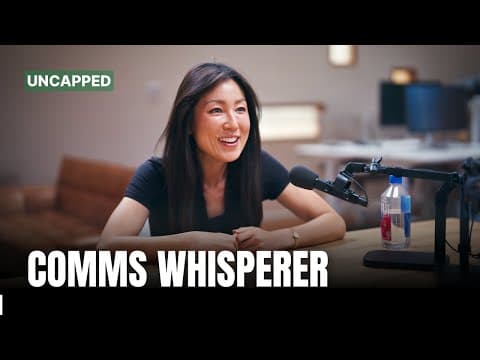
[0:00]The thing that I have extremely high confidence in is that comes is the final bastion of human ability. Where 10 years from now, 50 years from now, the ability to persuade and win over and make other people fall in love for other humans, will still be uniquely human. I'm really happy to be here with Lulu today. Lulu, I was just asking you before like what's the right way to introduce you. The way I would describe you is like a startup whisperer for comes behind like, you know, amazing companies, amazing investors. I don't actually know the full scope of how you do what you do and what it all is, but um, it's really incredible and uh you're one of the most thoughtful people on how people communicate, position things. And so I'm really excited to talk about this and learn from you today. Thank you. Yeah, I'm stoked. Why has coms been having like the moment that it's been having? And um, I feel like in the last few years, people have started like understanding what it is better and dissecting it and applying it and being more thoughtful. I think com is started to get paid more, which is appropriate. I think you can really feel it online, the companies that have it nailed and the ones that don't. But like why has it become more of a thing in recent years, seemingly? I think we're all just pattern recognition machines. And when we're seeing that the companies where the founders have the most aura and the companies that have built these impressive cults and the companies that have the best reputations. Are getting the best people and are winning and are worth the most, then the founders coming up say I want to do that too. It feels like even though so like even that word aura, I feel like there have been more of these lately, where I'm like there's cracked kids and there's like, we have a lot of aura and there's like vibes. And it seems to me, maybe this has always happening, but it feels more lately that people are more attuned to these words and these positions and what's the energy of the company and the thing. Does it does it feel like that to you? Yeah, and it's actually um hand-in-hand with people caring more about coms and how they're perceived. Like aura is code for how good of a communicator you are. You you can't be bumbling your way through a sentence and not able to describe what your company does and then still have aura as a founder. That's very difficult. So I I think that people are just seeing the pattern that the people with stronger reputations that other people think more highly of and are more impressed with are the winners. And they're trying to figure out ways to recreate that and so some are trying to do it with these cinematic videos and some are trying to do it with various forms of aura farming. Some are hiring online influencers, which I'm a little bit out by, but everyone's trying to approach it in in these different ways. But there actually is time tested grand strategy for how to curate a reputation. If you take a holistic approach, it is like you start with what are you trying to achieve? And it it's not what I want to try to achieve is people love me and thing I'm great. What I want to try to achieve is to uh save the US military innovation future by equipping them in the right way. Or to build the software engineer of the future or to build super intelligence, right? And that's what I want to achieve and as a means to that end, what do people need to know about me? Obviously, it has to be true, but out of the set of 10,000 things that could be true, what are the things that people will care about and that are useful for this project? And so thinking about it through those terms, sometimes it'll lead you to doing the standard checklist of like video influencer, tweet a lot, whatever. But sometimes it'll lead you to launch a fellowship program, host a competition, turn down certain opportunities. You know, it it might actually be um outside of distribution compared to what you you're seeing other people do. When you think about like the most successful coms, either just campaigns or chapters or people or companies. Is it more about clarity in what they say or is it more about like the way they say it and what the personality that they show as they do those things? Because, you know, like I think having a clear mission and clear articulation is really good, but we can all think of these examples where like many companies are all basically saying the same thing, but for some reason everybody wants this one to win. And then when people want this one to win, it becomes easier for them to win. It's like, what is, yeah, what's the balance here? Yeah, so two things, the what and the how are both more useful and important than the where. Uh have you seen this comic of Waldo sitting at a bar? And he's looking sad and he's got a drink and the caption is, nobody ever asks, how is Waldo? I love that. You know, everybody is always saying, which podcast can we go on? Nobody ever asks, how do we get people interested once we're there? Yeah. So the what and the how are both important. I will say one thing that people probably underrate is that if people just like you in their gut, they will figure out ways to try to help you be successful. And they will kind of recon to themselves the thing that they heard and how compelling it was. Yes. It's like one of the founder archetypes I think about a lot is not like you and there's there's many intersecting things that are very valuable. Like there can be visionaries and there could be deeply technical people, but there's also this type or this characteristic that can overlay, where people are just so magnetic, so likable, so just pure seeming, whatever, where just the whole world wants to see them win. And I think I don't know what that is, but that seems like a very important thing here. A lot of it is pure honest conviction and confidence. This is what, you know, you and I can't get through a conversation without talking about Napoleon, so we'll get to that. But some of it is if you just have complete confidence that this thing that you're doing is right and you're going to win and it's inevitable and you just simply share that with people, they will feel that emanating from you and it's very hard to resist. And this is true in the past when people have had to run into a storm of bullets in order to achieve this thing that you've told them must happen and will happen, or today if people need to leave their jobs and come, you know, turn their lives upside down to work with you. So I I think some of it is just like another human being telling you with complete confidence and conviction that this is the thing that's going to happen. And that's the thing that AI will not be able to take away from us. Well, we'll see, but but, you know, AI will be smarter and better than us in many ways and people who deny that are just hoping. A lot of these like AI can already do it better than me, but it needs me doing. It's like, no, you're just asking for a DIY program for yourself as a human, you know, like, it's like. Um, AI can do better, but for convincing other humans, I think we'll always take humans. I think that actually communication will be the skill that humans need. When you start work on helping a company position itself or get its brand right, and you think about stories. What goes into that for you? And so like, you know what I'm imagining is I got to like tour the like Pixar Studio one time. And like meet some of the people there and like the thoughtfulness and the deconstruction of a great story is just such a science. And I'm wondering if you could break down what's the what are the lenses or the attributes of a great story in tech. Every great story has a problem and a resolution, and the way people think about where you're headed from here is um by thinking about where you are on that curve. You know, what goes up must come down, um pride comes before the fall, darkest before the dawn. We have all of these different phrases for things meeting a resolution, is the same way that supposedly Eskimos have so many words for snow. It's because we have this deep, deep attachment and commitment to seeing stories through. So we assume in our hearts that every story has to have a problem that then gets resolved somehow and if someone flies too close to the sun, they have to come crashing down to earth. And if it doesn't happen, if the story was then flew happily away. Yeah, yeah. It's not a story or if somebody crashes down and doesn't make their way back up, if we were to see a movie like that, we would not be able to sleep. People would hate that movie and not know why. It's like this uncanny Valley of a story that was kind of heading in the right direction but didn't quite get to the other side. And so every story has that arc. Um a narrative arc is literally an arc, it goes one direction and then it comes back the other direction. The way this is relevant for founders is you need to help people understand where you are on that arc and where the arc is headed. You don't get to choose that there's an arc and that people will think there's an up and a down and a start, beginning, middle and.
[8:47]Yeah, yeah, but there's always an arc. Yeah. Or do you get to choose whether you're on this part of an arc and you've come through struggles and you're destined for greatness. So what is the arc, where are you on the arc? And people will fill in the rest of where they assume you're going to go on, where you deserve to go. I guess also companies need multiple arcs, of course. And so you think about the companies that have gone really far, there've probably been so many minor and major arcs and resolutions and then there's a new tension that's created and resolved. And I guess that's a big part of it too. Yeah. It's like you almost need to create the next tension point for the next story. It's sort of like the S-curves of technological adoption, you know, there's you can be on one S-curve, but you know that there's other coming, you know, that there's a there's a bigger arc. It's sort of like in um what was oh, Men in Black, where there's like universe in the universe and another universe or like the stock market, where there's a zigzags every day, but then you can zoom out to the month or the year and then um over the decades like each of the ups and downs are part of some bigger up and down. The point of this for founders is just you know, if you know that people think this way, then you have to be really conscious about where you are positioning yourself on those arcs because people will judge you by that. And that's um it'll shape their expectations on if you're headed up or down. So how do you create those arcs? Like if you're sitting there and you're running an early stage company, or maybe it's not so early stage. How do you make an arc? There's two things that you need people to believe. So first of all, imagine that people's opinion of you is like a living is like a living thing. And and the story that the uh take a set group of people, that's your audience. Like let's say that um my company needs to hire software engineers and I'm talking to like Bay Area software engineers, and that's the people that I care the most about. Among those people, my story will be kind of a living thing that has a homeostatic set point. Like um, your body temperature, sorry, this is like such a long roundabout way to the answer. I'm like here we go. Unfortunately. I'll lay out the ingredients and then I'll put them together. Um imagine that the the story among those people is a living thing. And imagine that that living thing has a homeostatic set point, the way that your body temperature does. Your body temperature doesn't have really like a neutral, you know, it's supposed to be at 98.6, let's say. I don't know you do. Let's let's call it that. Yeah. If it's above that, then the body will regulate to bring the temperature down. If it's below that, it'll regulate to bring it up. If it's far below that, it'll try really hard to heat up. The way this translates to the story is people have an assumption of the level of celebration you deserve. Interesting. Right? Like how good you are and how much reputation you deserve. How do people decide that? Let's get to that because you you you want to try to engineer it. Yep. If you're above that, people think you're overrated and they want to bring you down and they don't like you. If they perceive that you're below that, then you're underrated. Like underrated is a compliment. Why is it why is it a good thing to be poorly rated? In my mind it's sort of like you fumble. Like what do you mean you're not well rated? Like go fix it. That's an interesting point. But underrated is a compliment, overrated is an insult. You would think that being highly rated is good, but overrated is not. So people will fill that delta. If they think you're underrated, they'll try to bring you up. So this is like what people what will get to this too, but uh this is what people have been saying about Google Gemini. It's underrated. It's like they're it's high status to say. Yeah, it's a compliment, but it's also like seeing as insightful and valuable and useful to point out that Google Gemini is good. That's true. Yes, people feel good when they make that point. Yeah, they're like, I'm pointing this out. So I'm I'm writing some kind of wrong in the universe. I'm filling that imbalance. I guess people also feel good about themselves when they call it something overrated. People just feel good about identifying the discrepancy. We're all kind of reputational carence. That's interesting. We want to like bring people and companies to the level that we think they should be at. We get really satis. I'm thinking about it. People who think really smart when they make these points. It's all of us. It is all of us. We feel off when something isn't where it should be. And that's why all these phrases exist. So anyway, when you are the founder and you want people to think of you well, you want people to think that you're underrated. Because you want people to think that your true value is even higher than the market is placing on you right now. Even if that's high, your true value is like even higher, and your best days are ahead of you and things are even if they're good now, they're going to be amazing in the future, right? And so how do you get people to think that? Well, there's two points that are relevant. One is where should you be valued? Like what is the correct homeostatic set point for your story and reputation? And the other is where are you now relative to that? So where a founder would go wrong would be if you are saying um our mission is to do this thing. And we are achieving it, then people are like, oh, have you already you you were meant to go here and now you're here. Like so founders will talk a lot about mission statements and uh I think a lot of mission statements are either so lofty and generic that they don't mean anything. And so people don't have a set point, they'll just make one up, or they're so current and not sufficiently timeless that people feel like, oh, you you did it like what now? Yeah. So um choosing what the natural end point is and then choosing how to show people where you are relative to that. It's an interesting point about not wanting to seem overrated because you um there there's also, you know, you want to you want to be relevant and you want people to take notice. And usually people do that through look what I'm look what I'm done and look what I've built and look at these customers I have and all of those things. So it's an interesting balance where you're trying to in a weird sense be very loudly underrated or something like that. Yeah. Crypto was a good example of this. NFTs were a really good example of this. Where I happen to agree there was like some natural value that NFTs could have had, but but it just soared so far beyond that. It got crazy. Yeah, it got crazy and then you just saw people trading things where you're like, I can print and everybody kind of was like this doesn't make sense and at the same time these things are trading for millions of dollars. Mhm. Yeah. Open doors is an interesting example now. My friend Kaz who used to be president of of Shopify uh went to go run the company. And things have been bumping overnight because people are just optimistic about where the new natural set point for the company is. He's going to be making a lot of changes to product and R&D and to the team and culture, he's already started announcing some of them. None of those materialized in the first 24 hours. The only thing that materialized was this guy who showed up and said, I'm going to do this. So the pretty significant jump in the stock was based on trusting him, liking him, believing that he can get it done. Right? It wasn't actually anything that happened in those 24 hours, but people reset what they thought was the homeostatic set point for that company. Yes. And then all of a sudden it was underrated. All of a sudden it was underrated, undervalued. That's right. Do you think all companies just necessarily have to go through these ups and downs or are there examples of a company you've ever worked with that just like stayed maybe not right on the line, but that didn't have the dramas of the ups and downs and kind of just hung pretty close to homeostasis on its way up. I think the more ambitious a company is, the harder it is to stay steady with that. If you're ambitious, it's sort of like some of the most ambitious companies in the world today are these big AI labs. They're making massive, massive bets and each of these bets, if they pay off, lead to massive, massive returns, and if they don't pay off, could lead to just complete abject failure and destruction and ruin and humiliation, right? Yeah. And the way that this works is it pegs to your narrative, like there's volatile ups and downs and and the the slopes are just steeper. Whereas if you are a very steady kind of consumer company of your um like Chick-fil-A. You know, pretty much like, yeah, They've had some they've had some dramas, but the dramas didn't really seem to affect the chicken consumption. No, people still like the sandwiches, you're right. It's like if you like these sandwiches, come and eat them. Yeah. You know, and now with Maha, people are saying these sandwiches will kill you, but the people who are eating the sandwiches weren't eating them because they thought they were healthy, like. Yeah. So there's also some health kicks that go Like even just broad health kicks like, you know, how bad are micro plastics? People like it's terrible and they're like, ah, whatever. There's like, just doesn't seem to matter. We're still using a lot of plastic. Yeah. Like the plastic-less project came out with um, uh those Fairlife. No, no. Those Core Power. Core Power shakes had ton of thates. Yeah, I went over there and, you know, there's one in the fridge, I'm drinking it. It's like, yeah, it's like we're all saying it, whatever. There's a whole other lens that you've spoken about that, you know, is if what we just described is sort of like the flow of the up and down, there's another lens you've talked about with like circles in storytelling and like that that's more like the stock of where you're at. Can you talk about that? Yeah. Yeah. I think about flow and stock. So like um flow is more like a trajectory of where are you going and and drawing out the long arc for people and telling them what to expect. And stock is more like at this moment in time, what do you say? Okay, a bad recipe for this is what sounds good, what's going to get the most engagement. Um, good recipe for this is based on what I'm trying to achieve. What is the circle of things that are true? And then what is the circle of things that are relevant and interesting and then what are the circle of things that are strategic and helpful to the business? So let's say um that we're starting a company should we start? An AI personal tutor. Okay, we're starting an AI personal tutor and uh the circle of things that are true about us are that we have um we have discovered that one-on-one tutoring immediately puts you in the 99th percentile of student results and that it's worked throughout history. There are military studies that confirm this, and that people want this for their children because uh there's so much controversy about schools being a mess. Um and there's facts about Jack is a repeat founder, who you would be the CEO, how to be a chief of staff. And so like Jack is a repeat founder and uh has scaled and grown companies and has seen these and has children of his own. He's a father. Then the circle of things that are relevant to today are everybody's excited about AI, looking for real use cases and and solid business models. Um that the education system is in high controversy and tumult and that this next cohort of kids who are now in K-12 are going to graduate into a world where AGI has made it very unpredictable how they're going to make a living. And then the circle of things that are helpful to the business are like easy to use, we partner well with schools, we can lay our on top of traditional schooling, you don't have to go full homeschooling in order to use us. In order for us to decide like, oh, you're going on uh podcast today and how are you going to describe the business? We would want to look at the overlap between all three of these circles. So there are things that might be true and relevant, um, but not helpful. So maybe it is true that you what's your what's one of your hobbies on here? Music. Yeah. Like you're really into music and um, it is relevant because there's some study that music helps with neuroplasticity and in young children and helps to form a stronger brain. But we're not ready to offer that product yet and if we advertise it, it doesn't actually help us right now. So like that's not useful. Anyway, you could go through all of these examples. There are companies today that have left out the third circle of is it useful and strategic? There's this question of like is all press good press and like we could say something right now. If I said say something to just try to make this next 60-second clip do the rounds. Don't worry about any other variable. Just do the rounds with the next 60 seconds. You could say something nuts and make sure that this clip went viral. Yeah. But that doesn't necessarily help. And I'm curious actually your take on this specifically of this like all press is good press thing. Because this is like, you know, taking the circles analogy, this is basically say, if I'm just going to go nuts on relevance, I'm going to drop the other stuff. Mhm. There are a lot of people who think that's good. I I think based on your framework, you're actually kind of implying it's not. You could potentially super handicap yourself in the future. So imagine that you're saying something that is true about you and it is relevant, but it is not useful to say. So um there's a lot of controversy about is it useful for Cly to say cheat on everything and then they're explaining, well, cheating isn't technically cheating, when mean. It's a very valid question to ask, is that useful for the business? Because now you have distribution and and let's say you reach millions of people, and you've told those millions of people that your ethos is cheating, and you're building products really quickly. And so now your question is going to be, is that useful for the business we're trying to build? Well, if the business is um figuring out a way to make a sizzling video, no matter what, then it would be. If the business is let us record your screen and trust us with your data, then it might not necessarily be. So it's worth looking at all three of those. I guess the gamble could be can you change your narrative over time? In other words, like let's take that Cluly case study. Can you get a huge amount of distribution with something that feels a little, you know, tricky next to the trust us with your information kind of thing? Yeah. Yeah. Yeah. But then can you basically get to that place a year from now with a lot of distribution and say, we actually have a way to now navigate the other side of that. And have a new story that matches, but now we have the distribution. Like, do you ever see that? Or do you think it's really hard to change the ethos of what the company was to try to make those kind of moves? I think anything is doable, but it is hard, especially if it's something that accrues to personality and trust. Um because people can believe that your business model will change. So like Figma literally changed who they were as a company in the sense of like they changed what they were focused on as a business, but if you're somebody who trusts Dylan Field. To to to steward your data and to care about you as a customer and as a person or as an investor, you would trust him no matter what. He's an amazing example, by the way, of somebody that everybody just always wanted to see him win. Yes. Everybody wants to see him win. And then he even got the narrative arc with the Adobe thing and. Yeah, yeah, yeah. And he's been winning and we still want to see him win even more because we think that the correct level of winning for him has not achieved yet. That's right. You know, Dylan could say today I'm starting a new company that does who knows what and everybody would be, I hope he wins. Exactly. Absolutely. So it it's harder to pivot who people think you are as a person because either um you're flighty and fickle. You know, as an adult or something doesn't add up and something wasn't true before. Here's an interesting question. Do you feel like who people are from a coms perspective, is what it is and you're basically just trying to expose the truth more. Or are you more of the view that we can actually position somebody, like when you work with somebody, are you like in your head or you're like, you're actually this way, but we're going to make you seem this way a little bit more, or are you like, we're going to expose true attributes about you, but we can only work within the confines of what's true about you? I think more the latter. I think there are different archetypes of people, but um you got to lean into the thing that you are. And it's like Charlie Munger said, you can always invert, like everything has two sides. And so if someone is more remote and more cold, um and they're not like the warm and fuzzy type with people. To try to position them as that because you think people want a manager that has empathy is just hard. It's it's going to come across uncanny Valley where it's like, I see what you're saying, but I don't feel it. Um, whereas if you actually lean into this is a technical genius who is in the lab cooking up something amazing and you can be part of this team, you'll attract people who want that and that's actually the right thing long-term. What you don't want to do is bait and switch someone into joining the company, for example, because they think that they're working for this type of guy and then that guy just doesn't actually show up to work. He was only on the podcast. Yeah, you basically have to lean into authenticity, but you can choose which parts of somebody's overall shape to emphasize. Yeah, most people don't know you as a founder personally and they don't get to shape. So so there's like a there's like the the true authentic platonic ideal of Jack. And that includes all the things that are true about you properly weighted. You're a full person and that's, you know, hopefully like my wife would know. This is like between you and your wife and God, like that that complete picture exists.
[25:33]Yeah. And then there's the world. And then there's the world. And the world, maybe they have this parasocial relationship with you, but basically they see some um even more mini version of you refracted from afar. This is like the Walter Lipman theory of the the purpose of the media originally is that the world has too much data for us to actually take in. And therefore we need something to compress it down to us for little almost like a metaphor of the world that we then use. And so like the model of Jack that people will make will be some version of you. You get to have some influence over that version. It still is based on this. Someone watching this right now, it's like this isn't a normal setup. Like there's like cameras and lights and mics and microphones and whatever. And so it's like there's just no way for it to be like that. And so then you have this choice of like what side of you are you going to expose? And I do think some people choose to just be like whatever, I'm just going to be who I am. And some people think about it a lot more. Yeah. It's worth thinking about what are the things you want to intentionally highlight about yourself. You know, as long as it's also one of the things that's true, if it's a subset of the things that's true, you can choose like these are the traits that are most relevant and useful for the business for people to know about me, and I want to highlight those. It's like, you know, when anchors go on TV, especially Fox, they wear a ton of makeup. Yeah, which you and I should have done. Just just slaughter on the makeup for. It's fine. It's fine. And that is still like highlight their features so that it so that it still in person it looks almost Macabre. But like through the camera, it looks normal. And so for people for your personality traits and the things about you, you almost have to amplify them beyond what is normal in in this kind of a setting so that it really reaches the world. Like if you and I were just hanging out today and you told me one story about how you want to run your fund, like 10 times. Be a little much for me. Yeah. But if you're moving through the world and you tell that story 10 times and given personally hears it like once one and a half times or something, or something. Yeah, or zero. Or zero. Yeah. 0.5 times maybe if you're lucky. Yeah. I think about this a lot with um, just like companies doing marketing. I remember at Lattice like in the early days when we were just, you know, first doing this. Our team would be like, oh, we've said this so many times. I'm like, yeah, inside, but outside, it's like no one's heard it. Like zero people know about Lattice, so we got to keep saying it. It's like that kind of idea. And it's weird to repeat yourself so much, but it's kind of what you need. Yeah. Like how many times do you think that think different was said in how many places before it stuck with you? Or, you know, like uh Steve Jobs's stay hungry, stay foolish speech, like how many places did it have to show up before it like reached you and then actually stuck? Steve Jobs is another great example of this, where the comeback story is like this is his company. The correct version of this company has him in it. And when he's not there, it's not the same company. We don't believe in it. When he's back, it's become the company or it's on the path to becoming the company it was meant to be and it was like Destiny fulfilled.


