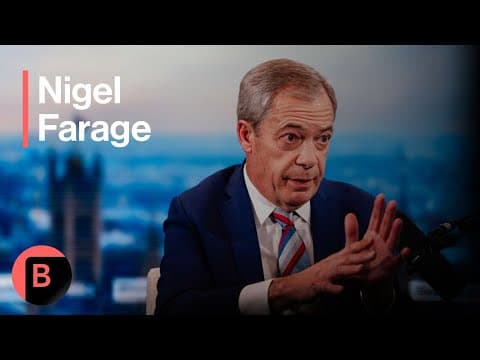
[0:00]Hello and welcome to the Bloomberg UK Politics podcast. I'm Caroline Hepker and today on this episode, I'm joined by Bloomberg's Finance reporter Will Shaw for a conversation with the Reform UK leader Nigel Farage. Welcome to Bloomberg and thank you so much for your time. Good to be here. So, you're the architect of Brexit, of course, well known to many. You have now won a seat in the British Parliament after eight attempts. Your party is sitting just below the ruling Labour Party in the polls here in Britain and you are poised to go to the inauguration of the U.S. President Donald Trump. Despite a recent row with Trump adviser and perhaps hoped for donor Elon Musk. But today I want to spend a bit of time with Will and you, Nigel, talking about whether Reform UK has the kind of long running, um, the kinds of answers to the long running economic challenges that Britain really has that we've seen in the recent GDP figures, in the concerns around stagflation. You're finally an MP, though, scoring highly in the polls. The political mood across Europe has moved in your favor. You must feel like you've really made it now. Well, not about made it, but and by the way, thank you. It was a very accurate introduction. Um, we're doing well. We're on the up. And do you know why? Because we're optimistic. You come to a reform meeting. I've done four rallies this year already. All complete sell outs of our members around the country. And I'll expand that to big public rallies as the year goes on. And it's like a rock concert. They're not depressed. They actually believe that with the right leadership, with the right vision, with the right courage, we can turn the country around. So yeah, we are very upbeat at the moment. I think the the uni party, if I can call them that, uh, just look morose. Labour look morose, the conservatives bitterly divided.
[2:00]I mean they all hate each other. Uh, so there is a massive gap there in British politics. And you know, in your intro, you made the point, it's a very good point, do we reform have the right economic answers and social answers to the problems we're in. Well, you can't find the answers until you first identify the problem. And I think we've had so many policy mis steps over the last couple of decades. And I think the parties are kind of so wedded to what they've done already, um, that I don't believe they're in a fit state to put us right. You've only got five MPs in Parliament overall though, so you're still quite. The joys of the first pass the post electoral system. Yes, absolutely. Um, but perhaps one of the key issues of course is, you know, you're going to Washington. We know that the Labour party has appointed Peter Mandelson as ambassador to Washington. I suppose the first thing that I'd like to understand is whether you've spoken to Mandelson, whether you've got plans, you know, to try to help Mandelson get the best deal for Britain. Look, I don't discuss private conversations I have with people and never have done, never will do, which is why, by the way, I'm trusted and I've survived 25 years in this game. What I will say is this, and I've said it publicly, and I've said this privately to the most senior labour figures, that that it isn't just Trump, that I've known for a long time and get on very well, which you know, which I do. Half his cabinet I know. Some of them are good friends. You know, I this whole movement, uh, you know, they're people I've worked with for a long, long time. So, It is anything I can do, for example. Well, so you must know Lord Mandelson very well. Obviously, he's a veteran politician. So what do you think of his appointment and and can he get Well, of course. Mandelson and I were in Brussels at the same time, you know, when he was a commissioner there. Look, Mandelson is bright and clever, wily, possibly, too. Um, nobody could ever doubt that Mandelson is not a good operator. I mean, he was part of the genius behind, you know, new Labour and the rebranding of the party. All I would say is this, that if you really want to get on with the Trump administration, you need somebody who is an entrepreneur. You need somebody who's a businessman or businesswoman. You need somebody who thinks outside the box. And and kind of what we're doing is we're going down the traditional Foreign Office governmental route of appointing somebody from within our governing circles. Uh and I think we could do better. I mean, look, you know, you're you're obviously at odds with the Labour government. Yes. Um, are you going to work together with Peter Mandelson and will you brief against him and the Labour government and Donald Trump if you differ on policy? I will get back to the original question. I've said privately and publicly to senior Labour figures that if they need help with the relationship, particularly in terms of negotiating tariffs or maybe sectorial free trade agreements, which I do believe are possible with the Trump regime, I, of course, would help because that is in the national interest. Uh and I have to say, sitting here this morning with you, how relieved I am that the Chagos Island, um, surrender of sovereignty as I see it, isn't going through before the inauguration. I think if that had happened, we would have been in a very, very bad place. So we've got a bit of a reprieve. And remember, that Trump is the most instinctively pro-British president we've seen for decades. And we ought to use that to our advantage. How does that really translate though, in terms of how hard Trump is going to be on tariffs globally and especially on the UK? I can tell you that in 2016 and past inauguration into the early part of 2017, the team around Trump were really anxious to get a trade deal with the UK. And to do it as quickly as possible. Why? They wanted to show that they're not protectionist. They believe in fair competition, but not as they see it, unfair competition with China and other countries that undercut them on wages on environmental standards and everything else. So and of course, we couldn't do it because we were still part of the European Union. But now we're freed, we're not part of the EU's common commercial policy. We can negotiate our own trade deals. These are the prizes that are on offer. But, you know, if the Prime Minister wants to have a reset with the European Union, and get closer to the failing economically European Union, it's going to be very difficult. If if, um, if we turn to Elon Musk, so, um, I thought you might. Joe Biden was speaking overnight. He warned Americans of a dangerous concentration of power in the hands of a very few ultra wealthy people that he feared could have an impact on the country's democracy. Through your friendship with Elon Musk, is there a risk of you introducing a similar threat into the UK in terms of like the interest of one very, very rich tech billionaire and his concerns taking priority over the concerns of regular voters and you know, the potential of someone being seen to try and buy an election in the UK? Well, first things first, I think Biden's record, um, on defending the American constitution, on the the way that he used the judicial system, um, doesn't bear much scrutiny. I think things went backwards during Biden's time and we concentrated so much power in Biden's hands, uh, that he gave Afghanistan back to the Taliban. So, you know, we can throw this stuff back and forth. In America, you know, billionaires have more influence over society than we do in Britain, as they you know, culturally, there's no question about that. Musk is a very powerful figure. Of that, there's no doubt. But I also think he's a hero. I mean, if you think back to the last election in 2020 in America, where the Hunter Biden laptop was there, the evidence was clear of criminality for which he's now been convicted of one or two things. The evidence was I mean, all sorts of things were there that that that deserved to be in the public domain, especially his father's close relationship and telephone calls with. That's a separate issue. No, it isn't. No, it isn't at all. I'll tell you why.
[8:10]Yeah. All the social media channels forbade any conversation about that subject. The Americans had an election with no debate on this issue. Musk has come along and bought Twitter, albeit for quite a high price, and free speech is coming back to America and the Western world. You've even seen Meta in this week. I mean, extraordinary you turn that has been made. So, so, so Musk is a force for good in terms of open democratic argument. What it comes to power influence, I think the important thing, the important thing is he mustn't be seen himself to be dictating what the Treasury Department do. And that is important. A lot of people would disagree with the point around, um, you know, freedom of speech, particularly the Europeans are deeply concerned about misinformation. The the Elon Anything you disagree with is misinformation. I know. Yes, yes, yes. We must all support globalism. We must all support open borders if we don't, it's misinformation. I don't buy it. On Elon Musk, um, with him and the other tech billionaires who support uh, visas for highly skilled workers into the U.S. That's pitting them against the Maga movement and people like Steve Bannon, um, who oppose immigration much more broadly. Who is right in that debate, do you think? Well, I'll talk from a UK perspective. You know, we've always favored, I've always favored high skilled immigration. People that come in on net contributors to the country and crucially, who integrate to a greater or lesser extent in our culture, our values. I've never had a problem with that. Um, but of course, we've done the opposite to that. Isn't it amazing that the last 3 million people that settled here in Britain from outside the EU, the last 3 million, 22% of them work. Only 22% of them work. So, how you manage immigration is becoming an increasingly crucial political issue. Bannon is sort of almost saying no immigration into America. Uh, I tell you what, if we want the city of London where we're sitting right now, if we want our tech sector to be a world leader, if we want to turn this place into one of the crypto trading centers of the world, all those things, there's a lot we can do with British people, but we will need some highly skilled people from other parts of the world. I have no problem with that at all. The issue with that though, in terms of the immigration debate, is that on the one hand, your manifesto ahead of the election last year talks about freezing immigration. No, no, no, no, no. Hang on. Hang on. Let's just be clear about what we're talking about. There are always people leaving the country. You know, you sell a three bed semi in the suburbs of London and you can go and live in Spain for the rest of your life or Portugal for the rest of your life or whatever it may be. What we're talking about is not to have overall population explosion due to immigration. So we're still plenty of room for people to come on either work visas or in some cases come to settle. So I'm not, you know, we are not putting up the barriers entirely. What we are saying is that low skill migration and those people bringing in dependence has net been a negative for the UK economy. How is that any different from the policy that the last, well, this government and the previous government have tried to enact? Because that's what they told people in manifestos and then did the complete opposite, which is why we're doing well in the polls. Trust has gone. Don't forget, don't forget the conservative party in 2010, 2015, 2017, specifically in the manifesto, said net migration of tens of thousands a year. In 2019, we've got control of our borders back with Brexit. Numbers will be lower. And the 2023 number before the revision, and by the way, all the revisions are upwards, is nearly a million. This is this is where we are. It it the biggest problem that those two traditional parties have is trust. If we turn to the UK economy, um, Britain obviously's got deep seated and long running economic problems, um, those have asserted themselves in recent days in in the turbulence in financial markets. Um, how would you create economic growth in Britain? Everybody says they want to achieve that. It seems exceptionally hard to actually make it happen. Like, how, how would you bring that about? Well, I mean, Rachel from accounts is not going to achieve that issue. I mean, clearly, utterly clueless. I thought that from the start, actually, utterly clueless, completely out of a dept. And there seems to be And yet they won in a landslide election. Well, they did it but but it wasn't really it wasn't really pro-labour vote, was it? It was just an anti-Tory vote. I mean that that that dominated the election. And and remember this, it was a fairly loveless victory, and they only got a third of the votes and two-thirds of the seats. Again, we're back to our friendly electoral system. Um, I was amazed how little scrutiny Labour's economic plans came under in the run up. What is clear is this. What is absolutely clear is this. They are increasing the size of the public sector. And the measures they've taken or is already, even before April the 1st when all this really kicks in, decreasing the size of the private sector. And there seems to be a fundamental misunderstanding on the center left of British politics as to how economics works. If you don't create private sector wealth, you are doomed. So she can talk as she did when she came back from China on Monday of this week, she can say growth is our number one priority.
[13:40]Everything they're doing is anti growth, including the key component and the key component is confidence and there isn't any. If if we if we look at the reform manifesto, it talks about department saving 50 billion pounds a year by cutting wasteful spending, bureaucracy and improving procurement. So that would be about 10% of departmental budgets every year for five years. How would you bring that about without huge cuts to the NHS, education, social care? It's very interesting you raise that. It's very interesting you raise that, because that was part of our contract that we put out with the people. We were told it's impossible. Nonsense. It would mean massive cuts to frontline services. Guess what? It's now government policy. So we're very good at leading arguments on this. Uh what I have no doubt about, and and this is going to be difficult for some industries to accept, and I think there could be the next big battle with the trade unions will be over the use of AI, the use of advanced technology, and how actually we can increase productivity with with fewer human beings. And therein lies your real answer. And I think what you're going to see with Musk, you know, if he's fully focused on Doge, this project in America, you will see technology increasingly replacing a lot of human beings. And that never through the history of modern mankind, that never comes without something of a fight. But is your economic agenda actually a real plan? Because you're also promising uh 1.5% extra growth in terms of what can be delivered to the UK economy as well as that 50 billion pounds in spendy cuts. I mean, partly, you know, the issue is that the government is already in trouble with its own fiscal policies for exactly that reason. And are you going to be able to convince the bond market anymore? I mean, 1.5% in terms of extra economic growth is pretty much the same as what Liz Truss was offering. Let's put it like this. What we have right now. And not just the rich leaving London and leaving our big cities, which they are, in their thousands. People are relocating. We're also losing the the 30 something entrepreneurs, they're going. They can't see any prospect of Britain being a pro-business community. And I return to that word confidence. You know, there there are things that make markets work at times that you can't always rationalize. But it's about confidence. It's about optimist is about optimism. It's about direction. And I would say this to you. Do you know there's not a single person on the Labour front bench, not one, who's ever set up or worked in a private business, not one. The Tories are not much better. And what we're saying is that we are and we're not Elon Musk billionaires, but what we're saying is, we're a practical group of people who have among us several successful business people. I think we've got more idea of what makes the economy tick than either the current Labour or Tory parties. Yeah, confidence is a very difficult thing obviously to gauge and to inspire and quite quick to sort of disappear. But the thing about your economic policy, can you sell this to voters? Can you actually sell a plan that is promising a lot of growth, which may or may not happen, but is definitely offering enormous tax cuts now, which definitely brings in less money to the revenue. Well, the tax cuts. Well, let's be clear about the tax cuts. Would bond markets buy that? And also that it it does mean effectively cutting the size of the state and that is definitely not clear in your manifesto. You know, there's 4.2 million adults now on health related benefits in the UK. Do they have to go back to work? I mean, in a Reform UK world. Oh, we need carrots and sticks, right? But but does the electora know that that's actually the stick? Hang on. The carrot's very easy. The big tax cut we want is to raise the threshold at which you start paying tax up from 12 and a half thousand a year to 20,000 a year. That is the big That is enormously costly. You cannot do that without massive cuts to government. That is enormously costly unless what it does is give people on benefits the real incentive to go back to work because the number of doors I've knocked. So how is that elecorly possible? It's a little bit like Javier Mile's plan. It is very difficult to sell that to to a broad swath of voters. I would say to London-based media, come out and knock on doors in the poorer parts of the country, because the number of people that have told me, to my face, you know, I want to go to work. I want us to be better off as a household. But as soon as I work more than 16 hours a week, I lose all of my benefits. There is this terrible welfare trap. So you think that that tough message of get back to work is actually very palatable to the British population? For example, you know, the the I mentioned Argentina, Javier Miley, which again, by the Republicans and Donald Trump and Elon Musk think that that has been immensely successful and a lot of markets that might agree. I do. Yeah, and you do too. The cost of that economic success that is not as well touted is that poverty within Argentina has jumped from 40% of the population to 50% of the population. That is the cost of doing that. Well, well, I'm trying to do is give people a way out of poverty by making work pay. And I accept that it comes at a big initial cost. I absolutely accept that. A big initial cost on day one. I absolutely know. I absolutely accept that. But I also think the stick. Yeah, there has to be a stick. I mean, what is all this nonsense about four-day weeks, work from home. The least we can do. How can you get the number down on that promise to the electorate that you have to get back to work? Anybody who's suffering from depression, who has, you know, benefits coming in, you have to give that very hard. Would they vote for for me? What about the working population? What about those people I see on the M25 at 5:30 on a Monday morning, right? Heading on to. Hang on. Heading off to work, working much longer hours than their parents or grandparents ever did, paying ever higher burdens of time. What about them? No one ever talks about them. No one ever talks about hard work in Britain and the burdens they're under. And you know what? I think they'll vote for us. I really, really do. And I think you'll find there are people on benefits who know they shouldn't be on benefits, who will see what we want to do as being a way to help them to be better off. But if your voters had read the manifesto, which you call a contract with voters, do as well as we have, do you think that that is actually what has been communicated on the doorstep? I think more would have voted for us. I suppose like, you know, we need a bit of honesty about this. Why don't we why don't we tell young people at university and at school that actually, the only way you'll ever succeed in work in life is to work hard, that hard work is good, success is good, making money is good.
[20:17]We need a change of culture. Um, the the people, the people that you're talking about meeting on um, knocking doors of course, that's extremely important. Those people do need the numbers to add up if your policy is going to work and is going to benefit them in real terms. The IFS said of the proposals in the reform manifesto, spending reductions would save less than stated, that tax cuts would cost more than stated by a margin of tens of billions of pounds a year. The problem is if if you if you don't have the kind of rigor in of the economic plan, you can't help the people that you're making the promises to. Well, you can, because there are many other things you can do. We talked about cutting the size of the public sector. I've talked about the use of AI. I've talked about procurement changes and cuts already. Um, but the thing we're all forgetting is the just enormous dead hand of the quangocracy. On everything from financial services to fisheries. The the the extent to which businesses are scared on a day-to-day basis, scared that some unaccountable person comes in, tells them they're doing everything wrong, demands extra costs for them. Again, you see, unless you have, unless you have frontline politicians who are actually in business, they don't understand what this is doing. And then, look, there may be a case for cutting regulation here in the UK. But you're not you're not going to find 50 billion pounds by cutting quangos. That is simply not not possible. But the idea also is that Britain has been through this now twice. The promise of cutting taxes now and feeling the benefit later, cutting taxes now and getting growth later. It did not last for Liz Truss. The October budget, you know, even though it was much more conservative with a small C, also has not withstood the market pressure very well either. And so that's why we go back to the figures. The figures are not credible. You're offering something that's not possible to deliver. But your trust, you will notice. You will notice that actually, on tax, for example, which you've both talked about to me, that we're being much more cautious than Liz Truss was. You know, Liz Truss was going for big bank, right? Everything at once and clearly way too much at once without corresponding initial spending cuts. Had she put big spending cuts in, although some may have objected to it, it might have been a different outcome. What we are saying is, we want to reduce the overall burden of taxation. Right? Yes, but the first big tax cut, the important first tax cut is that one at the lower end of the tax spectrum. All right? So we're not promising everything at once. Okay. There are a whole number of other very big pledges in terms of, you know, net zero. We might get into that later. Well, well, one that is very very much of interest to our audience. You know, speaking to an investor audience, um, the manifesto talks about slashing interest payments on what the Bank of England pays to commercial banks for the QE program.
[23:17]I mean, it's something that does have some support. It does have some support. It does have some support. Okay. That's your view. It does have some support amongst economists. You put, you basically peg the savings at 35 billion pounds. Some economists say, yes, you could do that. Barclays, for example, 20 billion pounds. And that's the problem also with the figures is that it promises more than it could deliver. How could you keep control of, um, your monetary policy if you don't pay the banks? Give us credit. Okay. Give us credit. We were the first people on the political stage to expose this racket. Nobody else even talked about it, because they've been living on QE like a drug addict. All right? So, you know, we are we we're actually quite good at putting some arguments and putting some debates out there that nobody else dares to have. And whether Barclays say 20 or 30 or whatever they say, it shows you that we that we were in the right ballpark to begin to expose what was going on. But can you just be Well, we look, we weren't going to win the last election. What we wanted to do with the contract was to set out our vision broadly of where we want to go. Now, the responsibility that is upon me now is very, very different. We're now in a completely different place. And I fully accept that the between now and the next election, we've got to be more specific rather than general. I fully accept that. Um if we turn if we turn back to the US, I mean, presumably nobody in Britain is as close to Donald Trump as yourself. What in four years from now, like what can the British public expect you to have achieved from that relationship in the national interest? What's like the best case scenario of like how you will leverage that. In the short term, we have a ceasefire coming in the Middle East just because of Trump. Great. Uh, let's hope there is an end to the extraordinary bloodletting. You know, a million battle casualties. It's like the some we drones. I mean, it really is awful Ukraine and what is going on. Let us hope some equitable solution can be found there. I think you'll see Saudi Arabia drawn back towards Israel. I think you'll see the Abraham Accords extend. I hope you'll see Iran isolated on the world stage as being the really bad actors that they are. And all those things, of course, are in our interests, maybe not hugely directly in many cases. In terms of what's in it for us, that's what you're really asking. Yes. I mean, I understand that. Look, this really is up to the government. You know, if if this government is intent on being run by human rights lawyers, uh, which are happy to give away, potentially, the nuclear capability of America's most important single base in the world outside mainland America, it ain't going to go well. Uh if this government is determined to reset our relations with Brussels, in the sense that we start to mirror single market rules that come onto the statute book, then we're going to find it very, very difficult. But it was interesting, I thought, the other day that Starmer gave the AI speech. It was all a bit funtry, but he gave the speech of AI. And he was asked a question. One of the journalists asked him, well, because of Brexit, we're now free. And you've mentioned European attitudes towards tech.
[26:45]So, you know, Starmer's got to make his mind up, which way do we go? And the closer we tie ourselves to Brussels, the more difficult it is at the end of that four years as you've asked to have achieved economically what we could. I am certain that in terms of intelligence, I am certain that in terms of special forces, working together. I'm sure in terms of those things, the next four years will be a great success. But it's on the economics that people want to see some results. I am certain that the with the right government, we could have free trade deals negotiated on booze, motorbikes, financial services and maybe agriculture we just leave because maybe it's too difficult. I don't know, but I think there's an awful lot of progress that we can make within an administration that wants to do it. Is there a risk that Donald Trump's quite mercurial and he, um, he'll listen to, he'll listen to yourself and be influenced by that and then we'll move on to the next person and be influenced by that? Let me tell you something about Donald Trump. He's not really influenced by anybody. He listens to people. He makes his own mind up. He's very, very good at making his own mind up. He's also very good at seeing the big picture. And I think one of the things maybe people don't like him.
[27:55]And I know, you know, I get it. He's a New Yorker. It's not everyone's style. But, but one of the things I think that people should credit him for is that the big thinking in the first four years of the Trump presidency was on foreign affairs and it was a huge success. Have you spoken to um Donald Trump directly about Tommy Robinson? I mean obviously Elon Musk is a big fan of Tommy Robinson. Tommy Robinson is someone with a a criminal record his supporters have associations with street violence. He's sort of rooted in the EDL and the British National Party.
[28:28]You obviously have differences with with Tommy Robinson. Never, never. I wouldn't have that. Fundamental differences. You know, Tommy Robinson has nothing to do with me, has never been anything to do with me and never will be anything to do with me. My brand of politics is non sectarian, non racist. It always has been and it always will be. And Mr. Robinson can do what the hell he likes, but he'll never have anything anything to do with my party. I want to be absolutely clear about that. Have you spoken to Donald Trump directly about or Donald Trump's team directly about that? I think Donald Trump's team have got bigger things to worry about than Tommy Robinson. There is an element of the there is an element of the conservative right in America that view Robinson as a hero figure, right? Because they see him as the man that fought the grooming gangs. All right? And and by the way, a topic that does need more debate and does need more sorting out. What they don't see is all the rest of it. And they don't know the full story in my opinion. We talk you talk a lot about your close relationship with the US and how important that relationship is. Our closest trading partner is still the EU. Only in your mind. I mean, you know, our biggest, our biggest country relationship is with America. But not trading. No, well, Germany's a country still, isn't it? Yeah, that's it. Well, there you are. The EU as a whole. Who, who's the biggest foreign investor in Britain? Who do you think is who also talked about the rise of parties with similar views of you know, anti-migration parties across Europe.
[29:57]That does, uh, so who said I'm an anti-migration party? Well, you did yourself. I didn't. I said the opposite. I said we're pro control immigration, right wing parties in the US. You asked me about high skilled, high skilled people and I said if they come into Britain, bring high skills, pay taxes and integrate, I've got no problem. Uh you know, our brand of politics, my brand of politics is different to many of the other European passes. All right? That's what we'll be clear about that. There are similarities, there are crossover points, but there are differences. But let me just come back to Europe very quickly in the economics and and a statistic that I think everybody following this podcast needs to just get embedded in their minds. I think it's crucial. In 2008, the American economy was exactly the same size as the Eurozone. Today it's double the size. Double the size. And that's what you get if you have economic policy based on idealistic but unrealistic net zero goals. Over regulation, welfareism has being a pretty good alternative to go into work and that's what you've got a failing Europe. One of the reasons I wanted Brexit was to give us an opportunity to get away from that failing model. I'm not saying we have to be identical to America, but I think in terms of business culture, there's a heck of a lot we can learn. Okay, Nigel Farage, thank you so much. We get to cut on for hours. I know. I have got a whole another sheet of questions. It just started. Nigel, thank you so much for joining us on the Bloomberg UK Politics podcast. Uh, the Reform UK leader joining us alongside Bloomberg's Finance reporter Will Shaw. If you like the program, don't forget to subscribe. Give it five stars so that other people can find it on Apple Podcast, Spotify or wherever you listen. I'm Caroline Hepker. This episode was produced by James Walcock, our audio engineer was Shaun Gracia. We'll be back with more on Monday. This is Bloomberg.


