[0:01]Question one. Which one of the following states was a milk-cow for the British? A. Hyderabad. B. Punjab. C. Mysore. D. Awadh. Correct answer is D. Awadh. Question two. In which year did the British introduces Gregorian calendar in their dominion in India? A.1740. B.1752. C.1765. D. 1772. Correct answer is B. 1752. Question three. who of the following led the army of East India company in the battle of Buxar in 1764.? A. Hactor Munro. B. Watson. C. Warren Hastings. D. Lord Clive. Correct answer is A. Hactor Munro. Question Q.4.which building constructed in India by the British was known as White Town.? A. Fort William (Calcutta) B. Residency (Lucknow) C. St George (Madras) D. Victoria Memorial (Calcutta) Correct answer is C.St George (Madras) Q. 5.who was the president of Fort William. A. Job Charnoka B. Sir John Clive C. Sir Lord Clive D.Sir Charl Ayar. Correct answer is D. Sir Charl Ayar. Q.6.The filtration theory in educational policy of India was propogated by. A. W.C Wood B. Lord Macaulay C. J Mill D. Lord Cornwallis Correct answer is B.Lord Macaulay Q.7. Between which stations was the first railway line opened in India. A. Calcutta to Raniganj B. Bombay to Pune C. Calcutta to Bombay D. Bombay to Thane Correct answer is D. Bombay to Thane Q. 8.what is the share of zamindar in parmanent settlement. A. 1 by 4 B. 1 by 6 C. 1 by 11 D. 1 by 2 Correct answer is C. 1by11 Q. 9.who of the following laid first rail line in India. A. Lord Ellenborough B. Lord Wellesley C. Lord William Bentinck D. Lord Cornwallis Correct answer is D. Lord Cornwallis Q.10. Who was the father of civil service. A. Lord Minto B. Lord Wellesley C. Lord Cornwallis D. William Bentinck Correct answer is C.Lord Cornwallis Q.11.which one of the following states was first annexed under the Doctrine of Lapse. A. Hyderabad B. Jhansi C. Sambalpur D. Satara. Correct answer is D. Satara. Q.12. Who among the following has been called as a Heaven born General.? A. Francis Dupleix B. Lord Hastings C. Robert Clive D. Lord Cornwallis. Correct answer is C.Robert Clive Q. 13. King George five visited India during the Viceroy ship of. A. Lord Ripon B. Lord Curzon C. Lord Hartinge D. Lord Mayor. Correct answer is C.Lord Hastinge Q.14. Who was the architect of communal award. A. Lord Linlithgow B. Lord Reading C. Lord Irwin D. Ramsay MacDonald. Correct answer is D.Ramsay MacDonald Q.15.Father of local self government in India. A. Lord Curzon B. Lord Hardings C. Lord Ripon D. Lord Lytton Correct answer is C.Lord Ripon Q.16. Which Viceroy is regarded as the catalyst of Indian nationalism. A. Lord Minto B. Lord Dalhousie C. Lord Canning D. Lord Curzon Correct answer is D.Lord Curzon Q. 17.who among the following is remembered for the annulment of partition of Bengal. A. Lord Chamfortd B. Lord Curzon C. Lord Hardinge D. Lord Minto Correct answer is C.Lord Hardinge Q.18. The system of indirect election was introduced in the year. A. 1861 B. 1892 C. 1909 D. 1919 Correct answer is B.1892 Q.19.When did the Battle of Plassey take place.? A. 1757 B. 1857 C. 1657 D. 1957 Correct answer is A. 1757 Q.20.Who was the first Governor-General of British India? A. Lord Dalhousie B. Lord Cornwallis C. Lord Wellesle D. Warren Hastings Correct answer is D.Warren Hastings Q.21.The Indian National Congress was founded in which year? A. 1885 B. 1905 C. 1857 D. 1920 Correct answer is A.1885 Q.22.The Jallianwala Bagh massacre took place in which year? A. 1919 B. 1920 C. 1947 D. 1857 Correct answer is A. 1919 Q.23.The Indian Constitution was adopted on: A. 26th January 1950 B. 15th August 1947 C. 30th January 1948 D. 2nd October 1950 Correct answer is A.26th January 1950 Q. 24.The Rowlatt Act was passed in which year? A. 1919 B. 1922 C. 1930 D. 1942 Correct answer is A.1919 Q.25. The first session of the Indian National Congress was held in: A. Bombay B. Calcutta C. Madras D. Allahabad Correct answer is A.Bombay Q. 26.Who was the Governor-General during the Sepoy Mutiny of 1857? A. Lord Dalhousie B. Lord Canning C. Lord Cornwallis D. Lord Wellesley Correct answer is B.Lord Canning Q.27.The Bardoli Satyagraha was led by: A. Mahatma Gandhi B. Sardar Patel C. Jawaharlal Nehru D. Annie Besant Correct answer is B. Sardar Patel Q.28.The first Indian woman to become the President of the United Nations General Assembly was: A. Vijaya Lakshmi Pandit B. Indira Gandhi C. Sarojini Naidu D. Sucheta Kripalani Correct answer is A.Vijaya Lakshmi Pandit Q.29. The Swadeshi Movement was started in response to: A. Partition of Bengal B. Jallianwala Bagh massacre C. Quit India Movement D. Simon Commission Correct answer is A. Partition of Bengal Q.30.The Indian National Army (INA) trials were held at: A. Red Fort, Delhi B. Cellular Jail, Andaman C. Jallianwala Bagh, Amritsar D. Sabarmati Ashram, Ahmedabad Correct answer is A. Red Fort, Delhi Q.31.The "August Offer" was a proposal made by the British during which year? A. 1940 B. 1942 C. 1945 D. 1947 Correct answer is C.1945 Q.32. Who was the first Indian to become the President of the Indian National Congress? A. Dadabhai Naoroji B. Womesh Chunder Bonnerjee C. A.O. Hume D. Gopal Krishna Gokhale Correct answer is B. Womesh Chunder Bonnerjee Q.33.The Champaran Satyagraha was launched by Mahatma Gandhi in which year? A. 1917 B. 1920 C. 1919 D. 1922 Correct answer is A.1917 Q. 34.The Cabinet Mission Plan was introduced in which year? A. 1942 B. 1945 C. 1946 D. 1947 Correct answer is C.1946 Q. 35. The "Direct Action Day" was called by the Muslim League in which city? A. Calcutta B. Lahore C. Delhi D. Mumbai Correct answer is A.Calcutta Q.36. Who was the Viceroy of India when the Indian Independence Act was passed? A. Lord Mountbatten B. Lord Linlithgow C. Lord Wavell D. Lord Irwin Correct answer is A.Lord Mountbatten Q. 37.The Nagpur session of the Indian National Congress (1920) is famous for the launch of which movement? A. Non-Cooperation Movement B. Quit India Movement C. Civil Disobedience Movement D. Swadeshi Movement Correct answer is A. Non-Cooperation Movement Q.38.The slogan "Jai Jawan Jai Kisan" was coined by: A. Lal Bahadur Shastri B. Indira Gandhi C. Rajiv Gandhi D. Atal Bihari Vajpayee Correct answer is A. Lal Bahadur Shastri Q.39. The "Quit India Movement" is also known as: A. August Kranti B. Swadeshi Movement C. Dandi March D. Bardoli Satyagraha Correct answer is A.August Kranti Q.40. The Indian National Congress split into two factions at the Surat session in which year? A. 1905 B. 1907 C. 1916 D. 1920 Correct answer is B.1907 Q.41.The Indian Independence Act was passed by the British Parliament in. A. 1947 B. 1950 C. 1942 D. 1935 Correct answer is A.1947 Q. 42.Who was the first Governor-General of independent India? A. Lord Mountbatten B. C. Rajagopalachari C. Jawaharlal Nehru D. Sardar Patel Correct answer is B. C Rajagopalachari Q.43.The Simon Commission was appointed in which year? A. 1927 B. 1935 C. 1919 D. 1942 Correct answer is A.1927 Q.44. The Non-Cooperation Movement was launched in response to which event? A. Jallianwala Bagh massacre B. Champaran Satyagraha C. Rowlatt Act D. Simon Commission Correct answer is A. Jallianwala Bagh massacre Q. 45.Bal Gangadhar Tilak was given the epithet Lok Manya during. A. Swadeshi movement B. Revolutionary movement C. Home Rule movement D. Quit India Movement Correct answer is C.Home Rule movement Q.46.Who founded the All India Muslim League in 1906? A. Muhammad Ali Jinnah B. Aga Khan C. Sir Syed Ahmed Khan D. Nawab Salimullah Correct answer is C. Sir Syed Ahmed Khan Q.47. The Round Table Conferences were held in which city? A. London B. Delhi C. Karachi D. Lahore Correct answer is A. London Q.48.The first woman President of the Indian National Congress was. A. Sarojini Naidu B. Annie Besant C. Vijaya Lakshmi Pandit D. Sucheta Kripalani Correct answer is B. Annie Besant Q.49. Who was known as the "Frontier Gandhi"? A. Khan Abdul Ghaffar Khan B. Mahatma Gandhi C. Jawaharlal Nehru D. Maulana Abul Kalam Azad Correct answer is A. Khan Abdul Ghaffar Khan Q. 50.Who is regarded as mother of Indian Revolution. A. Annie Besant B. Snehlata Wadekar C. Sarojini Naidu D. Madam Bhikhaji Rustam Cama. Correct answer is D.Madam Bhikhaji Rustam Cama Q. 51. The Government of India Act, 1935 provided for the establishment of. A. Provincial autonomy B. Indian Parliament C. Separate electorates D. Partition of India. Correct answer is A.Provincial Autonomy Q.52.Who played the role of mediator in Gandhi-Irwin Pact? 1. Motilal Nehru 2. Tej Bahadur Sapru 3. Annie Besant 4. Chintamani. Correct answer is B. Tej Bahadur Sapru Q. 53. The Poona Pact was signed between Dr. B R. Ambedkar and. A. Mahatma Gandhi B. Jawaharlal Nehru C. Sardar Patel D. Rajendra Prasad Correct answer is A. Mahatma Gandhi Q.54.The Quit India Movement was launched in which year? A. 1942 B. 1930 C. 1920 D. 1947 Correct answer is A. 1942 Q. 55.Who drafted the Quit India Movement resolution. A. Vallabhbhai Patel B. Jawaharlal Nehru C. Acharya Narendra Bose D.Mahatma Gandhi Correct answer is B. Jawaharlal Nehru Q.56.Where was Jatiya Sarkar formed during the Quit India Movement. A. Ballia B. Nagpur C. Satara D. Tamluk Correct answer is D. Tamluk Q.57.Who was the leader of the Red shirt party. A. Mahatma Gandhi B. Maulana Azad C. Jawaharlal Nehru D. Abdul Gaffar Khan Correct answer is D. Abdul Gaffar Khan Q.58.Who among the following attended all the three round table conference. A. Mahatma Gandhi B. Bhimrao Ambedkar C. Jawaharlal Nehru D. Vallabhbhai Patel Correct answer is B. Bhimrao Ambedkar Q.59.In which session of the Muslim League two nation theory was pro pounded. A. Lahore session 1915 B. Bombay session 1915 C. Delhi session 1918 D. Calcutta session 1917 Correct answer is A. Lahore session 1915 Q. .61. Who was the last Viceroy of India? A. Lord Mountbatten B. Lord Irwin C. Lord Wavell D. Lord Linlithgow Correct answer is A.Lord Mountbatten Q..62.The partition of India took place in which year? A. 1947 B. 1950 C. 1942 D. 1930 Correct answer is A. 1947.
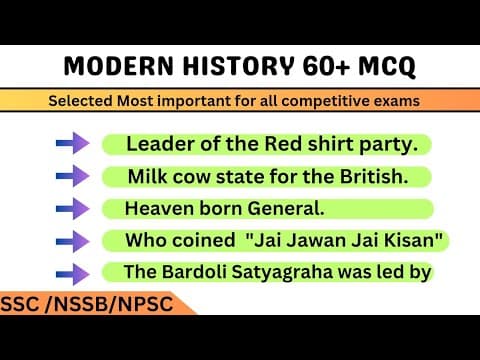
MODERN HISTORY || selected most important questions for all competitive exams.
GK Lai
16m 35s1,698 words~9 min read
YouTube auto captions
Transcript source
YouTube auto captions
This transcript was extracted from YouTube's auto-generated caption track. The transcript below is server-rendered so it can be read, searched, cited, and shared without opening the original YouTube player.
Pull quotes
[0:01]In which year did the British introduces Gregorian calendar in their dominion in India?
[0:01]who of the following led the army of East India company in the battle of Buxar in 1764.?
[0:01]Question Q.4.which building constructed in India by the British was known as White Town.?
[0:01]William Bentinck Correct answer is C.Lord Cornwallis Q.11.which one of the following states was first annexed under the Doctrine of Lapse.
Use this transcript
Related transcript hubs
Watch on YouTube
Share
MORE TRANSCRIPTS


