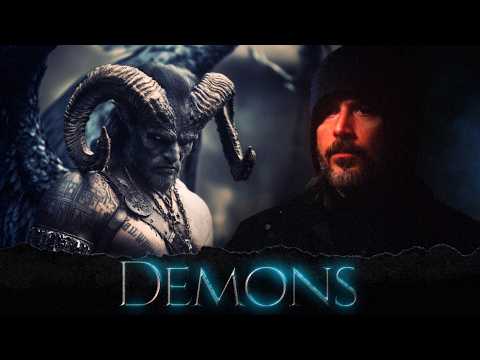
[0:00]there's this hierarchy of 72 angels and 72 demons. And each and every one of them have gifts that if you make sacrifices to, or you make particular deals to, or you're able to summon them and force them in a particular way, they will teach you wisdom, for example, or let you know secrets, or give you information about about particular individuals, or they will give you political powers, or they will do many different things.
[0:56]I seek refuge in Allah from the accursed Satan In the Name of Allah, the Abundantly Merciful, the Intensely Merciful O Allah, send Your peace and prayers upon Mohammed and the Family of Mohammed, the Imams and the Mahdis السلام عليكم ورحمة الله وبركاته، my dear sister and companion Tiffany. وعليكم السلام ورحمة الله وبركاته dear father. Thank you for joining me. Thank you so much for having me back. So today we're going to talk about a really interesting topic and that is the topic of angels and demons. Angels and demons are a mystery. uh, they're a topic that has always been uh, a fascination that mankind has had, the adherence of Judaism, Christianity, and Islam, um, in particular have always been fascinated with this topic. And other religions as well. And people that follow New Age movements, or even they are interested in the extraterrestrial or UFO phenomenon, they have made connections between these stories, um, and phenomenon that were described in the ancient books, and between the things that they are seeing today moving in the skies. So let's go over this topic together today and and explore it. Um, we know that in the Quran, in the Bible, and also in the Old Testament, uh there are these tales of these beings. I will start with angels first. Um, and these angels, uh as described uh in the holy texts, are beings that have particular jobs and they are good beings. They work um on behalf of God to carry out particular duties or functions. For example, you have the Archangel Gabriel, who is playing a particular role throughout the three religions, and that role is basically delivering the inspiration or delivering the message from God to the messenger. And so in Islam in particular, that is Gabriel's function, it's his job. Each one of the angels has a job that they are given the task or the duty of. So you have in Islam, this phrase always appearing, which is the angel who is entrusted with and it basically means that this angel, after you know his name, the next thing that you should know is what it is that he does or she does, perhaps, let's talk about that. And that's the other aspect, which is whether or not angels are male and female, or they exclusively male. But before we get into that, let's continue with the various angels, the most famous angels and their particular duties. You have another angel that appears uh in the Jewish literature as well as in the Quran, and in Christianity, and that is the angel by the name of Michael. Yes. And Michael serves as kind of like a patron angel who guards the Israelites and and is a person who or an angel that has been known to be on the side of man or be a defender of man, according to some ancient literature. He's also the angel that is in task to with bringing down the rain and making the plants grow according to some sources. You have the angel Azrael or Azrail, who is known as the angel of death. And he has the duty or the function of taking the souls out of the people at the time of death and and basically turning over those souls to Allah Subhana Wa Ta'ala. You have another angel by the name of Israfil, and people often associate him with the Archangel Raphael. And his primary function, according to literature, especially Islamic literature is that he will blow in the horn at the end times, like he's the one that blows the trumpet, you know how you have some images of an angel and he's holding a trumpet and he's kind of announcing the final hour or the end times. Israfil is that angel in Islam that blows the trumpet and by the blowing of the trumpet, the entire world of creation, according to many of the narrations, collapses and becomes destroyed. You have lesser known angels that appear in some of the narrations or some of the literature. For example, Satathail is the name of an angel who is the angel that has the task of bringing down the punishment or a torment upon, you know, upon a disbelieving people. And he makes an appearance in some narrations where there would be a prophet or a messenger that is about to get killed or skinned alive or, um, murdered by their people and then Satathail will come down and will offer that prophet. If he wants to, he will say that God sent me in order that I give you the choice whether or not you want me to destroy these people or not. So that's his task. His task is to, um, to bring down the torment or the punishment. We also know that there is an angel or a jinn that was in the form of an angel or used to be an angel or at the rank of an angel that was brought down from that rank, and his name was Azazil. Right? Yes. And the reason for that is because he used to be close to God, but then he disobeyed at one point. And so, when we look at these names, for example, we'll find that each and every one of them ends with I. and it ends with I because it is a reference to or L in English, a reference to the God of the Old Testament, which his name was I, right? Or L, who is the father of the gods, or also known as Yahweh or associated with Allah Subhana Wa Ta'ala. Yeah. These angels, uh, each and every one of their names, like it's a combination. So you have Azazil is Azizu Allah, right? Or the dear of L, or the dear of Allah Subhana Wa Ta'ala. You have Gabriel is Jabaruth Allah. So their their names are always two parts that are two words that are brought together in order to kind of reflect an aspect or a power or an attribute or a characteristic of Allah Subhana Wa Ta'ala. So these angels are kind of made out of the different names or characteristics of God. They're imbued with differing powers. They have differing tasks. And they also, um, have different amounts or different numbers of wings according to their rank uh with Allah Subhana Wa Ta'ala. So some of the narrations have mentioned that the higher angels or the more names of God that they embody or the more that they know God, right? Because they're in different ranks. Uh they they have angels that are Archangels that are really close to God. You might have angels that are Seraphim, you might have angels that are Cherubim. Uh depending on the rank in which they fall into is the number of wings that they have. And so each wing would be, for example, according to some narrations, a an additional name of Allah Subhana Wa Ta'ala that they came to know.
[10:23]Wow. That's very interesting. It is. It's interesting how the names correspond to their function with God and what quality they're reflecting. And also the fact that there's this correlation between the number of wings and the names that they've come to know. And it's also based in the scripture. I mean, it's mentioned this difference in the number of wings between like the the Cherubim and Cherubim and the Seraphim, for example. So that explains that sort of scriptural mystery as to why that is. Some angels, um, don't have necessarily the name I at the end of it. Um, we know that in Jewish sources, most of the angels either um will end with I, or will end with a. Like as in Yahweh, right? So they'll end with the A or the A to signify the last part of their name being, uh, you know, being the name of Yahweh instead of the name of I. And so that happens as well. We also have like, for example, in the name Hananya, right? That would be one of the names of the angels that would end differently than, for example, Michael or Gabriel or one of these names.
[11:44]We also have in Islamic sources, a few angels ending their names being different than than the traditional Israfil, Mikail, Azazil. Uh, for example, we have an angel that's mentioned in the traditions as being the dorman to Paradise or the guardian to Paradise. Anybody who enters into Paradise, uh through its gates, you'll find that there is an angel who stands there, who guards, who allows the people of Paradise to enter and rejects the people of hell, for example, or those who didn't deserve to go into Paradise from entering. His name is Ridwan. Okay. Yeah. So that's uh, that's a totally different name. So it's not necessarily the case that all of the names of the angels will be in that particular form, one form or another, or have God or one of the names of God as a secondary part to the name.
[12:44]Not all of the the angels as well work by their own selves. And so this is also clear from some of the narrations. So, for example, you'll have Azrael being in charge of collecting the souls at the time of death. But because there's so many people that are dying and he's in charge of all of creation, he'll have a staff, a group of angels, a legion of angels that are subservient to him, that he commands. He's the overlord of and he gives them also the task of going forth and collecting the different souls and he kind of manages or oversees the process of that matter or that event. So there's like a hierarchy and almost like a society going on within the angelic realm. Oh, absolutely. There's a there's a hierarchy and a society and there's angels that the others have to obey. And so this idea that that the higher ones are in charge of legions, this is something which is recognized and has been spoken about a lot. And we know that there are many traditions that state that, uh, for example, Azazil before he fell down, the angels used to all obey him and they used to admire him and they used to wish that they were like him. Even Michael and Gabriel used to look up to him, according to one narration, and wish that they were like him. And we know that basically there's this idea that everything that is happening in the universe above and here on Earth below, uh there's nothing that's taking place except that it is kind of being micromanaged by angels. So when we imagine angels, let me start there. When we imagine angels, we imagine what? What is the first thing that you think of when I when I say the word angel? I mean, I think we've seen a lot of artistic depictions, right? So we think of a human being with angel wings. Uh yeah, that's what I think of. Exactly. And I think that the reason why we think of human beings with angel wings is because there are so many stories about the angels interacting with mankind on a physical level and appearing to mankind in the image of man. And we have a verse from the Holy Quran that makes this a stipulation, you know? And it basically says that if we were to bring down angels, we would have made them in the image of men, and we would have made them wear what the people wear, right? So the Quran says that if we were going to bring down angels, because the people, the the the disbelievers were always debating with the Prophet Muhammad and they were asking him to show them the angels that, um, that he was speaking about. And the Quran comes out with a response that, okay, but if we were to bring down the angels, we would have brought them down in the form or the image of men, and they would have wore plain clothing. So how are you going to recognize them anyway, right? This is the type of question that it's that is posing or the response that's given by Allah Subhana Wa Ta'ala. In the Quran, it's obviously a reference to, um, the many stories that exist within Christianity and Islam of the interactions that took place between the angels and the people or the or the human beings.
[16:28]Like, for example, you have the the story of Gideon. And Gideon, when uh he was approached by an angel, the angel came to him in the image of a human being, a man. You have the story of Balaam ibn Ba'urah, when he was riding his donkey, and he was going forward to curse, um, Moses. You have the angel blocking the pathway, and he came in the form of a man. You have the individuals, the three angels that came down to Abraham and then they went to Lot. They also appeared in the image of man. In the traditions or the narrations of the Ahl al-Bayt, uh Gabriel would often appear in the image of one of the companions, whose name was Dahia. You have in the narrations of Muhammad and the family of Muhammad, uh Gabriel appearing in the image of Abul Khattab, one of the companions of Imam Sadiq. And so the angels were consistently and constantly appearing in the image of men. Even when Gabriel appeared to Mary, what happened? She becomes frightened, right? And she tells him to not approach her if he is Taqiyah. And it is later explained and have to Sharif, that Taqiyah was the name of a man who lived in her, um, you know, in that region or in that area. And she thought that Gabriel was this man named Taqiyah, and that's why she said to him, do not approach me if you are Taqiyah. Wow. I mean, yeah, you're right. Absolutely. All these stories, it's it's like they're they're undercover. They're angels of God undercover in the form of human beings. Uh and that's the test of faith that people, uh it wasn't so obvious. They weren't these human beings wearing wings. They were just appearing as normal human beings. So we learn from there that the angels can shape-shift. They can take on the form of man. That that's one of their characteristics, one of their abilities. And certainly that's why they are depicted, um, as beings that are resembling men that have wings. Wings to signify that they're not human beings fully. They're angels, right? That fly in the heavens, because birds fly in the sky. And they appear in the form of men because they can shape-shift. And that's so long as scripture has been available amongst mankind and these stories have been there. Um, they have always depicted angels as coming and interacting with human beings in the form of man. Um, we have though other depictions of these angels in their true form. Uh, we have narrations from the Prophet Muhammad as having asked Gabriel to appear to him at some point in his true form. And when Gabriel appeared to the Prophet Muhammad in his true form, the Prophet fainted or almost fainted from the terror of what it was that he saw. It was something that was so foreign to his expectations or to anything that he's ever seen before. The descriptions mentioned, uh the angel or Gabriel having hundreds of wings that were that he that, you know, was was all over his body. Uh other Jewish narrations depict the angels as having uh a more round form of being like wheels or resembling wheels. Like in the, uh, in the vision of Ezekiel, uh and that the wheels or the chariot of fire would have, uh, eyes all over it, uh or wings all over it. And so it is recognized in Judaism, Christianity and Islam that even though they take on the form or the image of mankind, that is not their original image. And that their original image is extremely terrifying and that mankind can't really handle that. Yes. Yeah. Yeah, that makes sense. Yeah. They also are not always pretty. Um, some angels are extremely ugly, even in their appearances that they make or with with with mankind. Um, so you have you have instances or narrations where, for example, the angel of death will come to the believer in a very beautiful form.
[21:17]Um, and will kind of exude this energy of of calmness and peace and beauty, right? Or will appear to him in the image of a beautiful young man or a beautiful calm old man. Uh but for the non-believer, the angel of death will appear to him in the most horrific and scary of forms. So the angels, they reflect also the attitude or the stance that God has towards that person. They act as mirrors also to the individuals. Uh if they're evil individuals, that are bad, they were more often appear to them in in a bad form. Even the narrations that speak about the angels that will question mankind after death, right? Uh they mention that those questioners at the time of death will appear to the individual who's deceased in a in a scary form. If he's somebody who's going to go to Hellfire, or in a beautiful form, if it's somebody who's going to go to heaven. Wow.
[31:36]I mean, that's that's a little bit terrifying to be honest, to think about, uh how scary that must be, uh for for the disbeliever. And also how comforting it must be for the believer. I mean, but it makes sense. It makes sense that if they have the shape shifting nature, that of course that would be reflected. So we have um the angels also appearing in different sizes, uh in the narrations. Some of the narrations have mentioned that the angels appear in a gigantic form, or a gigantic size. Um, there was one time where the Prophet Muhammad was sitting with Gabriel, and they were speaking with one another. And then all of a sudden their eyes uh are catching something in the heavens. And uh Gabriel seems terrified, and when the Prophet Muhammad asks him, what is wrong? He says that, uh, Israfil or Raphael is descending right now from the heavens. And he's never done this before, nor will he ever do it again until the day that, um, you know, the final hour comes or the end of creation comes. And so they looked and they beheld a an angel who was so vast and so huge that he blocked out him and his wings blocked out the entire sky. No matter what direction the Prophet or Gabriel looked in, all they could see is Israfil in the heavens above. And so, you have them appearing in a very gigantic form. You also have Gnostic scriptures and texts, uh describing the angels appearing in the heavens as these glowing orbs that are the same size as the stars that are up above. And so they can appear as a glowing, moving orb or star that's in the heaven above, and that's very big obviously, very large. Um, they can appear in the same size as mankind. And then you have this theme, this group of narrations that describe the angels as appearing on a kind of, uh, micro-scale. A quantum angel scale, right? Like a very small, tiny tiny angel, um, that is existing that's performing particular functions. And for example, you have one narration that states that every time that it rains, every single drop of rain has a particular angel that is accompanying that rain that has the task of delivering that drop of rain to the exact spot in which it is supposed to fall down in. And so, obviously, it's going to be an angel that is appropriate for the size of the raindrop that is falling down. And if anybody was unsure about the fact that these little micro tiny angels exist, we have a narration in which, uh, Imam Sadiq and Imam Baqir are explaining the cause behind and the reason and how the lightning and thunder take place. And so they state that the reason why the clouds move is because there is a particular angel that drags the cloud forward, right? And so the movement of the clouds, the bringing down of the rain, uh the the growth of the plant, each and every one of these things that appear to be happening naturally, uh have many angels that are involved in these acts of nature. And so, they come in very small size, as we know. Uh, and the same thing goes on the demonic side. Uh the demonic side or the Satanic side or the jinn side, it is the exact same as it is for the angels. Except it's for the bad side. You have these narrations that state basically that the angels and the jinn were working kind of on the same team. And that actually they were indistinguishable from one another. And for that reason, you have in Christian and Judeo sources, the devils are nothing more than fallen angels. Angels that ended up going the dark path or rebelling against, uh, God. Uh Muslims in general, they think that the only angel that rebelled was Iblis and that he wasn't an angel, he was a jinn. And, uh that the jinn are the ones that are against God. And then an angel has no ability to rebel against, uh, God. But I think in the book Um al-Kitab, which we've referenced on several occasions, it makes it very clear that when Iblis had rebelled in the very beginning, that he actually rebelled and he took with him a large group of angels and other beings, or creatures, if you want to call them jinn, that were convinced to rebel with him against Allah Subhana Wa Ta'ala. And when they rebelled, they kind of, uh, continued to maintain or keep those, uh, properties or those, uh, special powers until the final hour, where Allah Subhana Wa Ta'ala judges between mankind and basically causes the end of Satan and his, uh, party or his companions. So now they're utilizing their powers, uh, for, uh, evil, uh, to whisper to mankind. And you have, uh, the stories of the appearances or the apparitions of these demons, uh, in the same way, uh, as the angels are appearing for mankind. You have it written in scripture that the jinn and the Satans, when they would appear visibly amongst mankind, that they would appear in a human form. And for that reason, you have many stories and traditions where, for example, Iblis will appear as an old man to pledge allegiance to Abu Bakr at the time of the baya. Uh, you have other instances where Iblis, for example, will appear as a man to the brothers of Joseph, uh, as they were contemplating throwing him into the well. And, uh, you have, uh, in fact, they are able to, according to some of the narrations, to breed with mankind, uh, they can crossbreed with mankind and give offspring. Some of the narrations mentioned that one of the offspring of the jinn was the Queen of Sheba. And even the Jewish traditions state that when she arrived at, uh, to Solomon, after traveling to him, that Solomon had this, uh, this basically floor of his palace in a particular area, uh that was so clear that it was reflective. And it looked as if you were walking on water, but actually it was a solid surface. And so when she was getting ready to walk over towards Solomon, uh, Solomon positioned himself in such a place that she would have to cross over this particular floor. And when he glanced over at the reflection of her feet through the surface, the floor surface, he saw that she didn't have the feet of a normal woman. They were hairy feet, and they were feet that resembled the feet of a goat or, uh, an animal such. So he knew that she was, uh, not the offspring of mankind, but the offspring of one of these, uh, jinn. And so whether or not this story is true, it doesn't matter, like we're not talking specifically about that right now, but rather we just want to point out that that what the narrations have said about these particular entities. You also have stories that have mentioned that there are particular jinn that are extremely powerful and they describe them as being extremely large in size. Uh the Quran itself describes them as having the ability to dive into the waters has the ability, that they have the ability to build, uh, large structures, and that they were used by Solomon as such. So they're able to manipulate our physical reality. Uh, they're not just spirits that have no authority or ability to, uh, fix or or or build or destroy something. Uh, the narration state that they have the ability to go into people and to possess them, and they have a world that's parallel to our world. Uh, they're also known, uh, for having the ability to kidnap people and take them into their world, sometimes to be brought back, sometimes to never be brought back again. And for that reason, you have this connection that's drawn between the jinn and between the extraterrestrials, right? Extraterrestrials. Wow. That's really interesting. You have also these narrations that describe the Satans also as being very small in size, just like the angels. You have many narrations and traditions that state that every single, uh, every single hair of a human being will be one of these Satans or underneath each and every one of the mustache hairs of a person who does not clean his mustache or clean his beard, you will find one of these Satans that are residing underneath. You have narrations that describe sicknesses as being as coming from the devils themselves. And kind of really describing what we would describe in modern day terms as germs, describing the germs as being Satans or the bacteria or the viruses as being Satans or from that world of the Satans. And so they come in very small size, as we know. We have them also appearing in some sources, some Islamic traditions, as living or taking small pebbles or precious stones as homes that they can reside in. Um, they're also narrations that state that they would reside in cats or dogs, and in particular black cats or black dogs or in serpents. And so we know that they come in all shapes and sizes, uh from the small to the very large. And we also know that they have particular functions and missions, just like the angels do. Iblis commands a host of demons and devils that each and every one of them has a particular function to mislead people astray in particular ways. There's, for example, a Satan that's in charge of making people make mistakes while they're in a drunken state, or make them lust after drinking or become addicted to alcohol. You have other angels or sorry, other jinn or Satans that are in charge of musical instruments or other jinn and Satans that are in charge specifically of causing marital disputes and separating between a man and a wife. You have other jinn or Satans that basically are in charge of finding treasures or in charge of giving an individual information about the future or the past or the present. You have ones that spy on the heavens above. And so, each and every one of them has a particular function. And then you have the sciences, uh, that are developed, which, uh, is called essentially magic. Um, that Solomon used to be, uh, well versed in and many of the ancient prophets, messengers, saints, uh, sages used to know a lot about. And magic in general is not haram to learn about it. It's just haram to utilize it in a negative way or a way that would harm another human being. And the core of a particular type of magic, right, which is the real essence of it is this art of being able to summon the angels and the demons in order to carry out your bidding or to imbue you with particular qualities or traits. Uh, you have in Kabbalah this system whereby there are these, there's this hierarchy of 72 angels and 72 demons. And each and every one of them have gifts that if you make sacrifices to, or you make particular deals to, or you're able to summon them and force them in a particular way, they will teach you wisdom, for example, or let you know secrets, or give you information about about particular individuals, or they will give you political powers, or they will do many different things. And that really makes a lot of sense. Uh it makes a lot of sense in in the sense that what we're familiar with this concept of making a deal with the dark side, making a deal with the devil and through that you can, you can get powers, or you can get uh, you know, certain positions. So this makes sense. And it makes sense on the other side where uh it's it's basically a divine knowledge which enables a person to practice magic in the highest degree. So basically, Tiffany, this topic is so big, it's so vast that you could go on in it forever. That you could go on in it forever that you could go on in it forever. And there are people that spent their entire lives dedicated to gathering the names and the titles and the ranks and experimenting with summoning these differing positive and negative forces, um, and writing everything that they could and can about their conversations with these entities and, um, and the powers that they were dealing with. Um, in terms of whether or not the angels are male or female, the Quran seems to indicate that they're not females and there seems to be, uh, an instance where God takes offense, so to speak, at the very notion that the Arabs at that time were portraying the angels as being females and correcting them to note that the angels were in fact males. Other traditions, uh, indicate the opposite, uh, in regards to that. And that's something inshallah that if the people are interested in, that we can examine it more and we can talk specifically about the different angels and we can also talk more about the different demons that exist within Christianity, Judaism and Islam. And, uh, we can share more secrets with, uh, the people regarding, uh, this world of the unseen. Uh.
[46:35]That sounds amazing. I for one, am fascinated by the topic and I really appreciate everything that you've taught us today. God bless you, Tiffany. Thank you. Salam alaikum. alaikum. salaam.


