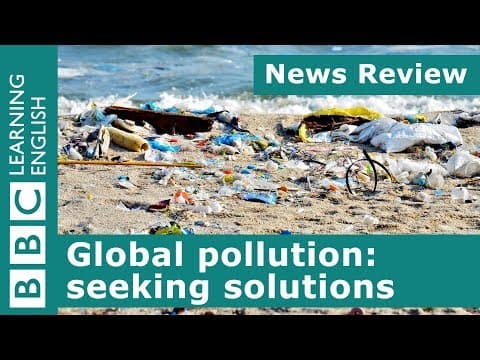
[0:00]News review from BBC Learning English. Hello and welcome to News Review, the program where we show you how to use the language from the latest news stories in your everyday English. I'm Dan and joining me today is Catherine. Hi Catherine. Hi Dan. So, what's the story? Today's story Dan is about a delegation and the environment. Delegation and the environment. Okay. Let's hear more from this BBC World Service bulletin. Environment ministers from about a hundred countries are meeting in the Kenyan capital, Nairobi, to try to finalize a declaration to combat pollution. Challenges include banning the use of toxic lead in paint and limiting the amount of plastic that finds its way into the ocean. So, ministers from around the world have gone to Nairobi in Kenya, and the reason they're there is to try to finalize an official document which has a purpose of trying to stop pollution. The issues in particular that they're talking about include things like toxic paint and plastic in the world's oceans. Wow, it sounds kind of serious. Okay. So, you've been looking around the news and the stories for three words and expressions we can use to talk about it. What have you found? Yes, I've been looking around and we have three quite serious words actually. Uh, we have Armageddon, packed, and rampant. Armageddon, packed, and rampant. Okay, can we have the first headline then please? Yes, so let's go to CBS News. The headline is U.N. environment chief warns we are facing an ocean Armageddon. Armageddon, a highly destructive event. Sounds very serious. It does. It is very serious and it has in fact a capital A, um, which indicates seriousness and it's a kind of proper noun that we call it. It comes originally from Hebrew, um, and its original meaning is in a religious context. Some people believe that um there will be a final big war between good and evil and this war will signal or will cause the end of the world as we know it. So, it's called so the word Armageddon often also is referred to as the apocalypse. Whilst we're not talking religiously necessarily here, the idea is that this will this is a really, really big potentially damaging problem. It could cause the end of the world. It certainly could cause it, well, potentially yes actually. The scientists are looking at it that way. They're using it to say this if we don't clean up the world it could actually end. So, an Armageddon describes really, really serious problem. Okay. It's quite a newsy word, very dramatic, nice and long, draws the eye, but can I use it on a kind of an everyday basis? Um, with you could use it to describe really life-changing events, divorce, death, horrible accidents. You wouldn't use it to describe spilling a cup of coffee. Okay. That would be possibly a crisis or a catastrophe. Especially if I spilled it all over the script this. That yes, would be would you say Armageddon? Probably not. Probably not. Okay, so before we cause Armageddon by not moving on to the next word, can we have our second headline please? We can. So, going to the Times of India, the headline is UN environmental entities sign pact for climate action. Pact, formal agreement. Yes, and this one comes from originally from French. It's a noun, and we use it in often in official um to describe official agreements maybe between countries, maybe between political parties, maybe between big businesses. Um a pact can also be referred to synonyms are a treaty or an alliance and it means an agreement to to do something or an agreement not to do something. Do you have any examples? Um you can have something like a non-aggression pact. You can have a political pact. Um you can have a trade pact. So, we often use it with a second word to to to form a compound. Okay. And if I'm not mistaken, you make a pack is that right? You make a pact with somebody or you make a pact to do something. The opposite if you have a pact and then um you don't keep to it, you can talk about breaking a pact. Yes, and you shouldn't break your pact down. It's very bad. I see. And is it always used in a diplomatic or official context? Uh, no, not necessarily. You can use it um in a personal level with you can make a pact with a friend, you can make a pact with a colleague. Often it's in an agreement to do something, maybe um regularly or in the future. Pact's often long-term things. That reminds me of my friend Paul and his wife Rosie. They have a pact for a no treats November. No treats November. No chocolate, no sugar in November. That sounds like a long month. Must be very long for them.
[5:21]All right, so our viewers know perfectly well that in this program we do three words, that is a packed that we have with them. So, let's not break it and we should move on to our third headline. We should. So, news 24. UN makes global bid to end rampant pollution. Rampant, increasingly out of control. Yes, and this is another word which comes originally from French. And it actually has um quite a a meaning in imagery. So, if you think of flags or often what we call coats of arms from the field of heraldry. Think of a flag which has animals on it like a lion, unicorn, sometimes horses on flags and statues. And if the animal is standing on its two back legs with its front legs in the air, we call this position rampant. Um and what it means is that animal's ready for action, ready to charge or ready to fight. Um and we use this word rampant in everyday English to describe something that is wild out of control, moving very quickly, something that you can't control. Okay is rampant. Are we talking about, we're talking about negative things here usually, right? Most definitely, yes. Disease. Yeah. Wild, I mean I saw a story this morning about wildfire in California. Oh, yes. Is it. Absolutely, if it's going, if it's destroying everything and nobody can stop it, it's rampant. We talk about crime being rampant, particular types of crime can be rampant. Um, so yeah, something that's negative, bad, destructive, and especially out of control and spreading more and more quickly. Do we always use it to describe very dangerous things such as crime? Can we use it on a kind of an everyday. Um, yeah, it doesn't have to be sort of world destruction level it can be on a personal level. If you've got like a problem with um insects in your house, maybe you've got ants in your fridge and you can't get rid of them. They're rampant. Or in my garden when I moved into where I live now, nobody had looked after the garden and the weeds were everywhere. They were rampant, took a lot of work to get rid of them. Fantastic. I mean, not the weeds, obviously, that was not fantastic for you, but thank you for the explanation. That was fantastic. Let's have a look at our Facebook challenge. I trust that our viewers have been going rampant giving their answers. So, we said an environmental meeting in Kenya has met to discuss global pollution including toxic paint and limiting ocean plastic. Which of these is not a synonym for limit? Is it a, hinder, B, inhibit, C, restrict, or D, slacken? How did they do Catherine? Did very well. We had a lot of answers almost, almost everybody got it right. The correct answer was D, slacken, does not have quite the same meaning as the other three. So, well done to Jenny Huang, Bernard Babu and Inha Kim who all got that one correct. Well done to everybody who got it correct and now Catherine, if you wouldn't mind, could you please recap the vocabulary? I can. So, we had Armageddon, a highly destructive event. Pact is a formal agreement. Rampant, increasingly out of control. Thank you. If you'd like to test yourself on today's vocabulary, there is a quiz that you can take on our website BBClearningenglish.com where you'll also find lots of other fantastic materials and videos to help you improve your English. Thank you very much for joining us and goodbye. Goodbye. News review from BBC Learning English.


