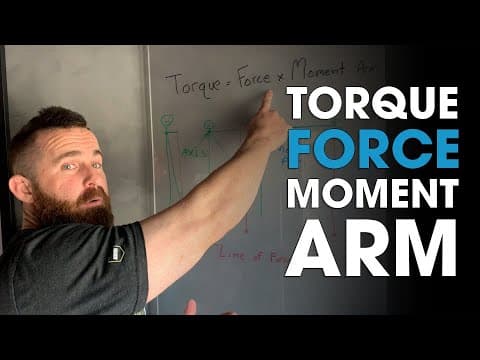
[0:03]All right guys, here we go, right into the fun stuff. Um, so I'm going to start here because uh, you'll see as I kind of go ranting along on this. Uh, I think this is the biggest, the most simple, there's times where you can get complex, absolutely. But the most overlooked and misused information that is out there when people are actually making decisions in the gym. Um, so what do muscles actually do for our intensive purposes, um, as far as training goes, there's some places where it gets a little bit more complicated. Um, like if we're talking the heart for example, um, but muscles for training purposes influence joints. And I say influence, um, because again, to keep things simple, let's just say they create motion around joints when we're, we're thinking about traditional training. I understand why motion is the first thing that people want to say too. That being said, there's times when muscles greatly influence joints and create absolutely no motion. Um, or very little motion and so obviously examples if you think about an isometric, you know, you think about somebody that's stuck on a lift. Everything in their body is unmoving at the hardest point of a lift, you know, for three seconds straight. Um, does that mean muscles aren't doing that because nothing is moving at the joints? Absolutely not. Um, so again, muscles influence joints. What do they influence and manage at joints? They influence and manage torque. Um, so people make the mistake, uh, again, of thinking that muscles directly use or move or influence weight. Um, and that is not the complete equation as this equation up here would indicate. Um, so again, all that a muscle does if we think about it using a bicep as example, or we're using the delt, we'll just stick with that exercise. That muscle crosses over a joint. If you have a weight in your hand, the muscle literally, it sounds simple, but it's not. The muscle doesn't attach uh to the weight. It just crosses over a joint and so when it contracts, it can either keep it still or it can move and influence that joint. So when you have a weight in your hand, that is just part of the equation as far as what that weight actually does at that joint. It is literally half of the equation. So we come down, and this is the, I think again, the most base and stem principle of uh making decisions with exercises and understanding things that get a lot more complex complex when we talk about muscles, you know, um, strength profile, a body's strength profile, um, and exercises. Um, your body performing an exercise, the strength profile it has performing that and then exercises resistance profile. You have to have a base understanding that almost all that comes back to torque as far as how does um our body create uh that torque and what is that actually look like at that access. And then again, what does outside forces, how does that actually express on our body and again, when we're talking muscles, when we're talking exercises, and how that is expressed at the joint. So, I say, you think about this, force, uh, for all intensive purposes for what we're talking about, is the resistance you're using in the gym. So it's dumbbells, it's cables, it's machines, whatever you want to call it. Um, I hope, I would assume this is everyone's first equation. So, does everyone understand what an equation is? And I'm not being a dick, maybe I am, but I'm going to explain it momentaril. So, does everyone know what an equation is? Okay, so force is literally only half of the equation. This is what muscles do. Think about that. That's all we care about when we say, when you think about what a muscle has to manage, like when it's working hardest, you know, how hard it's working, how much effort it has to do, you know, how hard a muscle has to pull, how much force it has to produce, it's all about torque. Torque is the thing that dictates how hard an exercise is, how hard it is at various points, that's our perception of that. So when we're trying to figure out how hard is an exercise, how much force is the muscle have to produce, we have to know both pieces of the equation. And so to come back to, is how important is each piece? You know, so which one's more important, the force or the moment arm, which we'll explain in a minute. And if this isn't your first equation, they are of equal importance. It's like literally try and figure out, let's say you're trying to figure out this number and you only know one thing over here, you literally can't solve it. You know, obviously to solve an equation like this, you need two pieces to actually be able to solve what the other piece is. So if you're trying to figure out how hard an exercise is, maybe at a given point of a range of motion, and you only understand weight, then you literally can't understand the full picture of what our muscles have to do, going through an exercise, going through a range of motion. So they literally have equal importance, and I'll go through some examples of this. If force is a billion pounds, and again, this is an extreme, stupid example, but it's you're holding a billion pound dumbbell, the first one ever Watson needed. It's a billion pound dumbbell, and the moment arm is zero, literally zero, how much torque is there? You know, a billion times zero is zero. Doesn't matter what number you put in here, if it's zero, then again, this is going to be zero. So literally, I don't care how big and how much force you have or how big your dumbbell or how much resistance is, if this is zero, then this is basically zero also. And so again, if the whole thing is we're trying to impose force upon our joints, we're trying to have them work as hard as they can. If we're doing something and spending time or doing exercises in the gym where torque is zero, that's the stem of this argument is that it's useless, it's useless. So at the same time, you wouldn't say have someone, this is people would make fun of someone doing an exercise with zero pounds. Again, even doing a lateral raise with your arm, isn't zero pounds because your arm weighs something. If you were literally doing an exercise with zero pounds, it wouldn't matter how big the moment arm, torque is always going to be zero. And again, every time that's zero, um, it's useless, uh, completely useless. And then in the muscle building world, um, everything, the simple version of it, but seems to be the most science validated version of everything, is that muscles respond to force. And they respond to an ever exceeding amount of stimulus required to hit some threshold where your body responds, adapts, and grows. So for our purposes as well too, yes, something being zero is stupid, but if you're spending time in the gym or doing exercises in the gym, where you're working, let's just say again, for how hard you're working, let's just say torque is work, how hard your muscles are working. If you're spending time in places where it is sub maximal, what your body can tolerate and what your body can produce, then that would also be a waste of time arguably. If you just keep hitting your body with the same stimulus it's ever had, why would it adapt and grow? If you're literally hitting it with a stimulus below its threshold, before the amount of below the amount of force it's capable of producing, what would be the point of that as well. So this is where again, if we're coming where, why is this all matter, why is this all important? We're, this is, this is basically the challenge on our muscle. This is how much a muscle has to work. And again, as much as weight is important, how many people keep track of their weights? How many people progress? I'm I did 95 pounds this week. I'm going to do 100 pounds next week. You know, people that do with the two and a halfs, I did 100 pounds last week, I'm doing 100.25, whatever next week. That stuff is obviously important, right? I mean, that's the whole point. That's why people logbook. That's why people keep track of things. If you have no idea about this, literally no idea, then you're missing half of what's important. And this is why literally some people can't see it logically when in the gym. I'll watch or see somebody do something like that normally what is portion of an exercise is useless. Sometimes half or more than half of an exercise, in my opinion, is a waste of time. It's creating sub maximum work on your body, torque on your body to actually have a an adaptive response and grow. So here's where we get into this is my man, so hopefully you guys can see this pretty well that is demonstrating a lateral raise. And this is I'm going to try not to go super, super deep in this, but give you guys the fact that everyone, most everyone, but it's not the case. But when you walk through it, most people, most gym goers, most trainers, do have some awareness, like this just natural common sense awareness of what a moment arm is. I understand that moment arm sounds catching and stupid, like people are trying to sound smart, but you just got to call it what it is, what it is, because you'll see, it gets very confusing. Sometimes a moment arm looks like it's something else, but if we don't call it what it is, then you'll confuse the moment arm with an actual arm or you confuse it with the distance and the length of a cable or something like that. So it's very important that we use that term just so we know what we're talking about. Um, so anyway, back to the example of this, I was saying people do have this internal knowledge of what a moment arm is. And what I mean by that is, if we're doing a lateral raise, what would you find more impressive? What would you like, people are impressed by amazing feats in the gym when people are strong, people sit back and go, holy fuck, that's impressive, that's strong. So somebody took 100 pound dumbbell and just sit here and move their arm six inches. Can't see my arm, I'm moving it right at the bottom of the range of motion. They just trained right down here. They did basically what was a dumbbell lateral partial. If they did that and they did 10 reps moving it six inches right there in that bottom range, how impressive would you find that? Not saying that doesn't have a place, I'm not saying that's bad. I'm just saying how impressive, how hard would that be? How impressive of a feet of strength would that be? Now, let's say that same person takes that 100 pound dumbbell and they do a lateral raise, six inches controlled, the exact same pace, the exact same six inches their arm is traveling at the top of a lateral raise. 100 pound dumbbell. Which would be more impressive? I'd probably stop and take pictures if I actually saw someone doing that because I've never seen anyone do that in my life. Um, so it seems silly, seems like a silly example, but again, it's 100 pound dumbbell in someone's hand, moving the exact same distance. You know, their arms, how many degrees of motion we're saying or how many inches their hand is actually traveling in space, yet people inherently know, this one would be impressive as fuck, and this one, you might see on a daily basis, it might have a place, but you wouldn't stop and take a picture of it, necessarily, you wouldn't drop your jaw. Drop your jaw.
[10:58]Um, so anyway, that's, this is the, the take home of this, what I'll get you guys understanding with moment arms. All you really need to be able to see eventually, and I'll give you, we're going to go through a bunch of examples of this, is how do you see them when you're in the gym, and that's the example of seeing it. If you, if you went through that example with me, and you understand this is really easy, this is really hard when everything else is the same, then that's you seeing a moment arm. You're understanding the purpose of knowing about moment arms. And again, this might seem simple, but it gets more complicated, and you have to start with the simple stuff before you see it everywhere else.
[11:40]So again, this blue distance is the moment arm. So again, as that dumbbell gets further away, draw that line of force. Maybe I should have said that one force. The red one is the line of force that is the force line path, basically of a dumbbell. If you imagine if I took a dumbbell from the top, and again, a dumbbell has mass, so again, that's whatever the mass is. Obviously, if you have a dumbbell in outer space, it just floats around. It doesn't produce any force, it just floats there. But when you add the acceleration that is gravity, 9.8, blah, blah, whatever, it doesn't matter, then this is the force the dumbbell would produce. If you want to see a line of force, imagine you dropped it from this height and it went straight down. The path that would go through would be the line of force. So again, as this dumbbell goes out, again, wherever that force from that dumbbell is, we just draw the line straight through, and when we're talking gravity, it's always straight down. We'll go to other examples in the future, but this goes straight down, what is the same thing, what is the closest distance this line of force is to the axis, or a 90 degree angle also. And then here, we continue the lateral raise, so this is the start of the lateral raise, the middle of the lateral raise, the end of the lateral raise. We can see the moment arm from here. So again, the axis is generally always going to be the joint you're talking about. You could eventually and we'll do this down the road, see how one resistance affects multiple joints, so a squat for example. We could draw lines of force to varying axis's. How does that line of force affect the hips? How does it affect the knees? How does it affect the ankles? How does it affect the vertebra? Um, so again, it just for simple purposes, it's good to start with a single joint and make sure you understand that first. So the axis is always going to be where we're creating torque around. Generally if we're talking about an exercise with motion, that's where everything, all the motion is occurring around, it's always a rotational type thing. It will always create an arc type path, an arc of the hand and it will create a plane, which we'll talk about down the road as well too, that it will go through. So the common sense thing all you need to see about this is the recognition of moment arms is, we could put numbers in here. Again, the numbers don't matter. It's for people that want to sound smart, but if we said this is whatever, this is 10 inches, then if we did 10 inches times 100 pounds, then it would be 1,000 foot pounds of torque at that joint. You could do it in feet, you could be foot pounds of torque, you could do it in um Newtons, or you could do it in kilograms, whatever you want. For me, it's like whatever it's like if I go here and I have small, medium, big, and I put small, medium, big, and this stays the same, then I just know this number goes from lower, medium to higher. And if I'm taking it all back to the gym, it goes, this is the easiest, this is the next hardest, and this is the hardest point of the exercise. And you got to remember, why is he saying all this, again, it might seem simple. The length of the person's arm doesn't change, the dumbbell they're using doesn't change, the only thing changing here is the moment arm. And so again, same thing if we took this out here, we want to look at the same equation, the moment arm let's say, let's just call this 1 foot, 2 feet, 3 feet, made up, doesn't matter, but this stays 3 feet. Now, we change the dumbbell, the same thing occurs. So again, if it was 3 feet, and we're holding a 30 pound dumbbell, it's hard, a 20 pound dumbbell would be easier, a 10 pound dumbbell would be even easier. In this case, the moment arm would be staying the same, all the other things would be staying the same, the line of force, the direction of the force, obviously, the length of the person's arm stays the same. Um, but this case, the weight, the force from the weight would change the amount at torque. Um, so again, bringing this back home a little bit, you guys have seen, and I can draw some more of this stuff. This will be something we'll get into and get into specific exercises. So why the hell does this matter? Well, if I'm choosing to go into a gym, and I'm choosing to do an exercise, and we won't even talk too much about an ex an individual muscles profile. But if I'm choosing to do an exercise, do I want the exercise I'm I'm going into a gym, and I'm saying, hey, I'm going to move my arm here. Are you moving for the sake of moving? No, because you could do this without a weight. And you're like, okay, well, I'm just going to do this without a weight and I'm going to get jacked. And people like, well, that's fucking stupid. And it's like, okay, well, I'm going to do this with a weight then because what do I want? I want to work hard and I want my muscle to grow. Okay, I want to work hard, I want to use that weight to create torque and make my muscle work hard. Well, what have we really learned from this exercise? Where does your muscle work hard? Sure as fuck doesn't work hard down here. It works kind of hard here, and it works absolutely the hardest at this point. So let's say you've been working with, this is how people when you just start, any stimulus will grow. Any amount of work or challenge to a muscle can make you grow. But at some point in time, I need the, I need a constantly elevating level of challenge. I need a constantly elevating level of torque and again, corresponding force production for my muscle to keep producing that uh stimulus, to keep producing that level of growth. So what am I doing if I'm in the gym, I'm moving my arm through 90 degrees and it gets mediumly hard. Mediumly getting too times if it's somewhere after the first 45 degrees, and in reality, the last little bit, the last 10, 15 degrees is only really you're at maximum challenge um for that point of that exercise. So this is why again, based off of this basic understanding, we'll get into this because I don't want to get too complicated. But this is why I prefer like a lying cable uh lateral raise, or why I prefer a good machine lateral raise. It's because the line of force being different, and we'll draw that out so it makes more sense, but you know, from kind of a common sense standpoint, at the moment arm doesn't have this drastic difference from one point to the other, at least not from where you're weak to strong. And so I can make the exercise challenging, appropriately challenge through the entire range. So again, if I can go in the gym and I can move my arm 90 degrees, or I can move my arm 90 degrees, I can do one with a dumbbell, and it's only going to be hard for 15-ish degrees of it. Or if I set up a cable properly, I can make it challenge through the entire 90 degrees range of motion. Again, for me, this is the overwhelming biggest opportunity for people to improve or to grow in the gym. Is the way I look at it, is this is only challenging for 15 degrees. This person is wasting 75, um 75 degrees of that range, so whatever percentage is that, probably 80% of the range is being wasted or under stimulus or under challenge. They're basically just moving in the gym for the sake of moving and not necessarily putting an adaptive challenge on that muscle for the range of motion that it's going through. So again, someone will say, well, I'm not necessarily saying, kind of saying lateral raise is a bad exercise. But the reality is, it will it be enough to produce stimulus or results for someone at some point in time? Yes. All that is a matter is, is the stimulus, the challenge that we're putting on the muscle, adequate to produce a change. And as you get further and further on in advanced athletes and especially crack them at bodybuilding, people look at the magic diet, they look at the magic drug. And in my opinion, they might be wasting 80% of an exercise just with bad exercise selection. So again, this is the stuff I want you guys to start thinking about. It's not necessarily that this is bad, what is the application? Now, if you got Miss Jones that just needs to get some stimulus on her delts and she's not trying to get the biggest delts on the entire planet, lateral raise isn't a horrible exercise. We're just getting some contractions there, we're getting some stimulus there. It might be enough for her to adapt and put on a little bit of muscle, get a little bit more metabolic output, or whatever it is, her goals are, and it's fine. But again, if you got Mr. Olympia trying to get his delts bigger and he's still doing this exercise, it may be an opportunity where this is not the most efficient exercise for you. Excuse me. So, hopefully that makes sense. This is your first crash course into torque, which again, is what it is all about as far as what muscles, what they do, what challenges we're trying to impose upon them. And what the two massive components of equal importance make up. And again, I make the joke. Is everybody tracks this with their logbook, but nobody has any fucking idea about this. It just doesn't make any sense to me. And this is where people will just kind of do things based off of habit, based off of historically occurring, where if you really understand this principle, at some point in time, like when I do dumbbell lateral raises, I'm just like, I can't help now be like, why the hell am I doing this? And we'll get into examples again, too. What a dumbbell lateral raises, just done in that challenging portion makes sense. I'd argue that would be a place that it would make more sense. So somewhere it could make sense somewhere within the workout for someone, for sure. So this is your crash course. This is an easy example. I've obviously got some places we're going to go with this. We're going to go through a couple of different examples where it's a different bit of a challenge, couple different examples where we're looking at multiple joints involved. And then once we have a firm grasp of that, then we'll start to talk about in more depth what I kind of hinted at here, where can you have a better exercise? And ultimately, that's where exercise selection comes to, is your goal, and this is the tip of the iceberg, is to make the strength profile of an exercise. So again, this is the profile that really easy to think profile of a lateral raises, easy, medium, hard. That's the profile. Now, we just want to find an exercise. So that's the profile of this exercise. Your body in general can produce a good amount of force from here and just a little bit less at the top. So basically, it's the opposite. It's going to get complicated.
[23:41]But the long-term goal is we want to make sure that the exercise that we're choosing to do, matches what our body can do. So that's really what it all stems down to for exercise selection, at least as far as profiles are concerned, is matching your body's strength profile with an exercises resistance profile, and it really just comes down to efficiency, no wasted range of motion in the gym. So there we go, guys. Let me know how that is. Let me know if it makes sense. Um, and uh, we'll keep cranking away on these as we go. Hope you guys enjoy.


