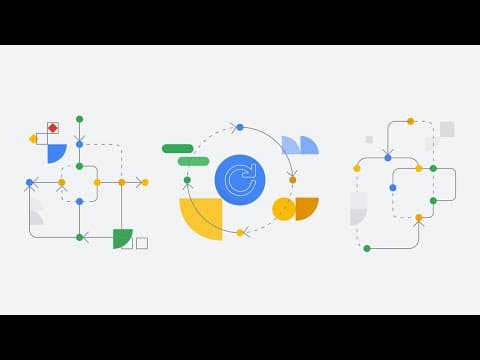
[0:00]AI agents are designed to observe, act, and achieve goals. While AI agents utilize models, they represent a significantly beyond their capabilities. Agents incorporate two key elements that distinguish them from standalone models: a reasoning loop and tools. The reasoning loop is the agent's thinking process. It's a continuous cycle of observing, interpreting, planning, and acting. This iterative process enables agents to analyze situations, plan actions, and adapt based on outcomes. Tools are functionalities that allow the agent to interact with its environment. Tools can be anything from accessing and processing data to interacting with software applications or even physical robots. This empowers agents to connect with real world information and services much like apps on our phones. For example, an agent could use tools to access and update a company's inventory, schedule meetings by checking calendars, automatically order new supplies when stock is low, or even communicate with a robot sensors and actuators. By combining reasoning and tools, AI agents transcend the limitations of large language models or LLMs. They move beyond text generation to solve complex problems, manage multi-step tasks, and produce results beyond just text or media. When solving complex problems, agents analyze information, gather data using tools, and make informed decisions with minimal human intervention. And when managing multi-step tasks, agents excel at complex workflows that LLMs alone can't handle, such as conducting in-depth research, troubleshooting code, and automating tasks across multiple systems. The reasoning loop is the heart of an AI agent's operation. It's an iterative process where the agent observes, gathers information about its environment and the task at hand. It interprets, processes the information and assesses the current situation. It plans, plans a course of action to achieve its goal, and it acts, executes the planned action. This loop continues until the agent reaches its goal or a stopping point. The complexity of the loop varies depending on the agent and its task. Some agents have simple rule-based processes, where others have more complex logic, potentially involving additional algorithms or probabilistic reasoning.
Gen AI agents: Beyond just models
Google Cloud
2m 43s339 words~2 min read
YouTube auto captions
Transcript source
YouTube auto captions
This transcript was extracted from YouTube's auto-generated caption track. The transcript below is server-rendered so it can be read, searched, cited, and shared without opening the original YouTube player.
Pull quotes
[0:00]While AI agents utilize models, they represent a significantly beyond their capabilities.
[0:00]Agents incorporate two key elements that distinguish them from standalone models: a reasoning loop and tools.
[0:00]This iterative process enables agents to analyze situations, plan actions, and adapt based on outcomes.
[0:00]Tools are functionalities that allow the agent to interact with its environment.
Use this transcript
Related transcript hubs
Watch on YouTube
Share
MORE TRANSCRIPTS


