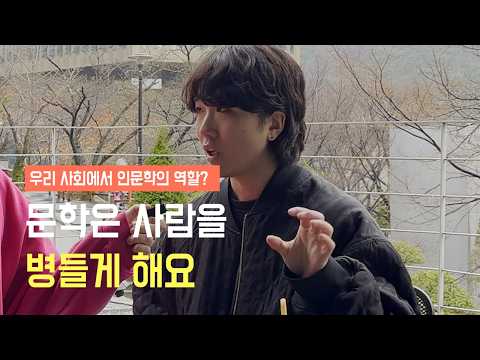
[0:00]If the humanities were deemed obsolete and humanities majors were eliminated from all universities, what do you think South Korea would look like? I don't think it would change right away because the humanities are not really about practical knowledge so I don't think it would change right now, but over a long period of time, when it accumulates, then something would happen There won't be any cultural heritage or anything and we won't be able to deal with the fact that China is copying us I don't think it's going to get to the point where my country becomes extremely bad, but I mean, for example, when we sentence people in court, there's actually a philosophical logic behind it Because if we say that human beings don't have free will, that they move according to determinism, then there's no basis for punishing criminals so the humanities continue to influence the foundation of social institutions and legal things in that way, so I can imagine that after a long time without the humanities at some point, all of those things are being treated as temporary solutions, as repairs 그 정도로 상상해 볼 수 있을 것 같아요. Can you introduce yourself first? I'm Myeonghwan Kim, a fourth-year undergraduate majoring in Korean Language and Literature with a minor in Political Economy and Philosophy at Seoul National University. Why did you choose that major? I initially chose Korean Language and Literature because I thought it would be interesting, and more importantly, because I'm still studying it I was in a class recently and my professor said something that really stuck with me: literature doesn't heal people, it makes them sick The first thing that came to my mind when I heard that was, "Then why do literature? Why do I have to get sick?" 이런 생각이 드는데 But when I went home and thought about it, I realized that it's not so much that it makes people sick who are otherwise fine, but rather that there are people in this world who are sick in so many different ways and who are more sensitive to that sickness, and doing literature is a process of getting closer to that realm So this is actually something that I have to be very uncomfortable with in a way, and it's something that I don't have to do, but I think there is some meaning in doing this and I want to think more about how we can go through a sick world together, 좀 더 고민을 하고 싶어요. so this is something that I feel a lot when I major in Korean language and literature, especially literature, and that's why I continue to do this major with love Okay. But I'm going to be a little bit aggressive because this is a video Okay, that's okay! I want more people to see it, and I've heard some people say that literature is useless, especially as an example, so what are your thoughts on that? First of all, I've been thinking about this question a lot since I was about 20 years old, and I think that the question of literature being useless is actually a double resistance that literature is doing First of all, it's trying to prove that it's useful Literature is supposed to elevate our sensibilities and help us emotionally and build certain intellectual and cognitive skills And I think all of those things are partly true, but I also think that the attempt to do that may fail at some point because I think it's closer to the essence of literature to question and think, "What is the use when you say literature is useless?" because I think that's where literature really has value For example, does it feed you? No, it doesn't Does literature make money? No, it doesn't But why is that, why do we need money? We need money, for example, to be happy So are we happy enough in this process of chasing money? And is it best for us to make money this way, to prove our abilities this way, to get a job this way, and are there people who are suffering and getting hurt in the process? And I think that's what literature is for me, to ask these questions and to make us reflect, so I would say yes to the proposition that literature is useless, but I would also say that the dividing line between what's usable and what's not is actually kind of set by society to a certain extent, and literature is trying to make a crack in that, and I think that's the extent of my answer Okay. So would you recommend the major to others? I wouldn't recommend it to others yeah... Basically, it's hard to get a job that everybody talks about, so I think the only thing you can actually do with this major is to be a professor or lecturer, but unless you're really at that level, it's hard to move on to a job where you can actually realize the values that you've learned from studying literature Because every job has such practical demands, and if you try to meet the demands, there will be a point where you have to compromise with reality, and once you get that sick through literature, you can't go back But now I wish there were more people who do literature, but when someone who is very close and dear to me says that they want to do it, I might want to discourage them a little bit So if you had the chance to choose your major again, what would you choose? I think I'd stay with Korean Language and Literature, because I think what I'm struggling with is that I can handle it, and if you put it in terms of being sick, it comes down to something negative, but actually, in terms of learning things that I didn't know, I've definitely gotten cognitively elevated in my studies, so if you asked me to choose again now, I don't think I'd want to throw away all that I've gained and go to another major Okay. So do you have any thoughts of going to graduate school after you graduate? I was originally, I was planning on it, but now I'm just starting to prepare for my administrative exams, so I guess I'm a little bit far away from graduate school What made you decide to do that? I think it was the uncertainty of life, or should I say vulnerability, because that was the biggest thing that was holding me back, because even if I want to be a professor, even if I do (graduate school), it doesn't mean that I can do it with ability, but I have to have a T.O. (professor job opening), and the situation in the humanities is not so good, so no matter how competent I am, there might not be an opportunity at all, and then I would have to live my life with an unstable income, and can I afford to give up that? So that's why I'm looking at something different now Okay. So if you had gone to grad school, is there anything you would have wanted to study in this area? I wasn't a student who always had a specific area of research, so I was more of a student who just dutifully followed the topics that my teachers picked for me in school, but if I were to talk about areas rather than areas that I became interested in along the way, it would be the ideas of people in a certain time period or environment or background For example, in the 1920s, there was a collection of letters called "The Flame of Love" by Nozayoung, which is a collection of fictional letters, and it's about a guy who saw a girl performing on stage and fell in love with her and wrote a letter to her and said, "I'm so uncontrollable with my feelings for you right now that I'm going to drink lye and die" to someone he'd never met in person And it became a best-seller I mean, this is not something that makes sense to our current sensibilities It's kind of creepy, it's kind of scary, but people were really into it then, and I thought, "Why is that?" And then there's this whole process of awakening to the idea of the individual, this awakening process, this romanticism, and it's interesting to me that love seems like such a visceral thing, but it's also really culturally coded and socially constructed When I compare my own thoughts to those of people in a different time and place than me, how much of it comes from the 'authentic me'? How much of it is infiltrated by social and cultural influences? thought it was interesting to think about these topics and how it's not just me, but a lot of people in general So we're going to try to imagine something a little bit extreme, If the humanities were deemed obsolete and humanities majors were eliminated from all universities, what do you think South Korea would look like? I don't think it would change right away because the humanities are not really about practical knowledge so I don't think it would change right now, but over a long period of time, when it accumulates, then something would happen There won't be any cultural heritage or anything and we won't be able to deal with the fact that China is copying us I don't think it's going to get to the point where my country becomes extremely bad, but I mean, for example, when we sentence people in court, there's actually a philosophical logic behind it Because if we say that human beings don't have free will, that they move according to determinism, then there's no basis for punishing criminals so the humanities continue to influence the foundation of social institutions and legal things in that way, so I can imagine that after a long time without the humanities at some point, all of those things are being treated as temporary solutions, as repairs I think it's really good. So, have you had any difficulties with the practicalities of studying the humanities? Of course there is, Yes, there is Making money And as I've gotten older, which I didn't always have, I've started to worry about what do I have to offer? A little bit of that So, do you think Korea is a good place to study the humanities? I haven't been out of the country, but I don't think Korea is completely hostile to the humanities institutionally There are scholarships and grants in place, but the social atmosphere seems to think of the humanities as a something that Confucius did this, Mencius did that and the Joseon Neo-Confucian scholar who ruined the country, or something for people with money or people who are comfortable, so it's true that those who have money do it, but those who have money do it for fun, so I think the opposite force is at work in that respect Okay, So let's go to the next question, What do you think a good humanities student looks like? I think a good humanities person is someone who doesn't wield the humanities as a weapon, and I don't think anyone should do that, but especially if you're a humanities person You know, what do you know about Plato, What do you know about feminism, and so on, and I don't think it's good to use that knowledge to attack other people or to criticize them too much Instead, I think that people who study the humanities are people who are constantly mastering how to read and write words accurately, so even if someone says something or makes an argument that is a little bit misleading, I think that a good humanities student is someone who thinks about the meaning behind it or what is the real balue that can be found here and tries to discover it Okay. So there are some harsh words like people who study humanities don't understand the concept of money, what do you think about those words? I don't think it's wrong because the humanities aren't really about money, and obviously people who have studied money better know more bout money, but I would say that if the intention behind that statement is a disrespect for people who study the humanities, it's because they have different values Because I'm not going to say, "Well, if you're good at economics, you're not good at the humanities" because I'm not saying that, so I think the reason I keep studying the humanities is because I want to be a good father I want the people I love to be happy for personal reasons because I want to be happy and I want the people I love to be happy and I want the people I love to be happy That's very cool Thank you very much
[12:41]That's very cool Thank you very much Okay. then do you think people should read books? No, I mean books are a medium, and there was a time in history where you could only get information through books, and we're not in that time, but if you ask me, is it useful to read books in your life, yes, it's useful, because in a lot of the environments that we work in, we still work in writing, and we still communicate in writing even when we're sending a KakaoTalk message, so in that sense, yes, I think it's necessary to read books, but if someone is not really pursuing things like I just want to be smart or I want to be wise, I'm not sure why they need to read books I love it, then Some people say that self-improvement books and essays don't mean anything and you shouldn't read them, how do you think about that sentence? If I think I need it, I can read it but I don't read self-improvement books Do you have a reason for that? I think a lot of self-improvement books are the kind of books that make me feel more hustled, and I don't want to be hustled into conforming to society's standards I want to be hustled into questioning those standards, and self-improvement books are books that assume that those things are a given, so for that reason I don't read self-improvement books Okay. So can you recommend any of your favorite books? I don't like the term 'favorite book', so I'll just tell you a book that I read recently that really impressed me, and it's called A Defense for the Disenfranchised, and it's about disability rights, and if I just summarize it like that, it might not make you feel like you want to read it, because it's like a world away from me, However, the title is a defense for the disqualified, and this disqualified does not include only people with disabilities I think it's a book that would be good to read a little overlapping with a certain sense of minority, minority sense I think every human being is a minority to some extent, the most typical one is that we all age and become old, so in that sense, we are all potential minorities, and for example, I'm short, so I may feel unattractive to potential romantic partners, so it's a book that encompasses all of these things with a sense of minority So one of the things that really struck me in the book was the part about the right to pee, and it's part of this act of inventing rights, and author talks about this thing called the right to pee, and why it's a right to pee is because if you're on a date with someone who's really attractive, and there's not an accessible handicapped restroom nearby, and you have to hold it in, and you feel like you're not really human, I think that these aspects of humanity that we take for granted can be very unnatural to someone else, and we all have moments where we feel very inadequate, and I think it's just that the clerk at the cafe just tsked at me, and I can feel humiliated in that moment, and I think that reading these experiences overlaid on top of each other gave me a little bit of perspective on a holistic life that is not all-encompassing in the name of rights That's great, and what did you learn from your time at Seoul National University? Actually, I only went to Seoul National University, so I can't compare it to other universities and say, "This is better," but I think a lot of people, not just me, would say that the best thing about Seoul National University is the people No matter what field I want to go to, there are people who have already done something in that field, and there are wonderful people in this university for very different reasons, so if I think about it a little more broadly, no matter what I want to do, any resources, people are a little bit difficult to express as resources, but resources are always everywhere and easy to find Even if I fail in my studies, there are a lot of books in the library, I can get quality lectures from professors, and even if I'm not interested in studying and I'm interested in employment, I think the biggest advantage is that I can form a network with people in that field That's great, So is there anything else you'd like to talk about? Do you mind if we end the video like this? Yes, yes, If you don't mind editing it Oh, the editing! I'm totally fine with that! Then we'll end the video like this!


