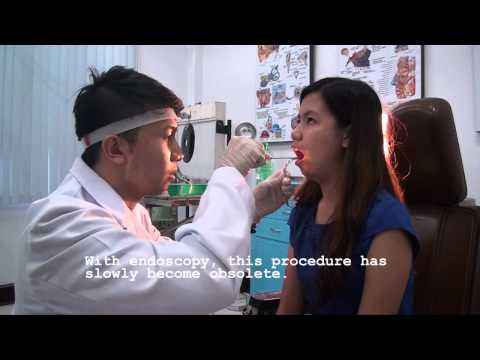
[0:15]A 24-year-old female patient comes in with a chief complaint of nasal congestion. After establishing rapport, obtain a complete and thorough patient history. After, a basic ear, nose and throat exam can now be done.
[0:34]Have the patient sit in a comfortable and upright position. Examine the ear through inspection and palpation of the Oracle and its surroundings. Observe shape, color, swelling, masses, deformities, skin lesions, or discharge. Check if the patient has tragal tenderness. Do this for both ears. Otoscopy must be done with proper handling of the otoscope. Hold the pina and gently rotate the oracle backward and upward. This straightens the ear canal. The speculum is inserted slowly into the canal without touching bone. Inspect the ear canal and all quadrants of the tympanic membrane. Note cerumen, color, lesions, or foreign body. Perform otoscopy on both ears. Tests for hearing acuity. In Weber test, the tuning fork is placed on the vertex or forehead of the skull. Vibrations perceived are compared between left and right ears. In Rene test, the base of the tuning fork is placed against the mastoid bone. The patient is asked to perceive the vibration and note when it disappears. The tuning fork is quickly placed just outside the ear canal.
[1:49]Inspect the external nose. Note shape, symmetry, color and patency of the nasal alley. The paranasal sinuses, frontal, sphenoid, ethmoid, and maxillary must be palpated. Check for tenderness over these areas. Palpate for discontinuities, mobility or signs of fracture. Evaluate the nasal vestibule and anterior nasal cavity using anterior rhinoscopy. Make sure your head mirror and light source are properly placed to provide adequate lighting. With the patient in a sniffing position, hold the speculum properly while bracing with your index finger. The speculum is inserted with blades closed and carefully withdrawn with blades slightly open. Avoid discomforting the patient at all times.
[2:42]Examination of the oral cavity first requires a septic and sanitary precautions. Adequate light must also be available. Begin by inspecting the lips with mouth closed. Note symmetry, color and surface condition. Ask if the patient has dentures before examining the oral cavity. With the mouth partially open, insert a tongue blade to depress the tongue. Inspect the pallets, buccal mucosa, gingiva, teeth and tongue. The patient maneuvers the tongue to assess its dorsal and lateral aspects, the floor of the mouth, and the tongue's rotation and limitation of movement. If inspection reveals changes, the affected region or structure should be palpated, using a gloved finger to assess consistency and depth. Posterior rhinoscopy may be done to assess the nasal pharynx and posterior nasal cavity. The tongue is carefully depressed and then a pre-warmed mirror is introduced between the soft palette and posterior pharyngeal wall. Indirect examination of the larynx is performed with a laryngeal mirror. The examiner grasps the protruded tongue with gauze and pulls the tongue forward. Advance the mirror beneath the palette to the uvula. Lift the uvula with the back of the mirror. Then push it backward and upward. Have the patient say "e" to assess laryngeal function. Evaluate the tongue base, oropharynx, and hypopharynx.
[4:10]With the patient upright and slightly forward, inspect the neck for its symmetry, midline structures, color, and deformities. Palpate the cervical lymph nodes in a tracing manner. Note the preauricular, posterior auricular, jugulodigastric, submandibular, submental, superior cervical, posterior cervical, supraclavicular, and deep cervical lymph nodes. Palpate in a tracing manner and note for size, consistency, and mobility. Assess the thyroid gland. Lightly palpate for the isthmus and lateral lobes. Ask the patient to swallow and see if the thyroid moves with the glutination. Thorough history taking and proper physical examination will ensure correct diagnosis and management of your patient. Knowledge of these procedures and maneuvers will help you become better healthcare providers.


