[0:00]Now, the long-lasting and powerful influence childhood has had on one writer, Jeffrey Brown has his latest addition to the NewsHour bookshelf. Imagination and memory, tools Amy Tan is mined since her hugely successful debut in 1989 with the novel, The Joy Luck Club, followed by five other novels, two children's books and more. In her fiction, she's written of mothers and daughters and the Chinese-American experience. Now she explores just where the writing comes from in a new book titled, Where the Past Begins, a writer's memoir. And welcome to you. Good to be here. You actually call this an unintended memoir. When did you realize that's what you were actually doing? I was going to write a book about writing, you know, how does my mind work, how does my writer's mind work, creativity, imagination. And it wasn't until I started writing things spontaneously and seeing that they kept reverting to what it happened to me in childhood. that it became more of a memoir. One of the things that comes through in the book is as you're pulling out documents and looking at photographs, each one is clearly a story connecting to you as a storyteller, right? It was finding out that my father and mother were illegal, and that's why my parents had lied on a form. Or it was finding out that I wasn't my father's favorite. Things that were traumatic in a way, you know, to discover at this age that you were lied to. And then I went into the reasons why, and who I became. And that became part of the memoir. But it also had to do with my sensibility as a writer. But your mother, of course, stands out as the most, I guess, vivid, uh, person in your life. And she was always looking sort of living in the past in a way. She hid that past, but it always kind of snuck up in different warnings that she gave me like, um, you know, don't, don't let a man kiss you or don't let a boy kiss you, and then you'll end up pregnant and you'll kill the baby and then, I mean, you know, not knowing where that came from and realizing later she was married to a, a sociopath. Not my father, but somebody else. You know, in her life in China. Yeah, and then the past then was always present in our lives. I found, you know, unearthing all these things. One of the, I found poignant things about our relationship. The letters she wrote to me and the letters I wrote to her. I had always thought that we were apart, and what I realized in writing this that we were almost dangerously like symbiotic twins. that there was a almost a pathological need to be within each other's feelings and to understand each other. Which then I realized became part of my skills as a writer. You have to empathize with the characters. You have to have sympathy for them. Well, you know, I was I was almost wondering as I was reading, obviously these are real people in your life, but as you're going back and looking, to what extent are they characters? Because you're a writer who writes characters. They were never characters. No. It was like going back into my past and being that kid again, and this is my mother and my father, and I'm in that scene again, where my mother and brothers and I are in the car. My mother's in the front seat. Something's going on between my mother and father, and I can I notice everything that's going on. I tell myself to be strong. My mother is about to commit suicide, and I know she's going to do it, and then she opens the door and her foot is out. I was there again, reliving something that I had pushed out of my mind a long time ago. She did not. I mean, She didn't kill herself. No, no, but this was the the threat. It was a constant because she actually tried a number of times. We couldn't ever dismiss it. It always made us quake. I've seen your fiction referred to as semi-autobiographical. Is that is that fair? Is that true? Everybody's everybody's novel is semi-autobiographical. I mean, you have questions or the way you think of life or the kind of people you think are interesting or not interesting. People who have impacted your life and made you who you are. That's who you put in your story. So they're all autobiographical. People say it's autobiographical even if I've written about a ghost. There are ghosts in your past, right? I mean, from the from the family, I mean they're they're as much alive as some of the real people. They're always with me. When I'm writing, what often happens is are strange coincidences and then I think these are the clues. It's like a little thing I have to follow and I keep following them. More coincidences. I'm on the right track, and then I find something that is shocking, that maybe my grandmother was a courtesan. You know, my mother had been in jail. All of these things come together and they make sense. Fiction makes those things happen faster because I let myself go. And I'm not as self-conscious, but all of the things from the past, they somehow rise up when you let go and, um, say it's fiction. You used to, uh, praise and criticism for the fiction. Does this feel different putting this out into the world, this slice of your your real self? Yeah, you know, I wrote this thing so spontaneously and I didn't get to edit it in the way that I wanted and it feels very raw. It feels, um, too new. So it's not criticism about the writing so much is about privacy and misinterpretation of who I am. And it's almost as though I can't bear to hear people talking about me. But you're the one who put it out there about your yourself, right? I know. It's a contradiction. It's a contradiction I have in myself to to be very private and then I write about privacy. I'm uncensored in a way and, um, I'm contradictory as a writer. So I'm very ambivalent about this book. It's out there. I told my editor, I hate it. It's too early to be out there. I'm still the kid. I haven't grown up yet. All right. Well, it's out there and it's called where the past begins, a writer's memoir. Amy Tan, thank you very much. Thank you.
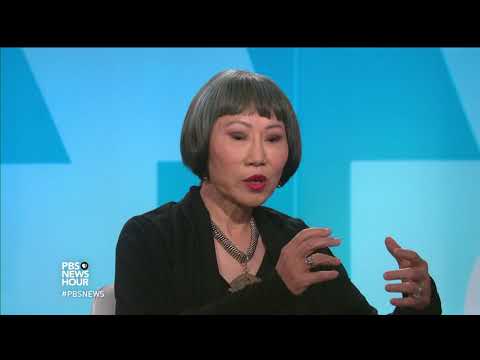
How Amy Tan’s family stories made her a storyteller
PBS NewsHour
6m 52s1,118 words~6 min read
YouTube auto captions
Transcript source
YouTube auto captions
This transcript was extracted from YouTube's auto-generated caption track. The transcript below is server-rendered so it can be read, searched, cited, and shared without opening the original YouTube player.
Pull quotes
[0:00]Now, the long-lasting and powerful influence childhood has had on one writer, Jeffrey Brown has his latest addition to the NewsHour bookshelf.
[0:00]Imagination and memory, tools Amy Tan is mined since her hugely successful debut in 1989 with the novel, The Joy Luck Club, followed by five other novels, two children's books and more.
[0:00]In her fiction, she's written of mothers and daughters and the Chinese-American experience.
[0:00]Now she explores just where the writing comes from in a new book titled, Where the Past Begins, a writer's memoir.
Use this transcript
Related transcript hubs
Watch on YouTube
Share
MORE TRANSCRIPTS


