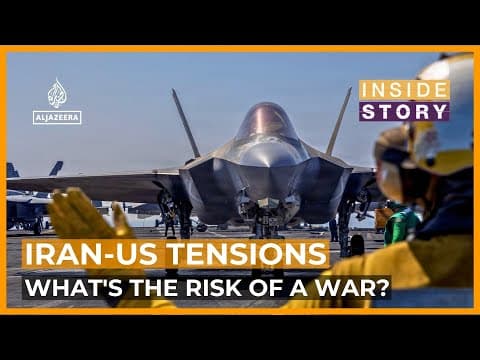
[0:01]More talks planned for Thursday between Iran and the US, which is mobilizing its largest military force since the invasion of Iraq more than two decades ago.
[0:11]Mixed messages from US President Donald Trump, while Tehran says it wants talks but is ready for war, too.
[0:17]So where do both sides stand? This is Inside Story.
[0:36]Hello again, I'm James Baize. The US and Iran gear up for more talks on Thursday with mixed messages from both sides as the world anxiously wonders what's next.
[0:47]Iran says it wants talks but is ready for war if they fail.
[0:50]US President Donald Trump is apparently surprised Iran hasn't capitulated.
[0:55]He's deployed the biggest military force the US has assembled in the Middle East since the invasion of Iraq in 2003.
[1:03]At the center of the build up is the aircraft carrier the USS Abraham Lincoln with fighter jets including FA-18s and F-35s as well as electronic warfare aircraft.
[1:15]It's supported by several guided missile destroyers operating in the Gulf of Oman and nearby waters.
[1:21]A second strike group is on its way, the USS Gerald R Ford is currently crossing the Mediterranean flanked by three destroyers.
[1:29]Flight tracking data also shows a surge in activity with multiple squadrons of attack aircraft, refueling tankers, cargo and surveillance planes moving between the US, Europe and the Middle East.
[1:42]All of this is well within range of Iran's extensive arsenal of weaponry.
[1:46]Its medium-range ballistic missiles can travel around 2,000 km capable of reaching targets in Israel, as well as American bases in Turkey and across the Gulf.
[1:57]So what does this military and diplomatic choreography signal? Are the talks meaningful negotiations or just a side show?
[2:05]Why would the US assemble such firepower if it doesn't intend to use it, and how might Iran respond?
[2:10]We'll talk to our panel of guests in just a few moments, but first this report from Alexandra Byers.
[2:17]The American war machine is assembling in the Middle East, while Iranian forces are testing air defense missiles and holding naval drills with Russia.
[2:27]All ahead of another round of indirect talk about Iran's nuclear program, set to be held in Geneva on Thursday.
[2:37]Tehran insists a diplomatic solution is possible, and the President is framing the negotiations so far as encouraging, posting on social media.
[2:46]Iran is committed to peace and stability in the region.
[2:50]He noted the latest discussions included the exchange of practical proposals and yielded encouraging signals.
[2:58]He went on to say, Toran continues to monitor US actions closely and has made all necessary preparations for any potential scenario.
[3:08]The US President has repeatedly threatened escalation to force a deal.
[3:13]Iran's nuclear program has long been the core issue for Washington and the West.
[3:18]But added to that now is its crackdown on anti-government protesters last month, which led to more sanctions.
[3:27]For 47 years they've been talking and talking and talking.
[3:31]And in the meantime, we've lost a lot of lives while they talk and legs blown off, arms blown off, faces blown off.
[3:38]It's been going on for a long time, so let's see what happens.
[3:42]In the meantime, we have, in the meantime, we have tremendous power has arrived and additional power, as you know, another carrier is going out shortly.
[3:51]So we'll see it out if we could get it settled for once and for all, that'd be good.
[3:55]But Tehran has made it clear it will not give into pressure and will defend itself.
[4:01]I think there is no limited strike.
[4:04]An act of aggression would be regarded as an act of aggression period.
[4:11]And any state would react to an act of aggression as part of its inherent right of self-defense ferociously.
[4:22]So that's what we would do. The US special envoy involved in the negotiations admitted President Trump thought the military build-up would have pushed Iran to concede by now.
[4:33]He's curious as to why they haven't, I don't want to use the word capitulated, but why they haven't capitulated.
[4:41]Why under this sort of pressure with the amount of seapower, naval power that we have over there, why they haven't come to us and said, we profess that we don't want to be, we don't want a weapon.
[4:54]So here's what we're prepared to do, and yet it's hard to to sort of get them to that place.
[4:58]At the heart of the talks is enriched uranium.
[5:01]Iran wants enough for civilian, not military purposes.
[5:06]The US and Israel want zero enrichment.
[5:09]Both sides believe they hold leverage, but the stakes are incredibly high.
[5:14]Even limited strikes could engulf the region, with energy supply routes and global markets hanging in the balance.
[5:22]Alexandra Byers, Al Jazeera, for Inside Story.
[5:30]Well, let's discuss all of this with our panel of guests joining us on today's inside story.
[5:36]We have Jamal Abdi, President of the National Iranian American Council, he joins us from Washington DC.
[5:43]In Tehran, Hassan Amadian is assistant professor at the University of Tehran, and also in Washington DC, Richard Weitz is senior fellow at the NATO Defense College.
[5:55]Thank you all three of you for joining us. Well, as you heard there, Richard in our intro, two simultaneous things are going on.
[6:02]A great big military build-up, absolutely vast.
[6:07]In fact, we talk about an Armada, but there are two aircraft carriers, each surrounded by lots of ships, you could in fact say it's a double Armada that is, that the US is, is gathering there.
[6:17]At the same time there is diplomacy ongoing, more talks taking place on Thursday.
[6:24]Which of those two tracks, the military or the diplomatic in your view, Richard has the upper hand right now?
[6:30]Right, I don't see them necessarily as conflictual, uh, in the sense that President Trump's uh view, uh having the military deployments could actually facilitate the diplomatic track.
[6:47]Um, I think, you know, President Trump would prefer a negotiated settlement, uh, and he certainly engaged in a variety of of of contacts, uh, primarily through the direct talks, but also indirectly through various intermediaries.
[7:00]And then the military forces uh give him a bunch of uh options uh if he wants to employ them, but I still think the focus for now is on the diplomatic track with the military forces in the background.
[7:17]Hassan, um when we do this game of working out what's going to happen, it's it's a mug's game really in the Middle East because it's such a combustible region with so many moving parts.
[7:29]Let me ask you the question a different way, how worried are people in Tehran right now about what might happen?
[7:36]Well, people are concerned with uh all the deployments into the region.
[7:44]Uh, the Iranians see what is going on rather differently from what was just described.
[7:50]Uh, the Armada as they call it is part of a uh capitulation effort that was talked about by Steve Whitkoff just yesterday.
[8:00]Uh, they want to force Iran to capitulation.
[8:04]That's how the Iranians understood it and obviously what the envoy said reinforces that message.
[8:15]And that's why the Iranian uh uh view and posture is mirroring that of the United States in that Iranians are talking diplomacy and preferring diplomacy but at the same time are showing their strength, projecting power, trying to keep the US forces at bay in in talks.
[8:31]So uh they're also backing their diplomatic effort with what they have as uh military equipments and uh military might.
[8:39]Jamal, of course, in some ways, you could argue we've seen some of this before because there were negotiations taking place um last year uh between the US and Iran.
[8:50]And then of course, while those negotiations were taking place, with more talks planned um in fact on the 15th of June there were supposed to be talks in Muscat, uh the capital of Oman.
[9:02]Two days before that, Israel attacked and the US clearly knew about that.
[9:05]Do you think this time the US is negotiating in good faith?
[9:12]That's a that's a really good question.
[9:15]Um I think that this time it's more clear and transparent what Donald Trump's view of negotiations uh truly is, and it's one that uh focuses pretty intensely on the coercive element of it.
[9:31]Uh, I do think though that uh, I think Donald Trump is sort of a gambler here who has doubled and tripled down on uh what really was a bluff and was not intended to be something that committed the United States to a open-ended war with Iran.
[9:47]I think that uh Trump must be concerned that there's really no sort of low-risk, cheap option here, uh to strike Iran and then quickly get out and not be committed to some long-term uh potentially long-term uh military uh exchange.
[10:00]And so I I think that uh Trump and the Trump administration, uh just as the Iranians have a lot of interest here in finding some way to get to a deal because the military alternative, I don't think has been very well thought out.
[10:14]Uh, and I think that if they have to go in that direction, it's going to be a major investment of of time, resources, uh human capital, not to mention political capital for the administration.
[10:25]Richard, are we even seeing the language of diplomacy?
[10:28]Hassan was referring a moment ago to uh recent comments in an interview by Steve Whitkoff, Trump's one of Trump's lead negotiators in this, saying Trump is curious that the Iranians haven't yet capitulated.
[10:43]But shouldn't they be negotiating, not talking about surrender?
[10:47]I think in practice they are negotiating according to the Media sources, there are variety of proposals under discussion.
[11:03]Um, it's I mean, I think we understand the issues in contention, they're primarily related to Iran's nuclear program.
[11:06]And there are three core issues here. It's how much enrichment should take place in Iran itself.
[11:13]What to do with the uranium that Iran has already enriched, and what kind of transparency measures should be in force to monitor any Iranians, any Iranian nuclear activities going forward?
[11:31]And so those three issues, you can think of a variety of tradeoffs, some can be addressed immediately, some earlier.
[11:38]There are other issues that have been raised, Iran's missile program, ties with proxies, treatment of protesters, and so on.
[11:46]But I think the core is going to, at least in the near term, will be the nuclear issues and and I think there're still discussions about various options there.
[11:57]Jamal, is it that clear-cut? Because I mean, I've been trying to read what the US position is, what the US desired outcome is, and different people in the administration seem to, as they did last year, say different things.
[12:12]Is it um Trump has said repeatedly Iran can never have a nuclear weapon, and Iran says it doesn't want a nuclear weapon.
[12:19]But is there position clearly no enrichment?
[12:23]No, and that's really a big problem with the President's diplomatic efforts, uh, in his second term.
[12:30]Uh, I don't think that the last round of negotiations that preceded the June strikes, uh, were ones in which the United States had a clear position until uh near the end of those talks, uh, when the military uh adventure broke out.
[12:44]Um, and you as you note, Donald Trump has always said no nuclear weapons, that's sort of ambiguous, but I think, uh, people who are trying to look at things, uh, glass half full, uh, people who, you know, hope for a deal, thought that that was, uh, sort of ambiguous enough that it left room for a creative solution that maybe did not, uh, cross the Iranian red line of zero enrichment, uh, but satisfied some of the skeptics of the JCPOA, uh, that Iran wouldn't be able to break out.
[13:17]Since then, this zero enrichment position has somewhat hardened uh politically in the United States, uh that came as Republicans in Congress uh sent multiple letters, sort of demanding that the administration maintain this position.
[13:31]Uh, and so I still think it's in flux, but there's uh sort of two parallel uh processes happening.
[13:38]There's sort of the process, um that is being run by, you know, bureaucrats and technocrats and sort of the uh political machinations of Washington around what diplomacy needs to look like from a Republican president.
[13:52]And then there's the Trump process, which is a little bit more make it up as you go along, uh and spitball.
[13:59]Uh, and so perhaps somewhere between those two processes, there is actually a solution here.
[14:05]But when you are hearing on one hand about sort of ambiguous but uh, you know, ambiguous goals about bottom lines like the nuclear program, and the other hand, you hear people talking about the need for Iran not just to prove that its nuclear program is not, uh, for military purposes, but potentially has to limit its ballistic missile uh distance, potentially has to eliminate support for proxies in the region.
[14:29]Uh, then you get into this territory where I think it's very hard to imagine that the United States is uh negotiating from a position of good faith because those are big, unwieldy challenges that need serious negotiations uh to to ever potentially unpack.
[14:46]And what we have here is sort of this gunboat uh, we want a fast answer negotiation, and so I think that is a much more favorable scenario for a simple solution that is more of a compromise and is only focus on the nuclear issue versus this broad comprehensive deal that I think people who don't actually want a deal are saying must be what is on the table.
[15:05]Hassan, perhaps you could give us clearly what the Iranian position is on enrichment.
[15:11]I think I'm right in saying, Iran says that under at the 1970 non-proliferation treaty uh that every country has a right to enrich.
[15:23]And I also think Iran is worried about the Libya model, what happened in 2003 uh when the Libyan leader Gaddafi gave up uh all his nuclear program, and of course, only a few years later was attacked by NATO and and and found himself uh you know, deposed and killed soon after.
[15:46]Well, incremental escalation against uh uh its foe has been one US policy for decades now.
[15:53]And of course, that's in the back of the heads of many Iranian strategists here.
[16:00]But at this point, uh as as Jamal, I think it explained quite well, the Iranian view is that we don't have a clear uh uh position on the part of the United States.
[16:11]We uh articulated a position that is focused on the nuclear and brought it to the table as the Iranian diplomats are saying, but at the same time, we hear different voices from the US team.
[16:25]Uh one time, it's uh no bomb policy, another, it's no enrichment, uh and voices about Iran's ballistic missiles, uh ballistic missiles program, its regional policy, its foreign policy, et cetera.
[16:40]So it's it's the the fluctuation there is really frustrating.
[16:45]You don't have a clear position on the other side.
[16:48]But when it comes to Iran, it's clear. We we will trade transparency and limits as it is said by many Iranian officials for sanctions relief, and that was done back in 2015.
[17:01]Iran has shown that it's not willing to go for weaponization and it expects for returned sanctions relief.
[17:10]That's the, you know, the the the entirety of the Iranian position.
[17:14]The the mismatch with the American position which fluctuates is really something that troubled the previous discussions, the five rounds that preceded the war, and now it's troubling it again because every time, as we hear from diplomats here, every time the US team comes to the room, they're as if that we didn't have discussions before.
[17:37]It's reset, and that's frustrating, and it's really impeding progress.
[17:44]Richard, um, by some estimates, 40 to 50% of deployable US air power is now directed towards Iran.
[17:53]Does that tell you anything about the timeline for this? Because one assumes you can't just keep all those forces there indefinitely?
[18:23]Well, there isn't an urgent imperative in the military sense, I would disagree with you there because, uh, at the, you know, as discussed, Iran is not going to get a nuclear weapon soon.
[18:50]It's missile and other forces have been weakened by the June war and will not soon be rebuilt.
[18:59]Um, and there's not another security crisis.
[19:04]So if, you know, if there look like China was going to invade Taiwan or something else, uh, which would force a timeline, need to reposition the US forces at some point, that might drive it.
[19:10]But President Trump showed a lot of patience in Venezuela, keeping large numbers of forces there for for months.
[19:28]Um, I think, you know, given the importance of the the issue and the fact that the advisers to the President are giving diverse views, which we discussed, I think it's really going to take a decision by President Trump, uh, on what he wants.
[19:40]And that to be, uh, will reflect what's given to him by his advisors, what we get from the Iranians in the next few days, and I think then once he reads a decision, it'll be focusing on implementation.
[19:57]And that may be easier, you know, we've been discussing this problem for 20 years, there a lot of creative solutions, uh about not multilateral enrichment, uh multilateral discussions to deal with some of the missile and proxy issues, bring in the GCC states, so, so there's a lot of um material out there that we can draw on. They're just needs to be a decision about what is going to be the joint goal that two sides want, and then we'll find the execution should be not as difficult as perhaps previous rounds. Jamal, as Richard says, all sorts of ideas have been floating around, enrichment outside the country, some sort of consortium of regional countries doing the enrichment.
[20:08]Those don't seem to be acceptable to Iran. Iran's coming up with its own plan.
[20:14]Um the senior security official Ali Larajani is presenting something we understand very, very soon.
[20:20]But my question is, what do you think President Trump will accept?
[20:25]And it's got to be something that looks very different from the 2015 deal, which he said was an awful deal.
[20:32]Yeah, I I really I of all the unpredictable uh characters and issues, it's Donald Trump and the Iran nuclear issue.
[20:41]So predicting what he will accept is probably pretty difficult.
[20:46]Um, I know that, you know, what the discussions are, at least publicly is that there um is a proposal for Iran to have a token level of enrichment.
[20:56]So under the JCPOA, Iran was allowed to enrich up to 3% and eventually, uh, increase its enrichment levels.
[21:05]Uh, you know, what's being talked about is something like 1.5%, which would satisfy the Iranian concern about maintaining this fundamental right to enrichment.
[21:14]But whether that actually addresses the concerns of the United States and Israel uh about just Iran having a capability to enrich, uh is really pretty uncertain.
[21:26]And I think that um, one of the features of these talks that may be actually is an asset to getting a deal is the fact that Iran is not currently, as far as we know, currently enriching uranium.
[21:39]Uh because of the June war, uh Iran's stockpile is likely buried under, you know, a mountain of rubble.
[21:46]Uh this for the parties at the table could be useful to be able to say, okay, we're going to continue to not enrich, uh for some time period and then have a token level of enrichment, uh so that Iran has that right, but then you're for Trump, you have something that Obama was not, uh, did not obtain through his talks, which is some sort of suspension of enrichment.
[22:10]I don't know if that's on the table or if it's even possible, but there are new dynamics here that I think allow the parties to find ways to potentially, uh, satisfy their their bottom lines, and it is really a question for Trump, is is no enrichment, uh, his bottom line?
[22:25]Because if it is, this has been a position that has prevented the United States from resolving this issue for many years, and it wasn't until Obama uh came in and said, we're actually going to compromise on that one issue.
[22:38]That is what unlocked the JCPOA and unlocked the ability for the parties to reach a deal.
[22:42]So if Trump is able to do that, I think that there are kind of a multitude of ways to sort of satisfy the Iranian bottom line, but also uh satisfy American concerns about weaponization and ensuring that Iran does not have a path to weaponization.
[22:56]Hassan, you'll be aware that President Trump um came into office with a campaign saying he didn't want to fight any more foreign wars, and yet you've got this massive build-up of military air power and naval power um just off the coast of Iran.
[23:13]Um perhaps Trump emboldened by what happened last year, but also Venezuela.
[23:20]I mean, let me ask you this question, is there a Venezuela model, um in this that Trump might try to remove the Ayatollah and keep the government in Tehran, and would that ever work?
[23:34]Well, I think they've tried it already many times in the past few decades.
[23:39]I don't think that would work because Iran's military and security apparatuses have been acting independently for five decades.
[23:48]They uh we don't have American boots on on or presence in in the country, uh and we don't have Israeli presence.
[23:56]I mean, of course, spies might be, but uh presence in the sense of uh official presence as the companies were in Venezuela for instance.
[24:06]They weren't here. I don't think I don't think the Iranian political system is that weak for uh that model to work.
[24:15]I can give you many reasons why I think so, but I mean it's it's it's basically uh uh it's not really comparable in my mind.
[24:25]It but but generally what concerns the Iranians is not that model.
[24:30]It concerns them that this con this basically uh uh standoff can escalate into a conflict.
[24:37]They prefer diplomacy, but they are not willing to uh give everything for that sake.
[24:44]They want diplomacy to work in a given take away, not in a capitulation way, and it boils down really to whether the United States wants a no bomb policy in vis-à-vis Iran or it wants all Israeli priorities in Iran.
[25:05]If the latter is the case, I'm afraid there won't be a deal and we are up for a confrontation, and that's the most uh concerning thing, not really the Venezuela model or any other model in Iran.
[25:16]Richard, um, by some estimates, 40 to 50% of deployable US air power is now directed towards Iran.
[25:24]Does that tell you anything about the timeline for this? Because one assumes you can't just keep all those forces there indefinitely?
[25:35]Well, there isn't an urgent imperative in the military sense, I would disagree with you there because, uh, at the, you know, as discussed, Iran does not going to get a nuclear weapon soon.
[25:50]Its missile and other forces have been weakened by the June war and will not soon be rebuilt.
[25:58]Um, and there's not another security crisis.
[26:05]So if, you know, if there look like China was going to invade Taiwan or something else, uh, which would force a timeline, need to reposition the US forces at some point, that might drive it.
[26:15]But President Trump showed a lot of patience in Venezuela, keeping large numbers of forces there for for months.
[26:24]Um, I think that he can take time to see to see the negotiation process go further and it doesn't need to execute an urgent military operation.
[26:34]Um, that said, there are a number of forces there, he has a lot of military options and he can implement them fairly quickly if he decides it's necessary, but I don't think he's made that decision yet.
[26:46]Thank you very much, Richard, thank you to our guests today, Richard Weitz, Hassan Amadian and Jamal Abdi.
[26:53]For more background context and analysis on this story, check out our website Aljazeera.com.
[26:58]We'd like to know what you think too, post your comments on our Facebook page, that's facebook.com/AJInsideStory, or you can find us on X just look for @AJInsideStory.
[27:08]For now, that's it from me James Baize, from the team here in Doha.
[27:12]Stay safe and well, bye bye for now.


