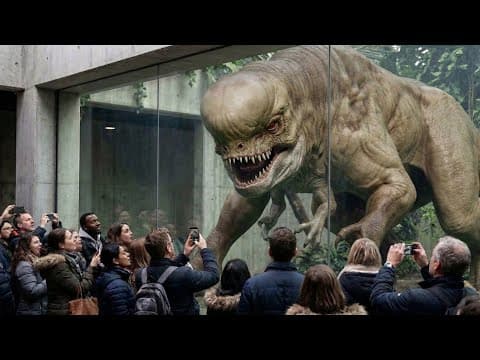
[0:02]Hey guys, it's D. I snuck into a real Jurassic Zoo and what I saw was insane, but it ended in the biggest tragedy you won't believe.
[0:13]You can literally see his legs. It's just a costume. One adult ticket.
[0:40]Titanosaurs were the largest land animals ever, with some like Patagotitan growing up to 122 feet long. Titanosaurs lived about a hundred million years ago. They were herbivores and could grow over 30 meters long. Baby Titanosaurs hatched from eggs about the size of a football. They hatch from relatively small eggs compared to their adult size. From day one, they are independent and start moving almost immediately. They grew very fast, Lords. They're herbivore, so they only eat plants. Even as babies, they start feeding on vegetation right away. Their body temperature was closer to mammals than reptiles, helping them grow faster and stay active. Is this restricted area? Spinosaurus was a patient shoreline hunter, standing still like a giant heron before striking fish in seconds. Dense bones helped them swim. They stayed near water. Babies likely stayed close for safety. Some evidence suggests it may have protected its young and guided them in water. It was an opportunistic feeder, eating fish, small animals, and scavenging meat. It could be highly territorial, chasing anything that entered its river zone. Its tail worked like a paddle, unlike any other large dinosaur. Did you hear that? Probably nothing. Its huge sail and crest were likely used to show off, attract mates, or scare rivals. Stay on the path. Got it.
[2:20]Spinosaurus lived around 20 to 30 years on average. It spent most of its time in water. With eyes and nostrils high on its head, it was a smart ambush predator hiding in water. Its partner died recently. That's why it's alone. Yes, it's been staying here since. Look, big one. Hey. Hi. Pterosaurs were not dinosaurs. They were flying reptiles and the first vertebrates to achieve powered flight. Ancient dragonflies like Meganura had wing spans up to about 70 cm. They grew that large because oxygen levels were higher back then. Look up there. Yeah.
[3:14]This habitat copies ancient river systems, natural light, real plants, stable water flow. Feels real. Some giant pterosaurs like Quetzalcoatlus had wind spans up to 33 feet. Compsognathus was very small, about the size of a chicken. It likely ate insects and small animals. Keep moving. Stay together. Look at this place. Are we close? Yeah, just ahead. Let's go inside. Wait, look at that dome. Some small feather dinosaurs likely had wings mainly for balance and display, not full flight. Its teeth constantly replaced themselves.
[4:09]Stay behind the rail. No feeding, no sudden moves. Got it.
[4:33]This way, please. Head toward the seating area. Keep moving forward.
[4:55]It's right above us. So big. Baby mosasaurs were born live, not from eggs. They could swim immediately. Newborn mosasaurs likely weighed just a few kilograms. They were already strong swimmers at birth. Slow, steady. They grab, not chase.
[5:32]T-Rex had one of the strongest bite forces ever. T-Rex footprints could be over 1 meter long.
[5:56]Stay still, let them focus.
[6:07]It's a feathered dinosaur, very close to early birds. Birds actually evolved from dinosaurs like this.
[6:19]Stay behind the rail. Do not cross the barrier. Okay. T-Rex average lifespan was about 25 to 30 years. A T-Rex egg is estimated to weigh around 3 to 5 kg.
[6:44]Ammonites went extinct with the dinosaurs about 66 million years ago. Their spiral shells followed precise mathematical patterns. Stay together. All instructions. Authorized access only. Do not cross the barrier.
[7:08]This is a baby T-Rex. They are not always this cute. This is believed to be the very first Distortus Rex experiment, an early stage hatchling still in controlled incubation. Distortus Rex was an early failed hybrid experiment created by Ingen. This species often had instability due to its deformities. Distortus was one of the earliest unstable hybrid experiments. Its extra limbs are a result of severe genetic mutation. Restricted containment zone. Access limited to authorized personnel only. This specimen is classified as failed experiment 5. Unlike earlier attempts, it was not abandoned and kept under observation. Distortus moves in an ape-like gate due to its enlarged forelimbs, a rare mutation not seen in natural theropods.
[8:02]Welcome aboard, please watch your step. Okay, sweetie, hold my hand. Thank you. Enjoy the ride.


