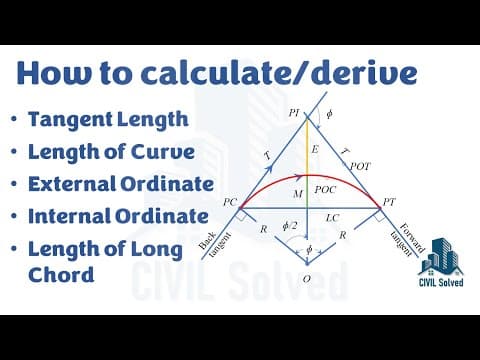
[0:00]Hello everyone. In this video, we are going to discuss that how we can calculate the tangent length, long cord, external ordinate, middle ordinate, and length of a simple circular highway curve, when the basic data of the curve is given to us. So let's discuss about the tangent length of simple circular highway curve first. Recalling the basic sketch of the simple circular curve, we know that this is the deflection angle, the angle that is being substanded between the back and forward tangent. And from the basics of the geometry, we know that the central angle substanded by the curve will also be the deflection angle. And if we draw a exactly vertical line between point O and PI, then this total deflection angle can be divided into the two half of the deflection angle. So this tangent length should be calculated when the basic data of the simple circular curve should be given like radius and deflection angle. So this tangent length can be calculated by considering this right angle triangle, the one which is being shown with the red line, O, PC, PI, O. So considering this right angle triangle, this tangent length is actually the perpendicular of this right angle triangle. And the another thing that we know, which is actually the radius, is the base. So we are going to use a trigonometr relationship that contains perpendicular and base, and we all know that it's 10. So 10 phi by 2 would be equal to perpendicular upon base. So t over R. So by cross multiplying, then we will be having the relationship of tangent length in terms of radius and deflection angle of the simple circular curve. So this is the basic equation of calculating the tangent length. Now, let's discuss how we can calculate the long cord of simple circular highway curve when we know the basic data of the simple circular curve. Recalling the same sketch of the simple circular curve. So this is the long cord I'm talking about, the distance between PC to PT. So this distance can be calculated by considering this right angle triangle, the one which is being shown in the red line. So in this right angle triangle, if we can calculate this side, that is actually half of the long cord. So then multiplying two with this side, we can have the length of the long cord length. So considering this right angle triangle, where perpendicular is required and hypouse is radius. So we are going to use a relationship that contains perpendicular and hypouse, and we all know that is sign. So sin phi by 2 would be equal to the required side divided by the radius. So then the required side would be equal to R sin phi by 2. Now that is one side. So multiplying this side with the two, we can have the length of the long cord. And again, you can see that the the formula of the wrong cord is in terms of radius and the deflection angle. So these two are the basic data, and if we know them, then we can calculate the long cord of the simple circular highway curve. Now, the next distance, external ordinate. Recalling the same sketch, external ordinate is actually the distance from PI up to the mid of the simple circular curve, the one which is being shown with the yellow line. Again, we need to have the relationship of external ordinate in such a way that the the variable should be radius and the deflection angle. And we know that the distance from center of the curve to the mid point of the curve would be the radius. So then by considering this right angle triangle, the same that we have considered for the tangent length, we can have a relationship for the external ordinate. So considering the same right angle triangle, and in this right angle triangle, base is radius, and hypouse is combination of external ordinate and radius. So now we are going to use a relationship that contains base and hypouse, and that is cos. So cos 5 by 2 would be equal to R over E plus R. Simplifying further, as we want to calculate E, so keeping E on one side and sending the other term on the right hand side,
[4:32]and simplifying further. Now, cos 5 by 2 is multiplied here, and if we want to shift on the other side, so we need to divide it on the right hand side. So simplifying further, then we will be having the relationship for the external ordinate in this way. And we know that one upon cos is actually equal to sec. So external ordinate can further be simplified as Again, in this relationship, we can see that external ordinate is in terms of radius and deflection angle. So if we know both of them, then we can calculate the external ordinate. Moving on for the next distance, that is the mid ordinate. And recalling the same escape, mid ordinate can be seen in the sketch with the yellow line, and that is the distance from the mid of the long cord to the mid of the curve. So we want to calculate this distance. And we know that the distance from center to any point on the curve would be the radius, and at the mid of the curve will also be the radius. So again, using the right angle triangle that we have used in long cord, this right angle triangle I'm talking about, we can calculate mid ordinate. So considering this right angle triangle, where now this side is required, which is actually the base of this right angle triangle. So base and hypouse, so that is cos. So cos 5 by 2 is equal to the required side over. And by cross multiplying, then the required side would be R cos 5 by 2. And from this geometry, we know that the radius it comprises of middle ordinate plus this base of this right angle triangle. So the base of the right angle triangle has been now calculated. Now, then the middle ordinate would be then the difference of radius and the base of this right angle triangle. So now putting the value of this unknown side in this equation of middle ordinate. And simplifying further, we will be having the equation for the middle ordinate. Again, in terms of radius and deflection angle. Moving on to the last distance, which is the length of the simple circular curve. Now, length of the simple circular curve, which is actually the distance from PC to PT measured along the curve. So, as we know that this is actually a part of a circle. And we know the basic formula to calculate the length of any segment of a curve if we know the central angle substanded by that curve. So the formula for that is L is equal to R phi, radius of the curve and the central angle substanded by that curve. But the angle in this case is in radian. So we need to convert into the degree. So from the basics, we know that pi radian is equal to 180°. Then by converting this radian into degree, then the formula for the length of the curve would be pi R phi over 180. And again, we can see the equation contains two variables, which are radius and deflection angle. So if we know the basic data, radius and deflection angle of the curve, then we can calculate tangent length, long cord, external ordinate, middle ordinate, and also the length of the simple circular curve.
[7:50]So this is all from this video. I hope you have understood the concept behind calculating the different lengths in a simple circular curve. Thank you for watching this video.


