[0:13]Welcome, everybody. My name is John Rodriguez. I'm an instructor with the Miami-Dade Fire Academy. This video will go over the first responder patient assessment overview. The patient assessment will be further explained in class in more detail. So the way it's going to start, the instructor is going to give you a scenario or a complaint of a patient. The first part in the patient assessment is the scene size up. You have to verbalize BSI Scene Safe, which stands for Body Substance Isolation and Scene Safety. For BSI, our minimum precautions are going to be a pair of gloves. We're going to be protecting ourselves from bodily fluids. Next is scene safety. We're looking out for suspects, weapons, vicious animals or any sort of hazards that could be happening on the scene. Next, the instructor will give you the general impression. It's going to be information regarding the call. It could be a lot of information or a little bit of information. It's going to be the number, the location of the patients, the age, the gender and the position. A general overview of the call. Based on that information, we're moving along. You're going to tell the instructor if it's an M.O.I. or an N.O.I. M.O.I. stands for Mechanism of Injury, which is a trauma call. Nature of illness is going to be a medical call. Continuing on, at that point, you're going to tell the instructor, am I holding C spine or not? That's when we're protecting the cervical spine of the patient. They could be lying supine, sitting down or standing up. We'll still hold C spine if it's an M.O.I. At this point we're going to call for additional resources, which is 9-1-1, because they're ultimately going to need a higher level of care. Additional resources could also include a hazmat team, TRT, or the police officers to ensure that our scene is safe. Next, we're finally going to be approaching our patient. As we approach our patient, we're doing a quick scan from head to toe looking for life threatening injuries. The two life threatening injuries we are looking for is an arterial bleed, which is bright red spurting blood, or if the patient is not breathing because they could not be breathing and still have a pulse. At this point, we're assessing our patient's mental status. We use an acronym called AVPU, which stands for Alert, Verbal, Pain, and Unresponsive. We're trying to figure out what kind of stimulus they're responding to. Now we're going to be asking our patient's questions. We use AAOX4, it's alert, awake and oriented times person, place, time and event. Now, we're going to be moving on to our initial assessment. We're going to be checking the ABCs of the patient, which stand for airway, breathing, circulation. We're also going to add D and E, which is for disabilities and exposure. For airway, we're checking if our patient's airway is patent or obstructed. If it's good or if it's bad, at any point in our AVPU or AAOX4. If the person is speaking to us, we know their airway is patent. If not, we have to do further investigating. We'll either do a head tilt chin lift if it's an N.O.I., or we'll do a jaw thrust if it's an M.O.I. Now we're going to be assessing their breathing. We're assessing the rate, rhythm and quality of that person's breathing by either visualizing chest rise and fall or feeling for chest rise and fall on the patient. We're going to be doing that for 15 seconds and multiplying it by four. Moving on to circulation. If the person is responsive and they're awake, we're checking a radial pulse. If they're unresponsive, we're going to be checking for a carotid pulse. Once again, we're going to be doing this for 15 seconds multiplying by four, because all of our vital signs, we want to do over a minute. If they're breathing or the circulation is irregular, then we have to assess that vital sign for the complete minute. We're also next going to be looking for a blood pressure. Normally a first responder, you're just walking around the street and you don't have a blood pressure cuff on you. A little trick you could use, or the street method would be, if you feel a radial pulse, you know that their blood pressure is at least 80 or above. Next, we're going to be assessing the color, moisture, and temperature of the patient's skin. After that, we're moving on to cap refill time. That's when you squeeze the bed of the fingernail and you release, and you're looking for that fingernail to return back to its normal color, at less than two seconds. After that, we're going to be assessing the pupils. When we assess pupils, we use an acronym called PEARRL. It stands for Pupils, Equal and Round, Reactive to Light. Next we're moving on to our disabilities. For this, we're looking if the patient's having a stroke or not. For that we use a acronym called FAST. Facial droop, arm drift, slurred speech and time last seen normal. Finally, we're moving on to exposing our patient. We're looking for D.C.A.P.B.T.L.S., which stands for deformities, contusions, abrasions, punctures, burns, tenderness, laceration, and swelling. If it's an M.O.I., we're going to expose that patient completely. If it's a nature of illness, we're only going to expose what's appropriate. Now, moving on to our secondary assessment. We're going to start by doing a detailed head to toe, which is going to be explained to you guys further in a different video. Now we need a medical history on this patient. We're going to use an acronym called S.A.M.P.L.E. It stands for Signs and Symptoms, Allergies, Medications, Past Medical History, Last Oral Intake, and Events Leading To. You do this assessment by simply asking these patients those questions. Finally, we're going to evaluate and we're going to treat our patient. We're going to reassess and reassure them. When we reassess our patient, we're going to start from the mental status down to the vital signs. Thank you guys for watching this video. My name is Instructor John Rodriguez. I'm with the Miami-Dade Fire College.
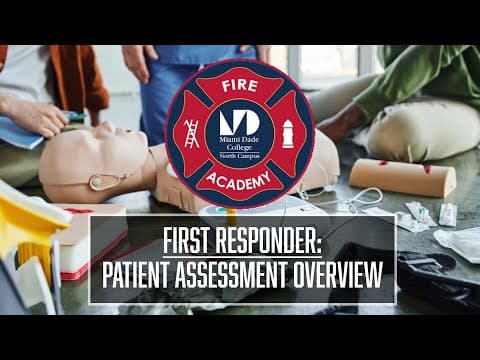
First Responder: Patient Assessment Overview
Miami Dade College Fire Academy
5m 36s1,044 words~6 min read
Auto-Generated
Watch on YouTube
Share
MORE TRANSCRIPTS