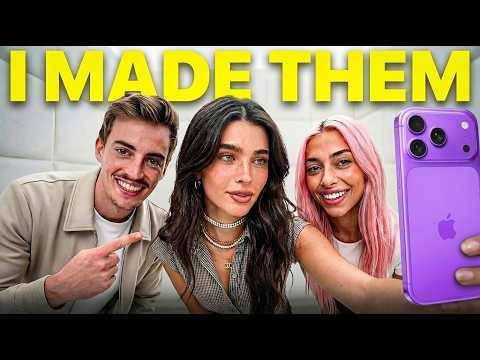
[0:01]This is not real.
[0:17]What the
[0:22]They call us AI influencers because your brain thinks we're real, but we're actually AI. This is how it was done.
[0:35]Now I don't even have to create content anymore because I got these three AI influencers that are running 24/7 that are doing all of the hard work for me. But you cannot make money with AI. Unless you master these three things. Prompting, Consistency, Motion.
[1:00]Come here. Every pore, freckle, and every little detail. Starts with one thing. Prompting. One wrong word and your influencer looks fake, plastic, and obviously AI. What if you don't have to prompt? There's a new tool that's called AI influencers Studio and this one lets you create your very own AI influencer without ever having to prompt. You can just build one based on all the characteristics that you want to have in them. It's available in Higgsfield, and I will leave a link to them in the description down below so you can try it out for yourself. Using this tool, I created three totally different AI influencers just to show you what's possible today with the power of AI. Now, this is Veronica. She's your Instagram influencer. She spends her days mostly by filming TikToks and spending daddy's credit cards on fancy outfits. Wait, he did what? Okay, no, you're literally joking. Then we have Jake.
[2:01]He's the type of guy that asks a lot of dumb questions but still somehow goes viral. Today we are going to ask some people if they can fight. Can you fight?
[2:19]And lastly, we got Emma. She's a bit of a freak, but she's really good at golfing though.
[2:31]So if you want to know how I made all of these influencers, then check out the settings that are on the screen right now. Just pause it and recreate this at your own pace. And by the way, I'm leaving all of the prompts and all of the settings I'm using in a detailed document in my free school community. You can find it in the link in the description down below. So these are just a few examples of what you can do with the influencer studio, but if you want even more control then you have to be prompting. Let me explain how that works. For example, let's say you want to make your very own YouTube AI avatar. Everyone is going crazy at how great the new Klingen model is. And in this video, I'll go compare the new Kling with Google VO3 to see who takes the throne. Like, let's say you want to replace me with AI, and I'm not going to say I'm going to do that, like I will always be making videos because I enjoy it so much. And also because I think like AI is not as handsome and funny as me. All jokes aside though, the type of funnel I'm making could also be done with AI. Like I've seen people already doing this. So, I've made this influencer right here. Now, if you want to make a similar influencer like this, you've got to prompt it in Nana. So inside of Higgsfield, if you go over to image, create image, and then you click Nana Banana Pro, then we're using this model to create her influencer. Now, let me explain how I prompt this. We will be using this prompt and let me explain how you can recreate this in your own words. So first of all, we have a front angle and that is kind of like the camera angle that we're going with. Then I'm going to describe my character, so we're going with a 20-year-old man with a bleached buzz cut hairstyle and he has a bit of freckles. Then I'm going to describe the type of pose and the backgrounds, so he's sitting at a desk in a YouTube studio. Then I'm describing what type of outfit he's wearing. Then we're talking about a few skin details to make it more realistic. Moving on, we're describing what type of pose he's holding, so he's resting his hands carefully on the desk looking at the frame. Then we're going to add in some more background details, so the background shows a simple, aesthetic creator setup, professional YouTube studio lighting. I gave it an extra specific prompt that I don't want any increment in the frame because otherwise it might do like a mic in the frame or any type of like a lighting or camera or whatever. Lastly, I'm going to add in some extra style features like realism and high detail skin texture. You don't have to prompt this in this specific way, but as long as you add in all of these features or all of these details in there, it gives the AI enough description to know what to do with it. This will generate this image for us. And if we add in this prompt, which I will show you in a little bit, we can actually make him come to life. Everyone is going crazy at how great the new Klingen model is. Now, that was done using Klingen 3.0. But if you want to do this yourself for YouTube, I would suggest you're using Hegen and Eleven Labs to make your avatar and your voice come to life. Okay, just one more for good practice. So here I got this influencer that is taking a selfie in the bathroom. Now, the way I created her was as followed. You see the prompt right here. We have the same elements that go into it. So we're describing the character description, then we're describing her outfit, then we're describing what type of camera we're filming on and the angle. Then we're mentioning in what type of location or in what type of background we have. And lastly, we're adding in some more skin details to make her more realistic. That's just a very simple prompt, even simpler than the previous one. And the great thing about this is I can easily edit her by just adding her in as a reference. And then let's say I want to add in any type of product. I can add in my product as another reference and then all I need to do is add in this super simple prompt like having her hold the Dior product in her other hand, UGC style. And we click generate. This will generate this image for us. Now we can do the same with a different product. And then if we put it into the video generator, we can have results like this. Okay, I've literally been using this every morning and girlies. This one is worth it. Just as how much I adore Logan Paul, I'm in love with his new Prime drink too. It's refreshing, it tastes like it's kind of sweet, but refreshing at the same time. Now that you understand how to prompt your AI influencer, let's talk a bit about consistency.
[7:03]Your influencer can live in 100 different worlds. Beach, studio, street, night, day. It doesn't matter. What matters is that every time that they show up, they're consistent. Same bone structure, same facial identity, same vibe. If you mess that up once, your character will lose all credibility. In order to get consistent results across all of your generations, we're using this framework. I call it the BoPA framework. And we're starting off with background. In order to get a consistent background across multiple different scenes, in this case, our different like YouTube backgrounds, I have this prompt for you. And let me just show you how it works. So what you do is you copy this prompt and then we're adding in our image of our character as a reference. Now, what this prompt will do is it will generate like nine different results with nine different backgrounds. You can customize this prompt to have the exact backgrounds that you like, and then once you hit generate, you will get a result like this. Inside of one image, you have nine different results, and as you can see, the lighting matches, the background matches. Everything looks good. There might be different ways to do this, but this is just the easiest and the fastest way to do it. Now, what you can ask is you can use this again as a reference. And then inside of Nana, you just ask it to upscale, let's say, the middle image, which is image five. You generate again and then you get this result. You can do that for all of the backgrounds that you like, and then you have good lighting and your character remains consistent regarding the background. Then we have outfit. This is by far one of the easiest ones. All you need to do is just prompt it for different outfits. Let me show you an example with Jake. So with Jake, we're using this image as our base reference image. And we have this outfit, but let's say you don't like it or you want to see a different type of outfit. All you have to do is you just put it inside of Nana and then you say keep the exact same person, face, skin texture, expression, pose, background, proportions, and camera framing as the reference image. This is important because if you don't do it, it might change some of these things. Depending on how you want your character to look, if you want to have everything exactly the same, add in that segment. If not, you can change up these things however you like. Then you can say change his outfit only to a cream oversized tea, straight-leg dark denim, clean white minimalist sneakers, and a simple silver chain. And then we got this result. Now, here I've done the same thing again. Again, this is super simple. By the way, there's also a custom tool for this. If you go over to character and then you go to AI stylist, then over here you can upload your image and then you can choose your outfit and any specifics that you'd like. And then it generates that outfit onto your character. Then we have poses. Now, there are multiple ways to do this. First, you could have your own influencer picture and then you have another image of the pose that you'd like to add to your influencer. And then you add them both as a reference. Then you mention to Nana that you want to use the style and the framing and everything of your first image, and then you want to use just specifically the pose of your second image that is like the post reference. And then it understands the exact pose that you want to have for your character. Alternatively, you can also use this method, where we're uploading our reference image and then we're entering in this prompt. So we're asking for it to keep the exact same person, face, skin texture and everything, and then we're making a two by two grid where we have like image one, image two, and then each character is taking on like a different pose which creates four distinct different poses of that character. And then we're using the same method as before. So once you've generated this, you can simply ask the AI to upscale any of these images and then you get a upscaled version of it. Lastly, we got angles, and this is a bit more difficult to do because there are multiple ways to do it, but sometimes the AI just doesn't understand. Like I'm hoping with new updates, it this will get better. But here you really have to direct how the shot was taken. So you need to understand what type of angle you want. Can't just say like side angle or if you want to have it turned like 45 degrees, you need to mention that you want to have it turned 45 degrees. So you can do this just by prompting. For example, I got my character right here, and just by saying change the camera framing to a 45 degree angle to the left, keeping the room and the women consistent with her pose, feature. And everything exactly the same. Then it gave me this angle. Here I have another one where I changed it to a top-down overhead shot. Keep in mind, what I figured out or what I found out from this result is if you have kind of like a flat background as your reference image, it doesn't really understand what's on the scene besides it. Like if you look at this, then you can see that the floor is now the same color as the wall, and that doesn't make sense. So, depending on your reference input, you might have mixed results with this. Now, an alternative method, which I personally think is not very good yet, but it has potential, is the edit feature and then angles. So in here, supposedly, you could generate 12 of the best angles from your character, but I've been having mixed results. So you can try this out on your own. You can change around like this globe where you can see like from what angle the image has been taken. I managed to make this from it, but still I'm having very mixed results. So try at your own risk. You might be wasting a few credits here.
[12:29]Then we have motion. This is by far the most overlooked element. Motion is what makes your influencer come to life. It's what gives your influencer a soul. But some movements are just impossible to do with prompt. That's why you need to use motion control. So first, let's start easy with some UGC ads. So I got my guy Jake over here. I've just turned him into like a tech reviewer. He's he's none of that, but let's pretend he is for now. So we're going over to video and then you click on generate video. Then we're going to give it a normal prompt. We could also do multiple shots, but we're not going to do it since it's just a static shot of him doing a review. We're saying fixed camera, no music, the man is filming a UGC style video at his desk, where talking naturally as if he's recording a YouTube video. He maintains eye contact, that's important, I forget to do that sometimes. Then we're just describing like all the little details that we want to have in there. Then you can choose the length of your video. I would say though, currently, anything over 10 seconds is taking sometimes like ages to generate, so be aware of that. Then you want to have the highest resolution and then you hit generate. That got me a result like this. So I received a few comments in my last vlog asking if I was filming using my iPhone or a camera, but I'm actually using this mini camera called the Osmo Pocket 3. It's even better than a professional camera, and here's why. Honestly, it's it's quite good. Like I'm going to say two it's not perfect yet, but doing this with AI wasn't possible like maybe like six months ago. Like look at the movement of that DJI Osmo. It kinda looks realistic. We see tiny bits of morpheme going on. But again, like this is very usable, and this is for a tech review. By far, one of the most difficult use cases for AI. Now, if you were to do this with something else, it might be a lot easier. So for Veronica, a social media influencer, using AI is a lot easier. Like, let's say we want to make this clip right here, this image come to life. We can just give it this prompt and then we animate it and then we get this. Okay, so my date stood me up tonight and I took hours to get ready. If anyone wants to bring me out to a nice dinner, hit me up. I'm just going to be real with you guys. Like people are falling for this, and it's it's scary how good that is. Like I can tell, you can probably tell, but some people are not able to distinguish this from a real person. Lastly, we have motion control, and this is super powerful because if you cannot get the AI to do a certain motion, like let's say you want to do something like that, maybe you don't know how to even prompt. So just to explain, we have this reference of a real girl dancing. Then we have our character, then we put it inside of motion control and then we hit generate and then we get a result like this.
[15:23]I didn't put myself as a reference obviously because I don't know how to dance like that, but I did do this one. So here we have me as a reference and then I put this into a different character.
[15:42]So all of this was done inside of Higgsfield. I will leave the link to this in the description down below if you want to make your own AI influencer. And now you actually understand how to make it believable. Now you understand like how to make good content with your influencer. If you want to learn more about AI influences, please let me know in the comments down below. Also, if you want to check out any of these prompts at your own base, check out the school community. It's free, it's the place where you can hang out with other creators where you can ask for advice. Overall, it's my goal to make like a good community with other AI enthusiasts. Watch the video on the screen right now if you want to learn how to make money with AI. It's a bit of an older video, but it's super relevant and it will teach you some of the things that you need to know in order to make money with AI.


