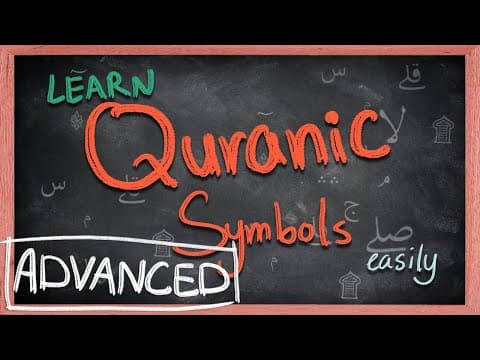
[0:00]So if you want to fine tune your reading of Quran, learning these symbols is a must. On the right side here, you see all the variations of tanween in the Holy Quran.
[0:10]Tanween is the addition of noon at the end of a word. Normally, you will see this sign if you read any Arabic text.
[0:18]In the Quran, however, there are three variations for each type of tanween, and this is what they mean. The first sign is the normal tanween in which you will fully pronounce and show the noon at the end of the word, like in this example.
[0:33]Wala hum `athabun `athim. The second sign means tanween with assimilation. Assimilation means fusing the noon with whatever sound that comes after it, like in this example.
[0:48]Wa`ala absarihim ghishawatun walahum `athabun `athim. So, we fused the noon at the end of ghishawatun with the waw that comes after it. So, ghishawatun walahum. The third variation means that you turn the noon in the tanween into a meem, like in this example.
[1:15]Afakullama ja'akum rasulun bima la tahwa. So, we turned the noon at the end of rasulun into a meem, as you can see in this example.
[1:32]The best way to train this is using ayas that contain all three of them to hear the difference properly, like in this example.
[1:39]Summun bukmun `umyun fahum la yarji`un. Tanween al-Fath will have the same variations with a little bit of difference. So, the first sign will be the full tanween in which you will fully pronounce the noon at the end of the word, like in this example.
[2:02]Wakulaha minha raghadan haythu shi`tuma. And this sign means the assimilation of noon with the coming sound, like this example.
[2:15]Wautu bihi mutashabihan walahum fiha. The last sign will be turning the noon at the end of the tanween into a meem, like this example.
[2:28]Walayyatamannawhu abadan bima qaddamat aydihim. Last is the tanween of kasr and its variations. And these are not so different from the previous two. So, this one is pronouncing the noon of the tanween, like:
[2:47]Wamallahu bighafilin `amma ta`malun. And this one for assimilation. Lan nasbira `ala ta`amin wahidin fad`u lana rabbak. And the last sign is turning the noon at the end of the tanween into a meem.
[3:12]Next is a sign that looks a little bit like the sad. And it actually stands for wasl, and it refers to the Hamzat wasl. And it means that the Hamza or the alif is not pronounced, like in this example.
[3:28]Faqadi-stam`asak bil`urwah-al-wuthqa lanfisama laha. As you can see, I'm completely ignoring the alif in istam`asak. So, I said faqadi-stam`as-ak. And the same way in the following word, lanfisama laha. So, the alif is completely not pronounced.
[3:56]Next is the sign that looks like a zero. And this is an interesting sign because when you see it above the alif, it means that you pronounce it. You pronounce the alif if you stop at this word.
[5:20]But if you continue, you will not pronounce it, like in this example. So, if you stop at the word, you will have to pronounce the alif, and you will say, "Wa huwa yuhawiruho ana".
[5:39]But if you continue, you will not pronounce the alif. Wa huwa yuhawiruho ana aktharu minka mala. So, I didn't pronounce the alif when I continued reading the word.
[5:57]Another example which is a bit more common when it comes at the end of the aya, like in this example. Ya laytana ataa'an-llaha wa ataa'ana-rrasul. So, the alif is pronounced because I stopped at the end of the word.
[6:16]Next is a sign that looks like a full circle, and this sign refers to an exceptional pronunciation for whatever it comes above or under.
[6:24]And in the first case, it comes above the alif to tell us that this alif is less heavily pronounced. So, instead of saying, "A`ajami", you're going to make it less heavily pronounced, and you would say, "A`ajami wa`arabiyy".
[6:42]Next example, and when it comes under the ra, and in this case, you will do what we call imala, which is not fully pronouncing the alif, and it would sound like that. "Bismillahi majreha wa mursaha."
[7:00]The last example is when it comes above the meem, replacing the noon. Here you have actually two choices. The first one is to fully pronounce the noon. So, you'd say, "Malaka la ta'manna `ala Yusufa."
[7:18]Or you don't pronounce the first noon, and you would instead put your lips in a position as if you pronounce the noon, and it would sound like this. Malaka la tamanna `ala Yusuf. Next is the sign that looks like a small ha.
[7:37]And this sign is actually the sign that refers to the sukoon. There's also another sign for sukoon in Quran, and that is completely nothing, like in this example.
[7:48]Walan tarda `ankal-yahudu. As you can see, the noon in lan has sukoon, but there is nothing there. And in the word tarda, there is a sukoon above the ra. So, this sign refers to the sukoon.
[8:09]Next is this sign, and this means the addition of ya. Like in Surah Quraysh. Li ilafi Quraysh. Ilafihim rihlata-sh-shita'i wa-s-sayf.
[8:25]Now, as you can see, there is no ya in the word ilafihim, but there is this sign which tells us that there is a ya that we should pronounce it, exactly like the ya in the first ayah, li ilaf. So, there is a ya here.
[8:42]This is a pretty common sign. It could be a little bit confusing if you forget to pronounce the ya in some positions. Next is the sign that looks like a waw, and it is exactly what you think it looks like. It is also the addition of a waw that is not actually there.
[9:02]So, you should pronounce it, even though it is not written in there, like in this example. Wa inna minhum lafarigan yalwuna alsinatahum. So, there is two waws here.
[9:14]One of them is already written, but the other one, we have this sign to tell us that it is there. So, you would say, "Yalwun". Next is the sign that looks like a small alif, and it is actually an alif that is not in the word.
[9:27]Like, "Bismillah-ir-rahman-ir-rahim". So, we say "ar-rahman", not "ar-rahman". So, there is an alif that is not part of the word.
[9:41]Next is the sign that looks like a noon. Again, this also refers to the noon. A noon that is not there in the ayah, but you must pronounce it, like, "Wakathalika nanjil-mu'minin".
[9:57]Last is the seen. And there are two possibilities here for this seen. The first is when it comes above the sad, like what you see here, like in this example. "Wallahu yaqbidu wa yabsutu."
[10:11]And it means that even though the word is originally pronounced or written using the sad, like in this example, it is better or more common to pronounce the seen instead of sad. So, it is better to say, "Wa yabsutun". So, you pronounce the seen instead of the sad.
[10:30]If it is the other way around, meaning that the seen is under the sad, it means that it is more common to pronounce this word with the sad instead of the seen, like in this example. "Am `indahum khaza'inu rabbika am humul-musaytiruun".
[10:42]So, in this example, it is better or more common to pronounce this word using the sad instead of the seen. So for those who watched the video until the end, I have a gift for you. You can find it in the description, download it, and use it for whatever is good.
[11:03]Thanks for watching. If you liked what you've seen today or learned something new, make sure you like and share the video for other people to learn from it, and don't forget to subscribe to my channel to see more videos like this. Thanks for watching, and see you next time.


