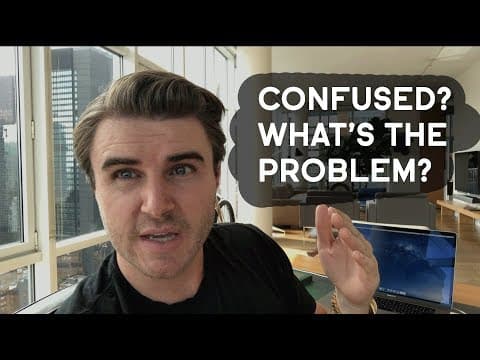
[0:00]Hey everyone, it's Sam Evans here, and today I wanted to show a quick video called stop confusing yourself. You know, define the problem and solve it. So, one thing that I see that is, you know, just plaguing most entrepreneurs and actually, you know, most people in the entire world, is that they're so confused. You know, they don't know what to do, and the main reason why they don't know what to do is because they don't know what they want. And when you don't know what you want, you can't possibly know what to do, and then they end up confused and frustrated because they know they should be doing something, but they don't know what because they don't know what they want. And they don't know what to do or what they want because they don't know, right? So this is just a big mess. And, you know, most of the time, like human beings, they actually get like satisfaction and joy out of, you know, having a clearly defined goal and making steady progress towards that goal. And this uh this guy actually did a fascinating study, and I've I've actually forgotten his name because, you know, it's like 28 L long or something. It's it's a really complicated name, but what I'll do is I'll link uh beneath this this video to the book that I read by him, which is called Flow. And this book's phenomenal, and, you know, it it talks about flow state and how like humans uh, you know, they they talk about this place called the zone. You know, you've probably heard athletes talk about the zone or extreme sports people, or, you know, anyone, they can get into this very quiet zone state. And when they're in that state, it's like their sense of self disappears, it's like time uh slows down and space, you know, just folds in and collapses, and it's like they're just in the work, right? And when you're in this zone, like, you do your best work. And what this guy wanted to really uh out, he was a psychologist, and he really wanted to figure out what makes humans happy. And so what he did is he got these little pages, like these little buzzers, and he gave them out to like uh hundreds of different people randomly selected all over the world. And they would buzz at random times. And at these random times when they buzz, when it buzz, the person was supposed to pull out a notepad, notebook, which they had in their pocket, and then write down exactly what they were doing at the time that it buzz. And how they were feeling, whether they were feeling happy or whatever. And he let this he let, you know, these people collect data for a long time, and then he collected all of that data and he started compiling it and analyzing it. And what he found was fascinating. You know, he found that when, you know, humans reported being most happy, when they were doing a task that had a clearly defined goal and objective, and they were making steady progress towards that goal without distraction. And also they were, you know, they were good they were skilled enough to like try the goal but not too skilled that it was easy, right? So it was it was challenging but not too challenging, definitely not too easy, clearly defined outcome, and they were left alone without distraction to just focus on it and get it done. And this is very true. You know, like, if you've ever experienced being in the zone before, and if you recollect, like, what was going on at that time, then you'll find that, you know, there was a very clearly defined goal, and you were left alone to just to just do your thing and get that goal done. And when you're in the zone, you know, you feel like amazing, and it's it's probably the most like it's probably the the happiest or like the, you know, the best you can possibly feel, really. And it's an amazing place to be, and, you know, uh lots of studies have shown that this is really good for your health too. This is where you're most creative, this is where you're most effective, this is where you're, you know, your your sharp at your mind's at its best. And, you know, there's there's there's so much benefit to being in this zone. And it really correlates to, you know, why most people don't know like what they want and why they're confused and frustrated. Because that is not the zone. You know, when you're confused, frustrated, and you don't know what you want, and you don't know what to do because you don't know what you want, then you're in the uh anti-zone. You know, it's basically just inverted zone, right? And if the zone is is good as you can feel then, you know, this one's going to be pretty shitty, right? And it makes sense, and it starts because there's no clearly defined objective. You know, you it's it's not very fun to be in a position where you don't know what you're trying to achieve, right? And it's because then you don't know what to do and you're just you just get totally confused. And what I've noticed is that most entrepreneurs are like this. You know, I've got a company called consulting.com, and what we do is we help people start and grow their own uh consulting businesses in any niche. And we do Q and A calls, and we do like two of them a week, and we've got like three programs and they go for hours long. So, you know, I end up doing probably like six hours a week of Q and A, just answering questions, just just hundreds of questions, right? And I've I've done this for years, like more than 4, five years. And so I've over this amount of time, you know, I've answered a lot of questions and I've observed a lot of people and they're their situations. And what I've noticed is is very similar to, you know, the study of the zone and having a clear objective, because most of the time on one of these Q and A calls, when somebody gets on and it's their time to to speak and ask a question, a lot of the time the person will tell a story. They will say things, and then and then they won't ask a question, right? And a very clear sign that somebody is confused is when they don't ask a question and they tell a story or they they tell a statement instead, right? And also another another uh sign that someone's confused is if they just tell their story and then they say, so what do you think? You can tell that that person is confused. And the like people who aren't confused are the people who will ask a very clear question, and then all the person has to do is answer it, which is very easy. And this is fascinating because what I've learned to do from hundreds of these Q and A calls, thousands of hours of them is just be like what's the question? And a lot of the time the person doesn't even know what the question is. So then I have to help and I have to be like, well what are you trying to do? And they don't know. And then when I say, well, you know, before we do anything, we need to figure out what are you trying to do? What are you trying to achieve here? And just by pushing them to to think, what am I trying to achieve here, they'll get that clarity and they will say, you know, I'm trying to achieve this. I'm trying to get more clients, I'm trying to grow my business, or I'm trying to, you know, get more more systems and processes and automation in my business so that I've got more time. Right? Then we've got some clarity. Now we've set that objective, we know what we're trying to do, right? Then once they've got that, I'll be like, okay, well, what's stopping you from doing that? And a lot of the time, the person is just like, oh, well, nothing. I I know what to do, and we're done, you know? And I didn't even have to answer their question, I didn't even have to really look at their story or anything like that. All I had to do was just ignore what they told me and say what are you trying to do, or what's the problem? And this is what this is a fascinating thing to learn about problem solving. And it works very well if you're trying to solve problems for other people, but it also works extremely well to use on yourself. And the reason why I wanted to make this video is that I've noticed a lot of entrepreneurs, they're they're out there in the world, and a lot of people actually, this isn't just for entrepreneurs, this is for humans. They feel frustrated, anxious, confused every day, and it's because they don't know what they should do, or what they're doing something, but they don't know if it's the best thing that they should be doing. And the reason why they don't know this is because they don't know what they want long-term. And so, step one to solving all of this, to solving all of this confusion and anxiety and everything is just to figure out what you want. And sometimes that's hard for people to do. You know, sometimes you've got to take some alone time to go away and think, you know, away from social media, away from your phone, away from other people, and just think like what do I want? What am I trying to achieve? And then when you've got that, write it down and make sure it's clear. And what you'll find is that when you know what you want and you've written it down and it's defined, now all we're trying to do is find the best possible action to achieve that objective, right? But we can't possibly choose an action when we don't know what the objective is. So objective number one, then choosing the best possible action. And a lot of the time, and, you know, Einstein said this. He said, if I had one hour to solve a problem, if I had one hour to solve a problem, I'd spend 55 minutes defining it, and 5 minutes solving it. Because what I've found and what you will find and what thousands of other people, or millions of other people have found, is that most of problem solving is problem defining. And it's near impossible to solve a problem when it's not defined, and as soon as it's defined, it's basically solved. And so that's what you've got to think about with yourself, like, if you're confused right now and you're, you know, you're spending time on social media, you're posting, you're doing, uh, podcasts and blogs, and you're, you're just all of your time is just getting scattered between all of these different things, right? You're reading all these books, you're meeting these different people, you're, you know, you're working 12 hours a day, and you're, but you're wondering why you don't have any clients and you, you're not making any money, and no one is interested in you, right? Well, that's, you know, you've got a problem there, and we need to figure out what it is. And we need to figure to figure that out, we need to figure out what you're trying to do. And what are you trying to do? Because it looks like to me, what you're trying to do there is just be famous or popular, and that is not the same as successful with clients, right? The two are not correlated. Quite often, fame, the people aren't very good at the the thing and, you know, they're just good at being famous, and, you know, they're not very rich or successful at all, they're just good at being famous. That's that's their skill. And if you want to be famous, then you should learn from the famous people, right? But when it comes to people who are very good at a specific skill, you'll find that they're working on the skill. They're not working on being famous, and they actually don't care about being famous because that isn't the skill, right? It seems so clear when you state it like that, but honestly, most people just get taken for the ride, uh because they don't know how to see. And, you know, a lot of people, this is what's causing a lot of people right now in entrepreneurship to focus on the wrong things. They see someone who has a fast, fancy car on the internet, and then they think, oh, well, that person's doing a lot of this, so I should do a lot of that, because that's, because obviously, they're successful if they have that car, and I know they are because I saw them in a photo with that car, and therefore, they're doing a lot of social media, so I should do a lot of social media. That's some really screwed up logic. If you if you think like that, and you make your decisions like that, you're going to, you know, run yourself into the ground, right? Because there's too many assumptions in there. You know, really if we boil business down to it, all business is solving problems for other people. We want to look at a market, like what is the niche that we want to pick? Let's say it's accountants, right? Let's say we're really, and how do you pick your niche? Well, you pick your niche based on what you're interested in, curious about, passionate about, interested in, who cares if you don't have experience in it, it's just a thing of interest. It's it's a love decision. It's not a logic decision. So you pick the niche based on passion. And then you look into the niche and you look at the participants in that niche and you start talking to them and researching them and you basically want to understand them. You're not trying to offer them anything, you're not trying to think what to offer them. No. You're just trying to understand what problems do these people have, what's their day like? And you understand them. And when you understand them and you talk to enough of them and they tell you your their problems, then you a pattern appears. And now you see that there's a common widespread problem that exists amongst the majority of participants in the niche. Now you've found something. Now what do we do that we have a problem? Then we think, well, how could we solve it? And how do we solve it? Well, we can look at, has anybody else solved this problem, or has anybody else come close, or how can, you know, how can we how can we fix it? And then when you think how you can fix it, then you can come back and offer it to someone, and they should be willing to pay you money for it, because people that's why people spend money. The whole reason why the global economy takes and does what it does is because people are out there every day wanting something that they don't have, and buying to try and get it, right? Buying happens because people are trying to find ways to get to a place where they want to be. And all businesses are, are providers of possible vehicles to get people to where they want to be, right? So if you want to be a good provider of these vehicles, then you need to understand the people and what they want, so you can provide something to help them get there. And that's all it is. Using first principles that is as simple as this thing is. And I see a lot of people think it's Facebook ads, it's funnels, it's it I've even seen people say, oh, it's just Sam's accent. Seriously? Yeah, it's my accent. Like, people need to people need a slap, you know? Like they they literally just think it might be like it's it's the suit that someone's got on or some dude's got a watch on, some guy's got a car, or it's some dude's Twitter account. Like, people need a slap in the face and they need to understand that, you know, these things are smoke and mirrors. These things aren't real. They're things put out there to confuse people. And the only thing that really matters is, are you solving a problem? Is it important? And are you actually solving it for people? Because there's people who try to solve problems, but they don't quite solve it, then you know that doesn't quite work, you need to truly solve the problem. And that's as simple as business is. And really, this transcends business and it goes into life itself. You know, all life is really is solving problems, and the best way to solve them is to define the problem, and it just makes everything so simple. So, you know, the whole point in making this video, and it's just a quick one today, was to stop confusing yourself, and to sit down and define the problem. So in life right now, if you're confused and you're anxious and you're a bit uh, you know, you just you just don't know what you should do. Or you're doing something, but there's this feeling inside you that you you don't think it's the best thing you should be doing, but you're just doing it to do it because if you weren't doing it, you wouldn't know what else to do, right? So if you're feeling like this and this is your situation, then take some time to sit down and define the you know what you want. Like, what is the objective? Step one is define the objective. Once that is done, then that tells us what action we should take. And the action we should take is the best possible action to try and achieve that objective. And how do we know what that is? Well, we want to see if other people or other companies or anyone in the world anywhere at any time has has this objective and actually obtained it or got close to it. And if they have, what means did they use to achieve that end? And what means they used is what means you should use. And whatever that means that is, that's what you should do. If you can't do it, learn how to do it, right? And then by doing that, then you should get close or you should achieve the thing. It's as it's really as simple as that. And it can you know, this process of just defining a problem can just totally change a business in one minute. You know, sometimes I get on these Q and A calls with my customers, and in five minutes with some words, we have completely restructured their entire business in life. In five minutes. And it's just it, I'm not really performing any magic. Like, you know, a lot of people might think, oh, Sam's just, you know, really good at all of this stuff, or he's, you know, really smart at this sort of stuff, or something like that, but it's not true, I just make it simple. I'm just like, what are you trying to achieve? Okay. You don't know, or what is it? All right, well, think, what do you want? All right, we've got it. Now, what's stopping you from getting it? All right, well, then how are we going to get you how are we going to, you know, get you to do it so that you can achieve it? Simple as that.
[21:38]And, you know, to show you, I'll give you one example, I'll end on one example here because this one is, I find this one quite amusing. And what I noticed is that, you know, there was in my training programs at the beginning, there were people who succeeded and got really good results. And then there was some people who didn't really succeed, and then, you know, I wondered why. Like, is it because these people are way smarter than these people? Like, what is going on here? And so I decided to investigate it. And a lot of the people who don't get results, they don't do the course, and that one's quite simple, you know, you don't do the course, you don't do any work, you obviously don't get the results. But then I wondered why. So I was like, why don't they do the course? And so I started investigating that. And then it turns out that really just their lives are so chaotic, and they've got so much going on, and they're so distracted, and they're listening to like 50 different people every day on 19 different podcasts, 15 different email lists. They're they're two pages in on 19 books. They've got another six coming from Amazon, and, you know, they're in six courses, and they've they've got four businesses and they're thinking of starting nine more, right? Um it's this is a bit of an exaggeration, but I'm not kidding you, this is basically what it looks like. And that's why they couldn't do the course, and that's why they couldn't do the work, and that is why they couldn't achieve the outcome. Yet they're puzzled as to why they don't have the outcome. So I realized that, you know, the course didn't have to be that much fancier. It didn't have to go into more tactics, it didn't have to go into, you know, more granular detail. The main obstacle and problem I had to solve was I had to help people just clean up their damn life. Because until you get rid of all the baggage, you're not going to have the head space to to do anything. And someone in that space, which I just explained before, like, they're not going to be able to watch a video and take it in, and they're not going to be able to implement something because they're they're not in the right head space because they've got so much baggage attached to them. And then so how do we how do we deal with that? Well, we just teach them how to get rid of their baggage. And that's a lot of what we do in our program, is just tell people how to get rid of all of that crap. Like, how to stop drinking, how to just stop going out and partying, how to, you know, to stop wasting time like going out and buying meals all the time and prepping for the whole week, and how to get enough sleep, and, you know, how to delete all of the apps on your phone and then turn your phone on airplane mode and then put it away in a drawer somewhere, and then how to stop using social media, and then how to unsubscribe from every email list, and how to just get rid of every piece of distraction in their life. Because you need to focus to to get something done. And it's hard for people to focus, and people sit there and they wonder why they can't focus. And it's because this one fascinated me too, like, why can't these people focus? Well, they're sitting there with all of this distraction, and they're trying to focus. And trying to focus in the face of such distraction is very hard. And what is the opposite of focus? If we take focus, we turn it upside down. What is the inverse of of focus? It's distraction. So if we don't do distraction, then what are we doing? If we don't do distraction, we're doing focus, that's how it works. And so, instead of getting people to try and focus, I just got them to get rid of distraction. And that is the secret that I use too. I am not really good at focus. I can't sit there with all of this distraction and just focus all day every day all the time. Doesn't work. I don't have the will power to do that, and it's just hard. And so instead I get rid of the distraction. You know, on my phone I've got like four or five apps, and, you know, I like no one texts me, no one calls me, and I have my phone on airplane mode most of the time and in my drawer, right? I only have one screen on my here. You my whole business just like that, right?
[27:27]And I don't have lots of stuff around me that's distracting me. Because the less things you have, then the more focus you have, because the, you know, if we get rid of distraction, then we're focusing. And so that's my recommendation to you too, is to focus on getting rid of all the junk and all of the baggage and everything that you're carrying around with you. Because if you just do that, then you will do you'll be way more successful. And it's way easier to do that than it is to learn some, you know, ninja Facebook ad and funnel tactic, right? And that Facebook ad and funnel tactic can even going to work anyway if you've got all this baggage attached to you. So sometimes the answer is so much simpler than what we think. We want to look at the tactic, we swear it's going to be another course or something, but it's not. It's just it's just getting rid of the crap in your life so that you can focus. And that's my advice for you. Get rid of the crap, focus, get rid of your phone, that thing is a disaster. Like phone smartphones and social media, uh smartphones, social media, and alcohol are probably the biggest distractions and uh most toxic things for you. Like if you're trying to succeed in anything, so you get rid of those, then you'll be way more successful. And then if you're still confused, sit down with a pen and ask yourself what are you trying to achieve? Then what is the best way to achieve that? And then whatever that is, do that task and don't do anything that isn't that task until it's done. And that's how you get things done. It's really that simple.
[29:50]So that's it for this video today. If you enjoyed it, just click that like button, and also uh subscribe to my channel on YouTube. I release a video like this every week, uh once every week on a Tuesday. And I also do customer interviews with some of my uh some of my uh customers with consulting.com and we share their stories too. And also let me know what you think in the comment section below. If you enjoyed this, or you've got a question for me or some feedback, just let me know in that comment section, I'll be checking it personally. So, thanks everyone for watching, and I'll see you in the next video soon.


