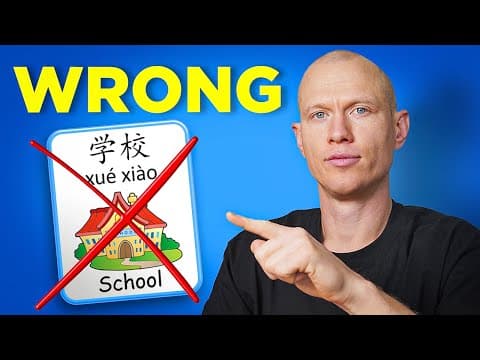
[0:00]Flash cards, when used correctly are an insanely powerful tool that will get you fluent in Chinese or any language fast, while having a ton of fun. Use flash cards wrong, however, and you'll waste hundreds, even thousands of hours and make learning this language a miserable process. And I know this because I've personally wasted hundreds of hours using flash cards completely wrong. And over the last 13 years or so as a Mandarin coach and course creator, I've learned a ton about how to create and review flash cards effectively to make insane progress with Chinese while having fun without wasting time and energy. So over the next few minutes, I'm going to share the most important lessons that I've learned with you. So let's start off with the biggest mistake that learners make with flash cards. And this was my mistake for many, many months. Most people use flash cards for learning instead of what they're actually designed for, which is reviewing. So here's what I was doing wrong. I was reviewing Chinese words based on simple definitions without actually learning the information first. I didn't learn the characters that made up the words. I didn't make pneumonics, for example, to remember the words and worst of all, I didn't see the words in context of sentences. I simply looked at a Chinese word, produced the English translation or looked at an English translation and produce the Chinese word. And I got really good at reviewing these flash cards, right? I got like 95%, maybe 99% plus correct, but I wasn't actually developing my vocabulary at all, and I wasn't learning how to use these words in real situations, in real life, fluently. What I was doing was getting really good at recognizing the squiggles and regurgitating the English definitions on these cards because I was used to it. I was literally spending hours a day doing it, so of course I got them right. But it wasn't actually making me better at Chinese. So here's the right approach, in my opinion, and one of the most important principles that I want you to understand when it comes to flash cards for language learning. So you learn the information first, then you review it. So for characters, for example, the best way to learn them hands down is by using the Hanzi movie method, our memory palace system. For words you use pneumonics to understand the relationship between the characters or the sounds and how they work together to form the word meaning. I'm not going to go into detail on either of these techniques. There's tons of content on my channel talking about these methods. And of course, you can just click the link in the description to sign up for our free course and community and we'll just guide you through everything step by step, you can learn hundreds of characters and words for free. So the key takeaway is learn the information first, then use flash cards to review that information. And this leads nicely onto the next major mistake that people make with flash cards. Again, including me, the most of all. And that do with what and how to actually review? So first off, when it comes to vocabulary, if you are just starting from zero and have no Chinese vocabulary, then I recommend that you use individual vocab cards until you get to at least around a thousand or so common Chinese words. That foundation will take you to 80% coverage and from there, you'll have enough of a foundation where you can start to understand lots and lots of example sentences, and that's what we're trying to get to. So as soon as you can, you want to graduate from individual word cards to example sentence cards and then stay there. And of course, if you're learning words, you need to also make sure that you learn their characters as well. And it's advised that you also have separate flash cards for the characters you're learning. So the most common 1,000 Chinese words or so use around 600 common Chinese characters. And in fact, many of these 1,000 words will be single character words, and these will be learned using memory palaces instead of pneumonics anyway. So really, in terms of compound words or multiple character words, which make up the majority of Chinese words, you probably only have to learn around 600 or so to get to that 1,000, that 80% coverage. So as you approach 1,000 words, you'll be ready to begin reviewing words in context of example sentences. While continuing to use flash cards to review the characters you're learning, which you should continue to do until you reach roughly 3,000 common characters. That will take you to any level of fluency and literacy that you need. And once you graduated to sentence flash cards, you only use sentences to learn new words. And any new words that come up in those example sentences, you just simply learn using pneumonics. So, for example, let's say you had this sentence to learn the word for yesterday in Chinese, Zao Tian. If you also didn't know the word Yao, you interesting, then you could quickly make a mnemonic for that. So to sum this up, I'd recommend that you have three decks, a character deck, a beginner vocab deck for common compound words and a sentence deck. Now, the next key question here is what do your cards actually look like? So there are two major types of flash card, comprehension and production or recognition and recall if you like. So the comprehension or recognition cards have the Chinese on the front and your goal is simply to recognize the meaning, understand what it means in English or your native language and move on. Now the production or recall cards are the opposite, they have the English on the front or your native language and your goal is to produce the Chinese based on that. Now, we've experimented with these two different types of cards for literally over a decade now. And here's what we decided on. So for characters, we provide both comprehension and production in our courses. So two flash cards for every single one of the 3,050 characters that you will learn throughout the blueprint, our core curriculum. Now, our thinking behind this is that characters are the backbone and foundation of your entire Chinese skill set. And having deep clear knowledge of Chinese characters will make everything so much easier in the long run. Learning words becomes so much easier. Reading of course becomes easier, even possible and listening and speaking even become way easier if you have a deep knowledge of characters. So that's why we do both cards for characters. Now, for individual word cards, the compound word cards, that most common 1,000 words that we've talked about earlier, we have used both comprehension and production in the past, but recently we removed the production cards. As we found that because we're doing so much work with the characters, doing the same level of work to learn the words was kind of overkill. Plus production cards for words could be really quite annoying because there could be several Chinese words for a single English definition. For example, the word for change in Chinese could be, could be, could be or just. So there's four possibilities right there and you have no real way of knowing which one you should be trying to recall.
[6:33]It's just a silly exercise. There really no need for the production cards for these individual words. You can save actively recalling or producing Chinese for when you do the characters or the sentence flash cards. Speaking of which, let's get into that. So sentence flash cards, when it comes to recall versus recognition or comprehension versus production for sentences, another major change that we've made to our courses based on years and years of feedback from members, is that we've now moved away from comprehension flash cards for sentences and move towards production flash cards instead. Let me explain what I mean and why we did this. So for years, we had our members review comprehension sentence flash cards like these by simply reading the Chinese on the front of the card. Now, if they could understand the sentence, they mark it as correct. And if they found it difficult to understand, they mark it as difficult. If they couldn't understand it, they mark it as wrong. But now we're advising all of our members to just look through these cards. Listen to the audio, using the downloadable audio files, just read them, read them aloud if they want, but don't add them to their review queue. Or if they do, do it very, very sparingly. And the reason why is that flash cards were really not designed for just reading and listening practice, they were designed for active recall practice or retrieval practice, which is the process of deliberately pulling information out of your memory rather than just passively reviewing it. So instead of just recognizing the answer when you see it, you force yourself to generate the answer from memory. So it's far better to just read and listen to lots of sentences multiple times from just a list or from our course platform, or just from audio files. And avoid adding hundreds or even thousands of sentence flash cards to your reviews every day. Save your flash card reviews for when you actually have to actively recall characters or entire Chinese sentences from an English definition or a translation. This is exactly what veteran flash card users do. In my opinion, the most veteran flash card users are medical students. And what they'll do, for example, is they might cover up labels on anatomical diagrams and then try to name each part from memory. That's active recall and it's scientifically proven to be perhaps the most effective way to learn pretty much anything. Now, I used to do hours and hours of sentence flash card reviews. Once I graduated to understanding the value of comprehensible input, and I stopped just memorizing individual isolated words and started moving onto sentences, I would review hundreds of these comprehension sentence flash cards without audio as well, I might add. Every single day and it was definitely helpful, of course, but I simply did not need to do it through flash cards. That anxiety that I would feel sometimes of having like 5, 600 or sometimes as many as 1,000 flash cards to review every single day is just not pleasant sometimes and it's 100% not necessary either. It'll be far more efficient if I just had a list of all the sentences I wanted to review for that day and I read them out loud. I listened to the audio files on repeat as many as much as I could and I made sure that I did that regularly, ideally every day. That would be more than enough reading and listening practice to begin to really acquire the vocabulary and the grammar. So, just to reiterate, because this is probably the most crucial point of this entire video, this is going to save you a ton of time. Do not use flash cards for the purpose of reading and listening practice. Just do reading and listening practice separately instead from a list. And we've found through lots of testing with our coaching clients that once you're able to shadow a sentence audio comfortably at full speed with full understanding of what's being said, that's important, you are then ready to do active recall or retrieval practice with those sentences.
[10:02]That's where again, you have the English on the front, ideally a relatively direct translation just to make it a little bit easier for you because it is a challenging exercise. And then you try to say the Chinese out loud from memory based on that translation. We found this out with a lot of practice and a lot of feedback from our clients. If you try and do active recall practice, if you're at a low level, and especially if you haven't had enough listen and repeat and shadowing practice, it's going to be extremely challenging for you, maybe quite frustrating. So I would highly recommend you only do that practice, the active recall, once you are either at a high level, and you can just naturally handle more complicated things, or you've just practiced with your sentences a lot to the point where you can easily shadow at full speed without full understanding. And then you're ready to go with active recall. Now, another thing you can do with flash cards that is also a form of retrieval practice, but just a little bit less challenging than full on active recall is close deletion. And we used to do this a lot with our courses as well. This is how we used to present the sentence flash cards in our courses. This could be quite effective. It's where you delete one or more of the characters from a Chinese sentence that you're learning and you just guess what's missing. Now, doing this is certainly more effective than just straight up reading Chinese sentence flash cards. Again, try to avoid doing that, but I don't think it's as effective as trying to produce the entire sentence from memory or from an English English translation. It is less challenging though and less intimidating. So close deletions are kind of a more friendly version of retrieval practice, but in my opinion, the results you get from them aren't quite as good as practicing with the full sentence from memory. Right, so now I've covered in great detail the major things to remember and the major do's and don'ts of flash cards. Let me go into some other really important tips for you based on all my years of using flash cards and coaching many, many people on learning this language. So the first major tip is to make sure that you're using space repetition software or SRS.
[11:58]There are some flash card programs out there that don't actually use algorithms or software behind them. You just sort of review the flash cards whenever you want manually, which for me, it doesn't make any sense. And the whole reason why flash cards are so done efficient is because they have that space repetition algorithm that predicts when you're about to forget something.
[12:15]And then it shows you what you need to review every day. And then of course, these reviewing intervals get larger and larger every time you answer a card correctly and your memory of that information gets stronger. So SRS sort of does all the thinking for you, all the planning and it lines everything up for you so that you don't have to plan your reviews every day. Now, we have our own SRS system in our courses, but the best publicly available SRS would definitely be Anki. Now, SRS works fantastically as long as you are following the principles that are already laid out in this video and you also follow this next principle, which is absolutely essential as well. And in fact, if you don't do this, then it renders the powerful algorithms behind space repetition software completely useless. You've got to finish your reviews every single day. Skip days and your reviews will be out of sync with your actual memory. And this will make the whole system way less effective. So make sure that you finish those reviews each day, it's the most important part of your daily study routine if you're doing flash cards. And that's why I tend to focus on finishing my reviews first before focusing on new cards or pretty much anything else. But if you do skip a day or multiple days, don't beat yourself up, just stop doing new cards, okay? So that you you prevent the build up happening and the anxiety that comes with that. Just gradually knock out your flash cards, take care of them as soon as you can and then just get back into the study rhythm. This is kind of related to another very important piece of advice attached to this, which is not just related to flash cards, it's kind of a general language learning thing, but consistency always beats intensity, every single time. So 30 minutes daily is far more effective than five hours weekly and finishing your reviews, as I said, is much more important than doing new cards. So don't take on too many new cards at overwhelm you in terms of reviews. Gradually ramp up your new cards over a few days and see how the reviews increase from there. Because the worst you can do is you do way too many new cards and then just become overwhelmed with the reviews and then you end up getting swamp. Now, another key tip for you is to practice honest and fair self-assessment. Rate your cards fairly, too easy, good, too difficult or just plain wrong. And if you do this, that will keep the algorithm working properly. Believe it or not, the biggest mistake that I see people make is actually being too harsh on themselves. So they'll get a card right, but they hesitated for just a second or two and so they mark it is completely wrong, which is wrong, right? If you do that, you're going to end up with way too many flash cards unnecessarily. In fact, I would lean towards being the opposite, be too lenient on yourself as opposed to too harsh. Another thing to remember is that flash card reviews should probably take up around 30 to 40% of your study routine, max. Maybe 50 to 60% if you're learning a ton of new stuff, but you can't get fluent from just using flash cards alone. And although, again, that massively helpful, but you'll also need to do other things like extensive reading and listening practice, uh, shadowing practice, speaking with natives. And if you focus too much on flash card, you can easily lose sight of the big picture and become demotivated. On the other hand, when you maintain consistent flash card reviews that aren't taking up your entire study routine every day, and you also are at the same time doing Chinese immersion practice, uh, having conversations, you'll notice dramatic improvements in your comprehension and communication ability. And that progress is massively motivating. So try to find a balanced point that works well for you, which might take a few weeks. And another tip to remember is that example sentences and by extension sentence flash cards are a dime a dozen, right? They're pretty much infinite sentences. So if you don't like a sentence, or don't feel that it's high quality or representing a particular word or a usage that you're trying to learn, or for whatever reason, you just find it boring or frustrating in some way, just delete it or bury it and get a new one using the internet or AI. Oh, and also avoid adding unnecessary extras to your cards as well. I see this a lot. So many of our members, for example, spend a lot of time on adding images to their flash cards or writing copious notes about their memory palace movie scenes or their pneumonics. And I've done this myself and I can completely understand why people do it. You want to just make sure that you get it right, right? But your brain, the actual mnemonic, for example, that you come up with to remember a word, if you can't remember it when you're presented with that word on a flash card, then that means you need to strengthen your mnemonic. Adding copious notes to the card or trying to spend minutes finding the perfect image to remind you of the mnemonic, it's just too much work with not enough gain. And you actually just giving yourself training wheels, and in the long run, you're hurting yourself because you're you're preventing yourself from becoming better at learning by just relying on this crutch of like images and notes. The only thing that I would recommend that you definitely always try to add to your flash cards is audio. And these days you can get AI to produce really high quality sentence audio for you, word audio, character audio. And we of course, provide really high quality audio for everything that we teach in our courses. So flash cards are a huge topic, obviously, and there's a lot to talk about and I'll probably make another video expanding on this later, but what I've covered today are by far the most important things to remember. Flash cards when you correctly can really be one of the most powerful tools in your toolkit. But even with perfect flash card technique, there's still one skill that makes Chinese 10 times easier and most learners completely ignore it. So in my next video, I'll show exactly what that skill is and how to master it many times faster and easier than the average learner. So click here to watch it now.


