[0:00]Thought for 17s. It looks like a wound at the end of the world. Rust red water spilling from a crack in a glacier that should be as pure and white as bone. The pilots call it eerie. The scientists call it extraordinary. And if you're watching this, keep your eyes on the screen, because what you're about to see isn't a horror movie effect or camera trick. It's real. It's called Blood Falls, and the secret behind it lay hidden for roughly two million years, sealed in ice and silence. Until a few curious minds asked the right questions and dared to chip into the unknown. Imagine Antarctica's McMudo Dry Valleys, one of the most extreme deserts on Earth. The wind is so fierce it can sandblast rock. Snow almost never falls here. Humidity is so low, the landscape looks like Mars. Brown, barren, and etched by ancient ice. At the valley's end, a tongue of blue white ice called the Taylor Glacier shoves forward. Its face towering above a frozen lake called Bonney. And there, smeared down the glacier's flank like a scarlet waterfall, runs a ribbon of liquid the color of old blood. Not a trickle, not a stain, a flow in Antarctica's deep freeze. Hook one. How does water flow in a place where liquid shouldn't exist? Hook two. Why is it red? Hook three. What has been living beneath this ice, in total darkness, with no oxygen, for longer than human civilization? The first official account goes back to the early 1900s, when a geologist on an Antarctic expedition spotted the strange discoloration and thought it might be a bloom of red algae. Life painting the ice with pigment. That guess made sense at the time. Red and green ice can appear where algae take advantage of melt water and sunlight. But the dry valleys don't play by the usual rules. There's hardly any surface water, hardly any sunlight that reaches liquid, and the temperatures are merciless. The mystery of the waterfall's color would persist for decades, because the real answer was far more surprising than algae. Here's the first truth you need to hold on to. Blood Falls is not blood, and it's not paint. It's brine, salt water so salty and dense, it refuses to freeze at temperatures that would lock ordinary sea water into solid ice. Hidden beneath Taylor Glacier lies an ancient trapped reservoir of water, a subterranean brine sealed off from the outside world for countless millennia. Picture an underground ocean the size of a small city, wedged into fractures and pockets within the bedrock and ice, squeezed by the glacier's weight. This brine is loaded with iron and other dissolved minerals, the chemical fingerprints of rock slowly weathered in total darkness. When that iron rich brine finally finds a path to daylight, through a crack, a channel, a pressure valve in the glacier, it oozes out like a secret being told for the first time. As it meets oxygen in the cold dry air, the iron oxidizes, rusts, turning the water a deep startling red. Iron plus oxygen equals iron oxides, rust. Blood Falls bleeds because Earth's own chemistry does. Now take a breath because that's just the geology. The biology is where this story veers from strange to almost unbelievable. Deep under the glacier, without sunlight, without oxygen, at temperatures that should be lethally cold, microbes are alive. Not merely clinging to existence, but metabolizing, reproducing, and running a tiny invisible economy based on chemistry. Most of us would never associate with life. They don't photosynthesize. They don't breathe oxygen. Instead, they survive by shuttling electrons between iron and sulfur compounds in the brine. Using what's there like scavengers in a shipwreck. If normal ecosystems are built on sunshine, this one is built on rock and patience. Every time the brine escapes, riding pressure gradients and micro fractures to the glacier's face, it carries a trace of that hidden biosphere with it. Microbes that can handle salt levels so high, they'd shrivel ordinary cells. Microbes that somehow avoid freezing, even when the thermometer dives well below zero. Hold that thought. If life can make a living here, in an iron salt cocktail beneath a block of ancient ice, what might be possible elsewhere? On frozen moons like Europa or Enceladus, where salty oceans hide beneath ice crusts, on Mars, where brines may briefly form in the subsurface. Blood Falls isn't just a weird waterfall. It's a window into the possible. But we're getting ahead of ourselves. Let's go back to the moment a modern research team stood at the base of Taylor Glacier and realized the red wasn't algae. They ran tests right where the brine touched air, scooping samples into sterile containers and watching as iron changed color the instant oxygen hit it. They measured salt concentrations so high, the brine behaved more like syrup than water. They checked the temperature and found it stubbornly liquid in sub-freezing conditions, because salt pushes water's freezing point lower. Then they looked at the chemistry. High iron, high sulfate, traces of other metals and the telltale metabolic byproducts of microbial life. The waterfall was not just a chemical reaction. It was, in part, a living exhale. How does the brine move if the glacier is a solid mass? Here's another revelation. Glaciers are not perfectly rigid. They creep. They crack. They hide channels and veins like capillaries. Especially when the ice is warmed, ever so slightly, by geothermal heat from below, or by the friction of the glacier's own grinding motion. Under Taylor Glacier, radar and electrical surveys revealed a network of brine threaded through the ice, a hidden plumbing system. Pressure builds in that network. When a fracture opens near the surface, an outlet along the glacier's face, the brine bleeds. Not constantly, not predictably, but in pulses, like the glacier is breathing. This is where the story gets almost cinematic. Picture the helicopter setting down on the barren gravel. The wind slams the door as the team climbs out, hauling gear that looks like it belongs on a spaceship. Sterilized cores, field microscopes, instruments to test conductivity and redox potential. The glacier glows blue where compacted ice has squeezed the air out of ancient snow. At a seam near the terminus, a smudge of orange red stains the ice. Up close there's movement, not a cascade, but a viscous ooze, periodic. As if the glacier is whispering and then going quiet. A scientist dips a sterile tube in. The brine creeps like cold honey. In minutes, iron in the sample begins to darken as it oxidizes. The same transformation that paints the glacier's skin with rust. Under a microscope, dot-like cells drift in the saline soup. Fewer than you'd find in a healthy lake, but alive, adapted to chemical extremes. Even here, where the air can freeze a breath and the sun is a distant rumor in winter, metabolism happens. Let's crack open the timeline of this trapped water. During warmer ancient periods, sea water and melt seeped into this valley, interacting with the bedrock, picking up iron and other ions. Then the climate swung cold and the glacier moved in, sealing off the basin like a lid on a jar. For geological time, that brine sat in darkness. Its chemistry shaped by rock, pressure and slow microbial cleverness. Two million years is an estimate you'll hear. A shorthand for older than we can easily imagine. The brine became a time capsule, an experiment run by nature itself. But why here? Why the Dry Valleys? Antarctica is ringed with ice shelves and studded with mountains, but the Dry Valleys occupy a special niche. Catabatic winds, dense and cold, scream down slope and evaporate snow before it can accumulate. The result is a sublime paradox. In the heart of the world's largest ice sheet, you get a hyper arid desert. No blanket of seasonal snow, no lakes that fall on schedule. Just old rock, older ice, and a climate that preserves secrets. For researchers, that means essentials aren't buried under meters of fresh snow. The landscape is accessible. A rare open-air archive. For Blood Falls, it means the glacier's face is exposed enough to display its strange wound where brine meets air. There's another human hook here. The way this place changes the people who study it. If you talk to those who've spent seasons in the Dry Valleys, they'll tell you about silence so complete it drowns your inner noise, about the way a plume of breath fractures into glitter and falls. About orange light stretched across peaks no one will ever climb without risk. They'll tell you that seeing red water leak from living ice resets your sense of what's possible. You can't stand there and not feel small and wildly curious. Curiosity has consequences. To understand Blood Falls, teams drilled shallow cores to trace where the brine had stained the interior of the glacier. They hauled radar sleds across the ice to map conductive zones that implied salt water channels within. They experimented in labs back home, recreating brine chemistry, testing which microbes could swap electrons in a world without oxygen. They fed inputs into models to estimate pressures that would squeeze liquid upward against gravity, and each answer forced new questions. How does such a hypersaline solution avoid freezing within the glacier for so long? How often do the pulses occur? Does the brine connect to ancient marine water beneath the valley, or is it entirely isolated? Are there multiple pockets, multiple lineages of microbes, multiple stories nested below our feet? One more hook. Nothing about Blood Falls violates physics. It only violates our expectations. Salt changes freezing points. Pressure changes flow. Redox chemistry changes color. Microbes change the rules of survival because evolution never read our instruction manual. Let's talk about the color, the thing you can't look away from. When iron is in a reduced state, dissolved in the brine, it's invisible. When that brine slips into open air, oxygen grabs electrons from iron, and the iron precipitates out as oxides and hydroxides, minerals with that distinctive rusty hue. Depending on how long the flow has been exposed and the exact mix of iron compounds, the red can skew orange or brown. Sometimes streaked with yellow where other ions join the reaction. It's not uniform, it's layered history painted on ice. Each pulse leaves a slightly different signature, like tree rings you can't trust because the tree is alive and also dissolving itself into the paint. You might be wondering, if this place is so special, why not scoop gallons of brine and culture the microbes in labs for insight? The answer is restraint. This is a fragile system. Every sample is a tiny invasion. Teams operate with strict protocols, sterile tools, minimal contact, careful logs. Because contamination from a researcher's breath, a glove, or a stray bacterium could ruin what makes this ecosystem unique. Think of it as the Antarctic equivalent of a surgical theater. You're peering into a body that hasn't seen the light in geologic time, and yet, balance again. What we learn here may have outsized value. Engineers study the brine's properties to design better de-icing strategies and to understand how salts migrate in frozen soils. Astrobiologists treat Blood Falls like a field school for alien oceans, trying to understand what biosignatures, chemical fingerprints of life, you might look for in ice plumes from Europa. Geologists use its chemistry to reconstruct climate histories and sea incursions into these valleys long ago. One crimson trickle, many disciplines. There are myths that cling to the name Blood Falls, and it's tempting to lean into them because names have power. People imagine some apocalyptic wound or ancient massacre sealed in ice. The truth is colder and in its way, more profound. This is Earth reminding us that life and chemistry are resourceful, that the planet's interior dialogues don't stop when a surface freezes over. The drama is not violence, it's persistence. Now let's walk the story forward to the present. To a field season when the falls are still, and the stain looks old. Weeks can pass with no visible flow. Then a crack opens, or pressure builds, and red returns, wet against the ice. Shocking even veteran scientists who've seen it before. Cameras click, drones orbit. A pilot radios another team. It's bleeding again. Somewhere below, valves we can't see open and close. And the subsurface plumbing makes it slow in different adjustments. Up on the glacier's surface, sifted snow cuts across boot tracks as if erasing a chalkboard. The only enduring graffiti is the rust. In some ways, Blood Falls is a message in a bottle sent from the deep past. The ions tell you what rocks the water touched. The microbes tell you what metabolisms were viable when oxygen wasn't part of the story. The salts tell you how isolated this world became and how it stayed liquid when everything around it froze. When you read that message correctly, you can reconstruct the life history of a place most of us will never visit. A place harsher than any desert, yet teeming with invisible negotiations of chemistry and survival. There's a moment near dusk when the sun drags long blue shadows across the glacier's surface, and the red brightens to something almost luminous. That you grasp the aesthetic side of this phenomenon. It is beautiful, alien. It makes you lean in, then step back, then lean in again. On a planet we think we know, it looks like a contradiction that has decided to be art. So what remains unsolved? Plenty. We don't know the exact geometry of every brine channel inside the glacier. We don't know the full diversity of microbes. Some refuse to grow in culture and can only be inferred from fragments of their genetic material. We don't know how climate shifts in Antarctica will change the pressure and temperature regime that keeps the brine mobile. If the glacier thins, will the system bleed more often or dry out? If air warms, will oxygen penetrate deeper and transform the microbiology? Questions accumulate like snowflakes that never quite settle. But here's what we do know, and it's enough to keep anyone watching to the end. A hidden reservoir older than our stories lies beneath Taylor Glacier. It is so salty it cannot freeze. It is loaded with iron that rusts in open air, painting the ice the color of blood. It carries with it microbes that have learned to live without sunlight or oxygen by mining the chemistry of rock. All of that is real. All of that has been measured, sampled and observed. And all of that points to a larger truth. Life on Earth is more inventive than we give it credit for, and the planet still keeps secrets in places we thought were too empty, too cold, too dead to matter. If you find yourself haunted by the sight of red water flowing from white ice, good. You're supposed to be. It's a reminder that the world is not done surprising us. That awe is not a childish reaction, but a useful one. Awe makes you ask better questions. Awe makes you look longer. Awe keeps a scientist on a frozen valley floor long after the wind picks up and the helicopter pilot checks his watch. Because maybe, just maybe, the brine will pulse again and you'll catch another glimpse of the hidden heart beating under the glacier. And if you're wondering why this matters beyond the spectacle, consider this last hook. Somewhere in the solar system, beneath kilometers of ice on a moon that looks dead from space, brine may be doing something similar. Moving in the dark, enriched with minerals, feeding a microbial community that's never seen a sunrise. If we can read the red script on Antarctic ice, we can learn to read whispers from other worlds. So the next time someone tells you Antarctica is just ice and penguins, tell them about a waterfall that bleeds without a heart. About a desert that teaches us how oceans hide. About a glacier that keeps a 2 million year old promise. And occasionally, when pressure rises and a crack opens, lets the secret out. Tell them that at the end of the world, the planet is still writing stories and colors bold enough to stop you in your tracks. And then ask the question scientists ask as they pack their samples and power down their instruments. A question that hangs in the cold like breath. What else is down there, still waiting to be found?
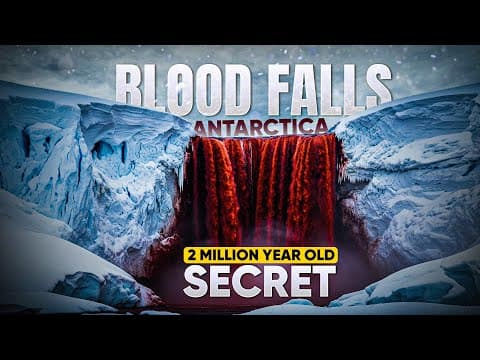
The Blood Falls of Antarctica – Nature’s 2 Million Year Old Secret
Veil Quest
17m 7s2,783 words~14 min read
YouTube auto captions
Transcript source
YouTube auto captions
This transcript was extracted from YouTube's auto-generated caption track. The transcript below is server-rendered so it can be read, searched, cited, and shared without opening the original YouTube player.
Pull quotes
[0:00]Rust red water spilling from a crack in a glacier that should be as pure and white as bone.
[0:00]And if you're watching this, keep your eyes on the screen, because what you're about to see isn't a horror movie effect or camera trick.
[0:00]It's called Blood Falls, and the secret behind it lay hidden for roughly two million years, sealed in ice and silence.
[0:00]Until a few curious minds asked the right questions and dared to chip into the unknown.
Use this transcript
Related transcript hubs
Watch on YouTube
Share
MORE TRANSCRIPTS


