[0:00]And one of the really exciting things uh about teaching reading is that it continues to evolve. We continue as a field to learn more and more about what happens. And many of you are familiar with Holle Scarborough's reading rope.
[0:15]What a great way, a great visual to be able to represent things that are known, things that are understood around the teaching of reading for young children, especially that pre-K to sixth grade level as well.
[0:30]And uh, some fun facts uh about uh, where it was that this visual actually came from. Hollis Scarborough, a wonderful uh researcher, uh was in the late 1980s and early 1990s, uh, doing work especially in the space of uh policy development, specifically around reading policy development.
[0:56]Now, Hollis is the first person to tell you, she's never been a teacher, um, and uh, and she doesn't teach reading. But she knew that what she needed to do was really to be able to dive down into the literature, the research at the time to be able to understand what that meant.
[1:14]And that was the birth, the place where the reading rope was developed. At the time, she was looking at what the research says about what needs to happen not only in terms of content around all of that language comprehension that you see at the top, but also the word recognition.
[1:33]And I think what was really brilliant about her representation is how it was that she tried, she attempted to to really uh demonstrate that developmental trajectory and the fact that all of those at first discrete skills need to be carefully braided and woven together to represent that automaticity and that increasingly strategic kind of uh reader.
[2:01]Now, as I said, this was first developed in the late 1980s and early 1990s, and we know even more now about that.
[2:09]And as Doug and Diane and I took a look at what the current landscape is, we recognized that as wonderful as the reading rope is, that it's also an opportunity to be able to continue to build on that.
[2:23]There's so much more that we know now about fluency, for example. There's so much more that we know now about alphabetics.
[2:32]And so what we've really attempted to do is to help begin to expand what that reading rope looks like.
[2:39]Now here are some really important things. Um, uh, two years ago, uh, Hollis was talking about the reading rope.
[2:47]And in particular, here's what it was that she had to offer. She said, being strong on the lower strands, the word recognition, being strong on the lower strands affords more opportunities to acquire knowledge of the upper strands, and being strong on the upper strands, language comprehension has been shown to enable faster and more accurate decoding of unfamiliar words.
[3:14]In other words, these aren't separate from one another, they inform and they amplify each other.
[3:19]Therefore, she went on to say, if any of the strands gets frayed, it can hold back development of the other strands and by extension can eventually weaken the entire rope.
[3:32]Brilliant, absolutely brilliant in terms of what it was that she had to offer for all of us.
[3:38]And it reminds us as well about what we always think of as the tent poles of teaching reading.
[3:46]Remember, her reading rope is around reading development. We move from that space of reading development to teaching reading.
[3:55]And instruction and text are really what holds up our uh teaching reading work for those young children. We have to pay attention to instruction, we have to pay attention to text.
[4:10]Now, I'll draw on some work of some other researchers, Dick Allington, uh and his colleagues, for example, looking at highly effective first-grade and fourth-grade classrooms. That's those were the spaces that they were working in.
[4:24]And one of the things that they found was that in those highly effective classrooms that students were reading for an average cumulatively of 90 minutes a day, eyes on text.
[4:38]Eyes on text are absolutely essential.
[4:43]We can't teach reading without making sure from an instructional standpoint that we're creating lots of opportunities for them to be able to have their eyes on text.
[4:58]Because here's what we know. Reading doesn't grow in an environment where reading rarely occurs.
[5:06]Right? It's a parched kind of environment if we don't have lots of opportunities for students to have eyes on text, to be able to interact with that text.
[5:17]All of those strands of the reading rope are essential in terms of reading development, but those strands can only come to life, can only grow if we create an environment that is focused on instruction and on the text that students read.
[5:37]Instruction must require more opportunities for eyes on text. Not just talking about reading, but actually having those opportunities to be able to look at words, to work with words, to work with sentences and with connected text.
[5:54]I've seen that the chat is already very busy. Uh here's an opportunity to uh answer in the chat. What's something in these last couple of minutes that's been absolutely confirming for you. What's something that's new for you in terms of reading?
[6:13]Go ahead and put those ideas right there in the chat.
[6:16]Eyes on text. Yes, absolutely. Reading, making sure that reading is happening in all of the subject areas.
[6:24]Yes, those great findings around those 90 minutes cumulatively a day. I I want to be really clear. None of us are saying that kids should have sustained silent reading for 90 minutes at a time.
[6:39]And I'm glad you like the tent poles too.
[6:42]Thank you so much. Now, Diana's going to get us started with an important part of that rope, which is the word recognition.
[6:55]But we always want to stay focused on this idea that we're strengthening that rope, that we're not only teaching isolated skills, but we're also making sure that they're braided together as well.
[7:07]Diane, I'll turn this over to you. Okay, so, thank you, Nancy. One of the ways that we strengthen that rope is with two major areas, thinking about language comprehension and word recognition as Scarborough mentioned for us and shared with us.
[7:27]And this visual representation was designed by Barbara Foreman, and I think it really makes it clear what's going on in that rope.
[7:34]Um, she suggests that, look at number one, that it's a manipulation of sound parts. You're beginning big, you're able to segment syllables, you're identifying onset and rhymes, um, connecting those to letter sound relationships, and then linking them to phonemes.
[7:55]And remember phonemes are the smallest uh part of sound.
[8:03]And so I think this helps us also, um for our in our instruction so that we know what to focus on with children.
[8:19]When we focus on those parts, children begin to effortlessly be able to call out, recognize their orthography in print.
[8:29]They begin to assimilate spelling patterns with that and they add the phonology and the pronunciation to that.
[8:37]What happens over time as we engage them in lots of practice and lots of activity is that it gets to be automatic.
[8:45]And so it's it's what we do as proficient readers, we come to a text even when we don't know well, um, sometimes we might find ourselves learning a new piece of information with all words that we don't even know.
[9:03]But because we have a strong ability to understand the relationship between sounds and letters, um, and those letters in the words that are part of language, we're able to decode them very quickly and associate them and make we may not make deep meaning, but we can at least word call the words because of those skills.
[9:29]So it becomes very automatic with practice.
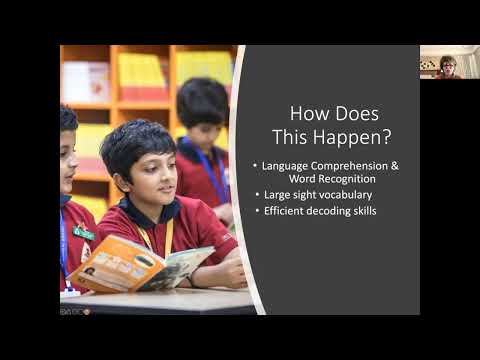
[9:37]How does this happen? Well, we know from lots of studies like Hart and Risley and other studies that having a strong language base is such a wonderful foundation for learning how to read.
[9:51]Um, children who come from families where they've done word play, they have all kind of language interactions, they have conversations, um, they have a strong base of word of language, and based on that language then they are able to start adding in all of the um fun activities that begin to make a connection between the sounds of that language and its representation in print.
[10:21]Um, and those words then become they then begin to develop a large sight vocabulary. And we want to start off by mentioning to you that a sight vocabulary is any word that you can recognize by sight.
[10:34]So the more you practice a word, the more you see it in print, the more you can sound it out and understand it, um, in print, you don't have to know the meaning, but just recognition of it adds it to your sight vocabulary. And this happens through efficient decoding skills.
[10:52]You learn how to do this by learning how to decode.
[11:03]Instruction matters.
[11:06]Word, word recognition is making a match between the spoken and written letters of our language, the spoken and written words of our language.
[11:17]It becomes automatic through instruction, through the experience in doing it, and through lots of practice.
[11:23]So it's not just a once and done, um, as we'll mention to you again, it's practice. Children need to come back to this.
[11:32]And that we also need to differentiate the amount of practice that we give them, um, because children learn this at different rates depending on what they bring to the task when they come to school.
[11:49]The alphabetic principle must be learned. First of all, the alphabetic principle is the idea that or the idea behind that letters of the alphabet have sounds that are that have sounds comprising the spoke our spoken language.
[12:07]And so when I can map sound on those letters, um, I then have acquired the alphabetic principle.
[12:16]It's the relationship between the letter names and the spoken sounds of language. And as you can see in this picture, this child is having lots of fun playing with these letters.
[12:25]And I'm going to talk to you about that in a minute about how you might begin this process so that the alphabetic principle can be acquired, um, by every child, that they're able to map sounds onto those letters and as they appear in words, they become part of the child's reading, um, and become eventually part of the child's sight vocabulary.
[12:55]Writing supports the alphabetic principle.
[12:59]So in addition to just having children look at sound at letters and talk about those letters, uh, writing doesn't need to be, now I'm not suggesting to you that writing become some full-blown writing composition.
[13:13]But children need to have time to start playing around with letters, writing their names, um, because that writing again helps map that into their permanent memory.
[13:25]Children should understand that letters are represented in their names, uh, letters are represented in the the cards that they send, you know, a perfect example was just Mother's Day.
[13:38]Um, several of my because I feel so strongly about this, my kids had several of their kids write me, um, letters, uh, Mother's Day card letters, and of course, they weren't all spelled right.
[13:53]Um, they weren't all written perfectly, but they were realizing one important thing that in order to be able to communicate through reading and writing, you have to be able to understand that there's a relationship between the letters and words and the sounds that those letters make.
[14:18]We put these together because we wanted you to see the difference between phonological awareness and phonemic awareness.
[14:27]Fonological awareness is a broader term, and it it involves being sensitive to the parts of speech, so understanding syllables, rhymes, and phonemes.
[14:39]So it's big chunks. You're you're looking at at syllables, you're looking at rhymes, and notice the spelling of this because later I'm going to talk to you about rhyme, which is different than just rhyming words.
[14:53]And, um, also the phonemes, which is mapping again, the smallest unit of sound onto our letters.
[15:00]And that differs from phonemic awareness because phonemic awareness is part of phonological awareness.
[15:08]It's the ability to focus on and manipulate those individual sounds or phonemes within a spoken word.
[15:17]So notice the difference there. Phonological is the umbrella term, phonemic awareness is embedded within phonological awareness.
[15:25]If you look back up at the top, you'll see that, uh, phonological involves syllables, rhymes, and phonemes, and it when we're just talking about phonemic awareness, we're talking about just the manipulation of the phonemes.
[15:43]This chart spells it out a little bit better for you. You'll again see, um, this division of phonological awareness and phonemic awareness.
[15:53]And phonological awareness is the ability to hear and manipulate the spoken parts of words and sentences.
[15:59]So, you have word, word awareness, you're able to rhyme, uh, you can chunk into syllables, and there's the word I was telling you about onset and rhyme.
[16:10]And what onset and rhyme means that you're able to do is onset is is the first consonant or sound in a word.
[16:20]And then the rhyme are is the letters that come after it. So for example, in the word bat, bu B is the onset and at is the rhyme. And that's all part of phonological awareness.
[16:34]And then, um, and phonological awareness then is pro very much a part of phonemic awareness, and you'll see again what I've just told you.
[16:44]Phonemic awareness just deals with the letter sound or sound letter.
[16:51]I always like to start with sounds. Um, I know some people talk about letter sound relationships, but I like to talk about sound letters because I think children have sounds before they have letters.
[17:02]But that's what phonemic awareness is. It's that connection between sounds and letters in blending those together in substituting, which I'm going to talk to you about in a little bit, being able to manipulate them and also being able to segment them.
[17:16]So this graph just just is just here to show you the components within each within phonological awareness and within phonemic awareness.
[17:29]And one of the things that we know is that uh phonemic awareness is one of the best predictors, as you'll see by A and Nunez, it's one of the best predictors of success a student will have in learning to read.
[17:45]So, again, phonemic awareness means that they are understanding that there are discrete sounds within a spoken word.
[17:55]Um, and then the ability to manipulate those, to segment them, to put them together, um, supports their uh learning how to read.
[18:10]So what's involved? Involved is the ability to detect and manipulate the smallest uh sounds of language.
[18:31]And you'll notice that that is, um, a definition from the International literacy Association, and I just want to put in a plug for you, for them, that if you are looking for word definitions, they have a compiled over the last few years, ever since Doug gave this as a charge to, um, the literacy research panel, there's a huge glossary of terms.
[18:57]And so if you are thinking about how to define any of these terms that we're talking about today, go to the International literacy Association's glossary and you'll be able to find it right there.
[19:12]Okay.
[19:17]So developing phonological awareness, how do you do that?
[19:22]Remember, phonological awareness is that you are, um, developing the ability to understand the sounds of language.
[19:33]You're you're beginning to understand what the parts are in words. So you are doing things like singing songs and and chanting, um, you are, um, clapping the sounds of language, you're tapping the number of words heard.
[19:54]You're doing saying uh tongue twisters like, remember when you used to do Peter Piper.
[20:06]Well, Peter Piper was a wonderful tongue twister to help you develop, uh, phonological awareness. So zebra zig and zag is another one.
[20:13]I scream, you scream, we all scream for ice cream. Singing songs like It's Bitty Spider and five little uh monkeys.
[20:19]There's poems that we say like hi diddle diddle, uh, Patty cake, Patty cake, and I want you to go back and think about when children come to school.
[20:30]Children who have been involved in these activities at home come with more awareness of the the sounds in their language.
[20:39]They are, um, much more ready to be able to start reading.
[20:45]And so go back and differentiate. I want to keep asking you to differentiate this and scaffold because if children don't come with these skills, it doesn't mean that they're not going to be able to learn them.
[20:57]They just need practice. They need to be involved with, uh, being read to, with books that have rhymes in them.
[21:10]Um, they can read, you know, books that by Jack Perletsky. I mean, we haven't talked about him for a long time, but if you look his name up, he has lots of read aloud rhymes that would help you to develop this with children.
[21:24]Um, um, Brian Cleary has a book called bug in the jug wants a hug. And can you see the alliteration there, the what we're hearing when we say bug in the jug wants a hug, it's all that rhyme that we're hearing.
[21:39]But, um, that fun begins to build phonological awareness. Children are playing with language. Look at the faces of the children in this picture.
[21:52]We picked them to show you that this is fun. We don't suggest for one second that early literacy instruction that involves the development of phonemic awareness or phonological awareness should be boring work.
[22:06]It should be fun. You're playing with language. You're playing with the sounds of language. Have children enjoy it.
[22:14]So focus your instruction on as you see here when you're developing phonological awareness, focus your instruction on rhyming, hear sounds, manipulate those sounds, um, have children become aware of the syllables in a word.
[22:33]If they're saying running, how many syllables are we saying? Um, I can say running, can you put it together and say running? Syllable deletion, um, make this all into games, omit the unstressed, uh, the unstressed syllable or the weak syllable in a word.
[22:55]So for example, if we say banana, maybe you want to leave out ba and stress Nana, which are the syllables that are stressed in that word.
[23:08]Or if you say above, leave out a, and what do you have? You have above. So you have syllable deletion there.
[23:18]Um, so start with children seeing syllables, they're doing rhyming, they start to blend those syllables, and here are three fun activities that I think that you might like.
[23:31]Um, one of them is called chin drop, and I'm going to I hope you'll not mind if I demonstrate these for you, but chin drop is if you just put your hand under your chin, and every time you say a word, you see how many times your chin drops down.
[23:51]So if I say running, it comes down twice. How many syllables do I have? Hello.
[24:01]I have two. Syllable, this is easy to play with children and do.
[24:07]You don't have to have any supplies ready. Every minute of your day that you have a an that is un, um, challenged by some other thing that you've scheduled, you can do the chin drop, the syllable jump, or the hum so that we can start counting sounds and syllables.
[25:36]We can also count, um, uh, multiple syllables. So it doesn't just have to be two.
[25:42]You can get more and more words, and the the chin drop works across grades.
[25:50]Kids love that. I saw somebody just, I happened to glance down and I saw somebody put that that even their third graders love this. Okay, so, um, one of the ways to, uh, be developing these sounds is through Alcon and boxes.
[26:08]Um, and Alcon boxes, you use either coins or chips, and as you're saying the sounds, not the letters, but the sounds, you are pushing the letters into the boxes.
[26:24]So for example, you can see the little, uh, circles down there, those are either pennies or plastic chips, and as I say, but at bat, I push those letters so that I'm hearing the sounds.
[26:41]I'm not telling children that it's spelled B A T. I want them to hear the sounds because we're developing phonemic awareness, not not spelling yet, just the because you saw that I didn't say push letters.
[26:56]I mean, I didn't say I said push pennies or plastic chips.
[27:01]We're not pushing letters. We're still hearing. We're developing phonemic awareness. So teach the direct correspondence.
[27:16]So alphabetics is the representation of uh spoken sounds by letters, which is pretty much what we're, what we are, uh doing right here.
[27:27]Alphabet knowledge is the best predictor of later reading success. And, um, as I mentioned earlier, it's important to always be connecting instruction with writing.
[27:43]So the connection of the the sounds with any writing that you can have children doing, really supports them.
[27:57]Alphabet recognition. So the ability to recognize upper and lowercase letters of the alphabet, understand that there are grapheme phoneme correspondenc and be able to read them and write them.
[28:26]Now, you're probably wondering, as we go, I think the next slide is, uh, first, this is the six principles from Ray Rezel.
[28:40]Uh, he did a lot of research on, how do you introduce this? And so one of the, these are the six ways that he thinks that you should begin to introduce, um, work with the alphabet.
[28:54]And the first one is, of course, your own name. Let children write the letters in their name. Let them say the letters in their name.
[29:02]Uh, the second one is the alphabet order. So and and if you notice, when children sing the alphabet song, they usually end up knowing ABC and XY Z because those are the ones that they are really focusing on in that song.
[29:20]And also probably when they look up at any alphabet chart that you have, so focus on the order, and that's called the alphabet order effect that in the research that uh Rezel and his colleagues did, they learn ABC and XY Z before they learn almost any other letters of the alphabet.
[29:39]He also want to think about letter frequency, um, so which letter which are seen more often.
[29:47]Um, you see Q and V less often in words, um, than you see B and D and T.
[29:57]So focus, think about that has uh letter frequency effect.
[30:04]Letter name effect means this, does the sound that the letter make correspond to how the letter looks.
[30:17]So if I'm saying the it correspond to its name, not its look. So B, when I go to say a word with B, it's a bu sound.
[30:26]So I'm still making the same connect in my mouth, different than when I say look at the letter Y and call Y, but a word would be would sound like you, so that's the letter name effect.
[30:40]Um, consonant phoneme acquisition, think about babies, what are the first letters that sounds that they make.
[30:51]That's all developmental. And so, uh, Rzel's research says stick with that connection. And then distinctive features.
[31:00]You know there are some that are easier to learn because, um, they have a curved, like a C and an S, they have curved structures, um, which are much easier to make than if you have to join line segments together as in the A, as in the M, as in the N, you have to make connections there.
[31:22]So thinking about those are the learning order for the alphabet. And, um, there's Ray Rzel has done lots of work on that.
[31:31]So now you're probably wondering, what should come first? Should it be, um, upper or lower case?
[31:40]Well, we don't have a definitive answer for that, and neither does research, but here's a few things that Doug and Nancy and I think. Upper case letters are easier to write for children because of their motor skill development.
[31:55]But 95% of words that they'll see in print are lowercase letters.
[32:02]So we suggest that you do what some teachers do. They do the mama and baby bear letters, and they teach children these letters together.
[32:15]So they might have a capital M and a small M, a capital B and a small B. So teach them together.
[32:21]Um, that seems to be just as effective or more effective, um, because no one has a definitive answer on what should come first, um, or what should come next.
[32:38]We know from the national early reading, early literacy panel and also look at the other two pieces of research that we've put in there, uh, 2012 and 2014, we have to get away from teaching, um, a letter of the week and instead teach a letter of the day.
[33:02]Because it's not a one and done. We have to revisit this. Start with letters, revisit those letters, revisit them in different ways, and when one seems to be learned by some children, they no longer need to be focusing on this.
[33:17]So this doesn't have to be whole group instruction. You can start now your center work and some children are focusing on different letters than others.
[33:26]So vary your activities.
[33:33]What are some of your favorite routines for building word recognition?
[33:37]I know you've been just writing furiously in uh the letter of the day.
[33:47]I saw the comment about letter of the day and yes, it works in preschool as well because we cycle back through the letters.
[33:53]Some letters take longer for us to learn than other letters.
[33:57]So we as we cycle through, when kids are familiar with O and there's regular with O, we don't cycle back on that one.
[34:03]But if they're really having a hard time with P or T or D, we come back to that more often.
[34:09]So a letter of the day, cycling it through.
[34:14]So, Diane, thanks for the time on the bottom side of the rope.
[34:18]We did a few areas of this idea of word recognition. We've paid attention to the phonemic awareness, phonological awareness and alphabetics.
[34:27]Of course, that part of the rope has many other aspects. There's phonics that has to happen.
[34:32]Uh what's not on the original version of the rope was reading fluency.
[34:36]There's been an explosion of evidence around reading fluency. And looking past now the last 20 years about fluency. So I would add a little strand on fluency these days, as Nancy said earlier.
[34:46]But word recognition, important, important. But so is language comprehension, as Nancy said, these get braided together.
[34:55]So Nancy's going to turn our attention to the top part of the rope now. But yes, we could have talked about phoning. Yes, we could have talked about fluency. Yes, we could have talked about decoding. There's so much that goes into actually learning to read.
[35:12]Uh I got you. Sorry about that. Um, uh, and that language comprehension piece is as important as the word recognition piece.
[35:24]Uh, Scarborough never meant to represent in any way that there was some sort of hierarchy or order in which all those skills were acquired.
[35:33]But rather that we look at that, um, from a horizontal standpoint that all of those strands are present in our instruction from the time that children enter school, that all of them are there.
[35:46]And that language comprehension, uh, section, those strands that are up there, what that really means is that it's the ability for you to be able to make meaning from language, whether that language is spoken language or that language is written language.
[36:03]Several of you have noted in the chat how important the speaking and listening aspects of this are, and they certainly play a role in the teaching of reading.
[36:15]It requires that language comprehension requires a child to integrate new information with what it is that they already know.
[36:24]That's what's happening for them. And so we see in those strands, things like background knowledge, vocabulary, language structures, as well as verbal reasoning and literacy knowledge.
[36:36]We're going to actually talk about just a couple of those strands, but please know that it doesn't mean that those other strands are not important.
[36:44]Um, and background knowledge is an essential one, uh, essential component of this.
[36:50]We build background knowledge through the strategic text selections that we use.
[36:57]As I noted from the very beginning, instruction and texts are important tent poles in being able to have this reading development happen.
[37:06]And one of the strategies that we've been excited about is quad text selection as an approach to thinking about how it is that I can pull together text strategically, they're going to contribute to their knowledge.
[37:32]And the suggestion is in particular that at least one of those texts are multimodal to be able to build that visual knowledge that's so needed.
[37:40]But also informational texts, motivational texts, and challenge texts as well.
[37:48]And I'll show you an example of what I mean by that. So, for instance, you're teaching a unit about weather in science.
[37:57]Let's take that quad text selection approach.
[38:00]My multimodal or visual, uh, texts might be from the national science Teachers Association.
[38:07]They have a wonderful video called introduction to weather. We get to see it, we get to talk about it and view it and build a language chart for what it is that we've been learning.
[38:17]And adding to that, we think about things like for instance, those challenge texts.
[38:23]What are those challenge texts that we're going to use during shared reading?
[38:28]Remember, eyes on text. Shared readings help us to do that.
[38:32]Those challenge texts to help them consolidate their knowledge and skills. As well as motivational texts that are meant to build interest.
[38:41]Come on, Rain is a wonderful uh text for being able to do this in this particular case.
[38:46]And how about informational texts? The little kids first big book of weather. You would never read from beginning to the end, but think about it this way.
[38:55]You solicit questions from children, and then use those parts of the text to help align to their answers as well.
[39:06]And wondering, go ahead and drop into the chat, what additional advice you might have for selecting text specifically to build background knowledge.
[39:21]Ah, student interest, so important.
[39:25]Yes, in pairing fiction and non-fiction. Uh, using those KWL charts, Don Ogle's work on KWL has been transformative in our field. Look at all of those wonderful ideas that you have.
[39:39]Background knowledge, an important part of language comprehension. Doug, I know you're going to talk with us about vocabulary as another one of those strands.
[39:48]Yes, because vocabulary and background knowledge are pretty closely related with do you have a concept for it? Do you have a label for it?
[39:54]I hope you all save the chat because I am just loving the chat. I could just watch your chat all afternoon.
[40:00]But vocabulary, so yes, much like we weave together those foundational skills under word recognition, we weave together things like background knowledge and vocabulary and verbal reasoning and making inferences from our text.
[40:20]We have to build learners' vocabulary so that they can access increasingly comprehensible connected text.
[40:24]Vocabulary bridges word recognition and language comprehension. It's this bridge process that helps students access those really complex texts.
[40:33]Often background knowledge and vocabulary are the barriers, the qualitative barriers to text complexity.
[40:39]Yes, we can level a text and figure out it's a Lexile or it's score. But when we really know what contributed to the complexity, it helps identify the teaching points.
[40:50]Often, as I said, it's background knowledge and vocabulary. It could also be language structure and some of those things.
[40:55]But building vocabulary, super important. So what does it mean to know a word or phrase?
[41:00]The research has talked about this, there's both the breadth of words, how many possible words do you know, at least at the superficial level.
[41:10]How many word families do you know? If you know judgment, do you know adjudicate, do you know judgmental?
[41:16]Do you have this idea of these at least at the superficial level?
[41:20]And then some words we learn at the depth. We go deep on these words, and students know pronunciation, spelling, meaning, frequency, morphology, properties.
[41:28]They understand how it's syntactic properties of this word work. And that's as I was thinking about some of you are working with older readers, we have to go deeper into vocabulary.
[41:39]Students should probably know around 99,500 word families, a half a million words by the time they're in ninth grade.
[41:45]But they need to know some of them really deeply so that they have automatic recognition.
[41:54]See, we don't learn words, we learn concepts. We have a concept, and then we learn a label for that concept.
[42:00]So as you saw in the chat earlier, routines for learning words, multimodal, there's some evidence that when we use multimodal inputs, our brains store it better.
[42:11]We need repeated exposure, once and done vocabulary, you know, what looking up words in a dictionary is not changing our learners' vocabulary repertoires.
[42:20]Students have to produce the words if they're going to go deep with that vocabulary.
[42:24]So it's it's superficial when the teacher is teaching words and we should do direct instruction of vocabulary.
[42:30]We should also teach students word-solving strategies. But at some point, they have to produce the words if they're going to go deep with that vocabulary.
[42:40]There is some incidental vocabulary learning. You learn words from being alive on planet Earth and reading things and noticing things and listening to other people.
[42:51]We acquire some of our words that way. I mean, just think about how many words that you didn't know before that come up in a song that you hear your teenagers singing.
[43:02]And we learn new words, but there's also the need for explicit vocabulary instruction, vocabulary instruction that is purposeful and intentional that says here are target words that we need to learn.
[43:15]I've also taken a pretty strong stance against pre-teaching vocabulary.
[43:19]So here are 10 words. I'm going to teach you them. Then we'll actually do the reading. I don't think that's helping.
[43:24]In fact, students are often forgetting the words and their meanings.
[43:28]I think we need to do much more depth of vocabulary instruction during the reading process.
[43:36]I'm seeing the chat already, Nancy. There's all kinds of ideas in there about vocabulary learning and how to make people, our students grow vocabularies.
[43:46]If we could have, of course they need to decode, and eventually I didn't say this earlier, but the goal is that all of our words, every word we encounter becomes a sight word.
[43:55]That we map phonological orthographically map sound onto those words automatically with great automaticity.
[44:02]So we have to know what the words mean. We have to know how to pronounce them so we map this automatically.
[44:10]And as we do that, we can free up working memory for other kinds of thinking such as verbal reasoning, such as comprehension.
[44:18]And speaking of verbal reasoning, that's the last of the strands that we're going to highlight for today. Uh again, there are other strands that are equally important, but we wanted to take a taste of especially those ones that are either familiar, we put a new spin on them or perhaps are less familiar.
[44:36]And verbal reasoning, I think can be at times, one of those strands that gets overlooked.
[44:43]It's not that we don't teach it, but perhaps we don't teach it with intention. So what do I mean by verbal reasoning?
[44:52]Right? Um, it's important to understand, first of all, that as readers mature, as they move past those primary grades, there's a gradual decline in the relative amount of influence decoding has, and that's a good thing.
[45:10]Decoding is super important for those emergent readers, but as a reader matures, they begin to rely less on strictly decoding skills, and they rely increasingly on language comprehension.
[45:30]That that increasingly exercises this dominant role. Um, and I would like to point out, um, that among the folks that have been telling us this, are, uh, are especially the simple view of reading folks, uh, especially.
[45:47]Uh and, uh, more currently, those, um, those verbal reasoning skills, those are those inferential reasoning skills that become increasingly important as a contributor to reading comprehension as the grade levels increase as well.
[46:06]Verbal reasoning includes things like metaphors, referents. Teaching children about pronoun reference.
[46:14]When there's a pronoun in the sentence, who or what is it being referred to?
[46:18]We teach verbal reasoning when we draw attention to tone and mood, when we discuss the author's voice, and especially when we encourage both forward and backward inferences.
[46:34]I'll show you an example of what I mean. So here's one page from Jabari Jumps, a great uh book, and that verbal reasoning helps us to understand what happened across the sentences.
[46:48]Jabari says, looks easy, Jabari said, but when his dad squeezed his hand, Jabari squeezed back. There are a couple of reference that are in there.
[46:58]The word his is used twice. But we have to untangle who is his in each of those. But is a contrastive. If you take it out, there's no longer any reason to question how he's feeling. Listen to this again.
[47:18]Looks easy, Jabari said. When his dad squeezed his hand, Jabari squeezed it back.
[47:24]That simple presence of the word but introduces a question in the mind of a reader who's comprehending, right? Here's a backward inference.
[47:35]Is it going to be easy or hard for Jabari when he does jump?
[47:40]Keep in mind, we know what the title is. Jabari Jumps.
[47:44]We don't need to predict whether in fact he's going to jump or not. But rather to ask the question, when he jumps, is it going to be easy for him or is it going to be hard for him?
[47:55]Now, we're encouraging students to be able to use their verbal reasoning.
[48:00]Some things to consider in terms of instruction with teaching around verbal reasoning, make sure that we're teaching those referents.
[48:09]Many times we're looking at dialogue, for instance, and following who it is that the speaker is during that time.
[48:15]Or linking up evidence by asking those book and brain kinds of questions, things like that question answer relationship approach.
[48:29]And teach inferencing as a strategy to be able to make sense of a text.
[48:35]It's not just a discrete skill, right? It really requires that active reasoning, that continuous engagement that happens along the way.
[48:44]So just to kind of finalize some of those major ideas that we talked about very quickly, some takeaways if you will.
[48:52]Word recognition and language comprehension cannot be left to chance. But the strands complement one another. You neglect one and it weakens the entire rope, not just that strand.
[49:06]Teaching reading effectively requires lots of time with eyes on text throughout the day.
[49:12]And when we link all of those domains, reading, writing, speaking and listening, what we're building are those active comprehenders.


