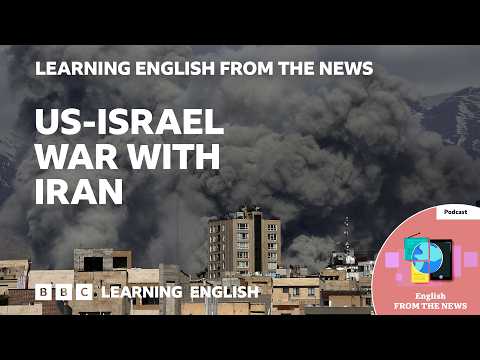
[0:00]From BBC Learning English. This is Learning English from the News, our podcast about the news headlines. In this program, the US Israel War with Iran.
[0:14]Hello, I'm Georgie. And I'm Becca. In this program, we look at one big news story and the vocabulary in the headlines that will help you understand it. You can find all of the vocabulary and headlines from this episode, as well as a worksheet on our website. BBCleningenglish.com. Okay, so let's hear more about this story.
[0:39]The US and Israel launched strikes on Iran on Saturday, killing Supreme leader Ayatollah Ali Hamene. Iran has retaliated, which means fought back with attacks against Arab states in the Gulf, which are allied with the US, such as Saudi Arabia and Bahrain. The conflict has threatened Lebanon and Cyprus in recent days. In an address on Monday, US President Donald Trump said the war aims were to destroy Iran's missile capabilities and its navy, as well as destroy its ability to develop nuclear weapons. But Donald Trump has made no mention of what Iran's future might look like after the war ends. At least 1,097 civilians have been killed in Iran since the war began on Saturday, says a human rights organization based in the US. Let's have our first headline. This is taken from the Financial Times, an international newspaper. Sweeping assault on Iranian state leaves residents reeling. And that headline again from the Financial Times, Sweeping assault on Iranian state leaves residents reeling. This headline is about the military action in Iran. Residents of Iran are left reeling, that means they are shocked by the strikes. We're looking at sweeping, a sweeping assault. Now, you might know sweep in the context of cleaning. When you sweep the floor, you cover a lot of area instead of picking things up individually. Sweeping in this context means to affect many things or people at once. So a sweeping assault means that lots of places were attacked around the same time. Another phrase you're likely to hear with sweeping is a sweeping statement. People often say, don't make sweeping statements, which means don't generalize.
[2:26]We've had sweeping, affecting many things or people at once. For example, the new government wants to bring in sweeping changes, they want to change lots of things.
[2:42]This is learning English from the news, our podcast about the news headlines. Today, we're talking about the US Israel war with Iran. The United States and Israel are continuing to carry out air strikes in Iran after war broke out on Saturday. Iran has responded by firing missiles at Israel and other countries in the region with links to the US. Iran has hit military targets, but it has also hit airports and other civilian sites like luxury hotels and shopping malls. Iran's foreign minister has said, we are not attacking our neighbors in the Persian Gulf countries. We are targeting the presence of the US in these countries. And our next headline is about this. Yes, this one is from BBC News. Allies of US in the Gulf bear brunt of Iran attacks. That headline again from BBC News. Allies of US in the Gulf bear brunt of Iran attacks. So, this headline is about Iran's attacks on the US allied states in the Gulf. We're looking at this phrase bear the brunt. In the headline, the word, the, is dropped. Becca, what can you tell us about it? Well, bear the brunt of something means to experience the worst part of a bad situation or be most affected by it. Yes, so in this context, these countries are bearing the brunt of Iranian attacks. It means they are the most affected by Iran's retaliation. They've been hit the hardest. Bear the brunt of is followed by a noun, usually something negative. Yes, now war is obviously a very serious context to use this phrase in, but it can also be used in more everyday situations. For example, small shop owners often bear the brunt of price rises. They are most affected by them. We've had bear the brunt of, be most affected by a bad situation. For example, customer service employees bear the brunt of angry complaints on the phone. This is Learning English from the News from BBC Learning English. We're talking about the US Israel war with Iran. As mentioned, it's not clear what Trump thinks Iran's future might look like after the war ends. Following the Supreme leader Hamene's death, there is an interim leadership committee in charge. Interim means temporary, but it's not known who the next leader of Iran will be. The lack of detail in Trump's plan beyond the air campaign has been criticized by politicians in the US Congress. And that is what our next headline is about. This one is from The Guardian, a British newspaper. No one can predict how the US war with Iran will unfold. And that headline again from the Guardian, no one can predict how the US war with Iran will unfold. So this headline is about the uncertainty surrounding the US Israel war with Iran. We're looking at unfold. Yes, unfold in the context of the headline means something similar to develop. How will the war unfold? How will the war develop? Yes, it has this sense that a story or events will be revealed gradually over time. Think about the literal meaning of unfold. If you unfold a paper map, you reveal what's inside. Now, again, war is a very serious context for this word, but unfold is also used in more everyday situations. We often use unfold to talk about stories, events, or drama. For example, it's clear the company my friend works for is having financial difficulties, but she's going to wait to see how things unfold before she looks for other jobs. We've had unfold, develop or be revealed. For example, when the storm hit, we watched everything unfold on the news. That's it for this episode of Learning English from the News. We'll be back next week with another news story. Try the worksheet on our website to test what you've learned. Go to BBClearningenglish.com. And don't forget to follow us on social media @BBCLearningEnglish. Goodbye for now. Bye.


