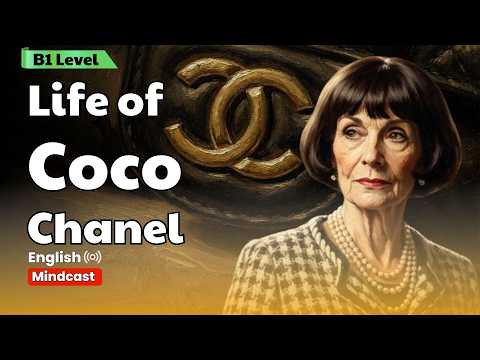
[0:00]Welcome, my friends. Pull up a chair. Let's take a moment together. Tonight, I want to tell you a story. It is a story about a woman who changed the world with a pair of scissors and a very strong will. You probably know her name. You see it on expensive bags, on bottles of perfume, and in the windows of the most beautiful shops in Paris. Her name was Gabrielle. But the world, the world remembers her as Coco Chanel. But before the fame, before the diamonds, and before the cameras, there was just a little girl with nothing but her dreams. So, let's go back. Let's go back to a time of heavy dresses, cold winters, and a young girl who refused to be ordinary. Imagine a cold, gray building in the French countryside. This was an orphanage, a place for children who have no parents. This is where our story begins, in a place called Aubazine. Gabrielle was born in 1883 in a small town called Saumur. Her family was very poor. Her mother died when Gabrielle was only twelve years old. Her father, a man who traveled to sell things, could not take care of her. He took Gabrielle and her sisters to the orphanage and he never came back. Can you imagine that? Being twelve years old, alone, and left behind by the person you love most? But, my friends, it was inside those cold stone walls that Gabrielle learned the skill that would change her life. The nuns, the religious women who ran the orphanage, taught her how to sew. They taught her how to use a needle and thread. Everything in the orphanage was simple. The colors were mostly black and white. The floors were hard. The air was quiet. Many people think Gabrielle hated this time, and perhaps she did. But look closely at her later work. The black and white colors, the simple lines, the sense of order, it all started there. Gabrielle was not like the other girls. She was quiet, but she was watching. She was learning that if you want to survive, you have to be strong. She didn't want a life of pity. She wanted a life of power. She realized early on that her hands, and her ability to sew, were her ticket out of that gray world. Have you ever had a difficult start? Sometimes, the hardest parts of our lives are actually the seeds of our greatest success. For Gabrielle, the silence of the orphanage was the beginning of her loud voice in the world of fashion. When Gabrielle left the orphanage, she was a young woman with a sharp mind and a slim figure. She didn't have money, but she had a dream to be a performer. She began to sing in cabarets, small theaters where people drink and listen to music. She wasn't the best singer in France, my friends, but she had "spark." She had a special energy. She often sang two popular songs. One was about a girl who lost her dog, and the dog's name was "Coco." The soldiers and the crowds loved it! They would shout, "Coco! Coco!" and the name stuck. From that moment on, Gabrielle Bonheur Chanel became Coco Chanel. But Coco knew she wouldn't be a singer forever. She met a wealthy man named Etienne Balsan. He was rich, he loved horses, and he invited her to live at his large estate. This was a new world for Coco. She saw how the rich lived. But she also saw how uncomfortable the women looked. They wore giant hats with too many feathers and dresses that were so tight they could barely breathe. Coco began to make her own hats. They were different. They were small, simple, and elegant. When the other women saw them, they laughed at first. "Where are the feathers?" they asked. "Where is the lace?" But soon, they stopped laughing. They realized that Coco looked modern. She looked cool. She looked free. Coco realized that she didn't want to be just a guest in a rich man's house. She wanted her own business. She wanted her own money. She started to realize that her "hobby" of making hats could be something much bigger. She was ready to move from the countryside to the heart of the world: Paris. In 1910, with the help of a man named "Boy" Capel, who was perhaps the true love of her life, Coco opened her first shop. It was a small hat shop at 21 Rue Cambon in Paris. She called it "Chanel Modes." Imagine the street. Horses walking on the stones, the smell of fresh bread, and women in long, heavy skirts. Then, there was Coco's shop. It was different. Her hats were like a breath of fresh air. But Coco was hungry for more. She didn't just want to change what was on a woman's head; she wanted to change how a woman felt. She opened another shop in Deauville, a beautiful town by the sea. In Deauville, she saw women struggling to walk on the sand in their heavy, fancy clothes. It looked so difficult! So, Coco did something shocking. She took jersey fabric. Now, back then, jersey was only used to make men's underwear. It was cheap and soft. Coco used it to make dresses. People were surprised! "Underwear fabric for a lady's dress?" they cried. But when the women put them on, they felt something they had never felt before: comfort. They could move. They could walk. They could breathe. Coco's business grew very fast. She was no longer the poor girl from the orphanage. She was a "Businesswoman," a word that was not used for women very often in those days. She was building an empire, one stitch at a time. She was showing the world that simplicity was not boring. Simplicity was the highest form of style. My friends, let's talk about the corset. Have you seen one in a museum or a movie? It is a piece of clothing made of stiff material and metal. Women wore them under their dresses to make their waists look tiny. It was very painful. It was hard to eat, hard to sit, and almost impossible to run. Coco Chanel hated the corset. She thought it was like a cage for women. She said, "Nothing is beautiful if it is not comfortable. She began to design clothes that followed the natural shape of the human body. She got rid of the tight waists. She shortened the skirts so women could actually walk. She even took inspiration from men's clothing, using jackets and trousers. This was a revolution! Before Coco, fashion was about showing how much money you had by wearing expensive, heavy things. Coco changed the rules. She made it about freedom. She also introduced the color beige. Before her, beige was considered "dirty" or "plain." But Coco saw it as elegant. She loved colors that were found in nature, the color of sand, the color of stones. Think about it, my friends. Imagine being a woman in 1915. For your whole life, you have been told to sit still and look like a doll. Then, this woman Chanel gives you a soft jersey dress and tells you to go for a walk. How would you feel? You would feel like you finally had a voice. Coco wasn't just selling clothes. She was selling a new way of living. She was telling women: "You are active. You are independent. You are free." By the 1920s, Coco Chanel was a star. But she was about to create two things that would make her name live forever. The first was a smell. In 1921, she worked with a famous perfume maker named Ernest Beaux. She told him, "I want a perfume that smells like a woman, not like a flower." At that time, perfumes usually smelled like one flower, roses or jasmine. Beaux gave her several samples to try. They were numbered 1 through 5, and 20 through 24. Coco chose number five. Chanel No.5 was born. It was a total change. The bottle was simple and square, like a laboratory bottle. It was clean and modern. To this day, it is the most famous perfume in the history of the world. It is said that a bottle is sold every few seconds somewhere on Earth. Then came 1926. Coco designed a simple, short, black dress. Now, listen to this: before 1926, women only wore black for funerals. If you wore black, it meant someone you loved had died. It was the color of sadness. But Coco changed that. She published a picture of a simple black dress in Vogue magazine. They called it "The Ford of Fashion," because like the Ford car, it was something everyone could have, and it was always in style. She called it the Little Black Dress (the LBD). She showed the world that black was not just for mourning. Black was chic. Black was powerful. Black was perfect for every occasion. Every woman could look like a princess in a simple black dress. With the perfume and the dress, Coco Chanel didn't just follow the trends. She made the trends. She was the queen of Paris. The 1920s were a wild time. They were called the "Roaring Twenties." People were dancing the Charleston, listening to jazz, and drinking champagne. And in the middle of it all was Coco. She was friends with the greatest artists of the time. She knew Pablo Picasso, the famous painter. She knew Salvador Dalí. She was part of the "high society." She traveled on huge yachts and stayed in beautiful palaces. She even had a famous relationship with the Duke of Westminster, one of the richest men in England. People asked her, "Why don't you marry the Duke?" She famously answered: "There have been several Duchesses of Westminster, but there is only one Chanel. She was proud. She was independent. She didn't need a man's name to be important. But it wasn't all parties and sunshine. Coco suffered a great deal of pain. Her great love, Boy Capel, died in a car accident. She was heartbroken. She said, "In losing Capel, I lost everything." Some people say she started wearing black because she was mourning for him, and that is why she made black so popular. She was a woman of many secrets. She was successful, but she was often lonely. She worked very, very hard. She would stay up late, pinning fabric to models, searching for the perfect line. She was a perfectionist. She was also a woman of many faces. She could be kind, but she could also be very sharp and mean. She was a complicated person, just like the times she lived in. In 1939, the world changed. World War II began. When the war started, Coco Chanel did something that surprised everyone. She closed her fashion house. She said, "This is not a time for fashion." Thousands of people lost their jobs. During the war, Paris was occupied by the German army. This is a very difficult and controversial part of Coco's story, my friends. While many people in France were suffering, Coco stayed in the famous Ritz Hotel in Paris. She had a relationship with a German officer. Because of this, many people after the war called her a "collaborator" - someone who helped the enemy. There are many books and stories about her actions during this time. Some people say she was just trying to survive. Others say she was a spy. It is a dark cloud over her history. When the war ended in 1945, the people of France were angry with her. She was not the hero she used to be. She left Paris and went to live in Switzerland in a kind of exile. For almost ten years, Coco Chanel was silent. The world of fashion moved on without her. A new designer named Christian Dior became famous with his "New Look," which used lots of fabric and tight waists, everything Coco hated! People thought Coco Chanel was finished. They thought she was a woman of the past. But they didn't know Gabrielle. They forgot about the girl from the orphanage who never gave up. In 1954, Coco Chanel was 71 years old. Most people at that age are sitting in a garden, resting. But Coco? She was ready for a fight. She decided to return to Paris. She wanted to open her fashion house again. On the day of her first show, the French newspapers were not kind. They said her clothes were old-fashioned. They said she was too old. They said she had "nothing new to say." But then, something interesting happened. The Americans loved it! The American magazines like Life and Vogue saw her new designs, and they thought they were perfect. They loved the Chanel Suit, a simple jacket and a skirt that was perfect for the modern, working woman. Famous women like Jackie Kennedy and Elizabeth Taylor were wearing Chanel. Coco introduced the 2.55 handbag, named after the date she created it (February 1955). It was the first handbag for women that had a shoulder strap. Before this, women had to carry bags in their hands. Coco said, "I got tired of holding my purse in my hands and losing it, so I added a strap." Again, she was thinking about what women needed. She also made "costume jewelry" popular. She wore big, fake pearls with real diamonds. She showed the world that style was not about how much the jewelry cost; it was about how you wore it. She was back on top. She proved that you are never too old to have a second act. She proved that her vision of comfort and elegance was timeless. Coco Chanel worked until the very last day of her life. She died on a Sunday in 1971 at the Ritz Hotel. She was 87 years old. Think about her life for a second. She started with nothing in a gray orphanage and ended as the most powerful woman in fashion history. She once said, "Fashion fades, only style remains the same. And she was right. Today, more than 50 years after her death, her influence is everywhere. Every time you see a woman in a simple black dress, or wearing a jacket with gold buttons, or putting on a little perfume before she leaves the house, that is the legacy of Coco Chanel.
[17:20]Gabrielle "Coco" Chanel. A woman who lived by her own rules. Thank you for listening to her story tonight.


