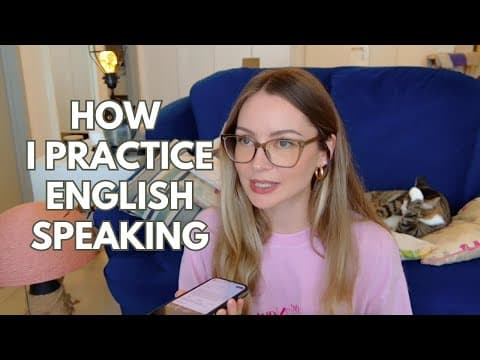
[0:00]Look at this tiny little paw. This video is for English learners who want to practice their English speaking skills and become more fluent. English is my second language, and I also teach it, so whatever I recommend or suggest comes from either my experience or my students' experience. This is from years of learning, practicing, living in English speaking societies, having a job in English, and kind of going through the challenges that come with that. So, what I noticed a lot especially through all of my comments that I get pretty much every day is that people think that the only way to practice English is to find a native speaker and talk to them. And that's not entirely true, that's not true at all. So, I'm going to show you four ways you can practice English speaking by yourself, at home, without needing a native speaker to help you with that. And I'm also going to explain why these methods work so well and why you're going to want to implement them right away. So, method number one is practicing your speaking through shadowing. And if you don't know what shadowing is, I'm going to try to explain it to you in very few simple words. So, basically what shadowing means is you being someone's shadow and repeat everything they say and the way they say it, the same tone, the same melody, the same speed, the same connected speech. So, I'm going to shadow a little bit of a TED Talk called The Simple Secret of Being Happier by Tia Graham. It's from Ted Manitou Springs edition, I think. Um, so I'm just going to shadow her and there's two methods for doing this. Two shadowing methods. So, if you're just at the beginning, if you're just learning English now, um, the first method is you listen to one line, pause, repeat. Listen, pause, repeat, right? So you give yourself a little bit of space, a little bit more room. The second method is simultaneous shadowing, basically you just press play and then repeat immediately after that person, you are a shadow for their voice. So first we're going to do the first method, so then you can see how you can apply it and then I'll show you how to do the second. Spend a lot of quality time with your friends and your family. Spend a lot of quality time with your friends and your family. For me, this looks like weekly date nights with my husband. For me, this looks like weekly date nights with my husband. playing with my daughters, every single day with my phone away, and face timing and calling my sisters multiple times a week. playing with my daughters, every single day with my phone away, and face timing and calling my sisters multiple times a week. So, see how I imitated her. I imitated her melody and her rhythm. That doesn't necessarily mean that that's exactly how I would have said those words if I read them off of a piece of paper, right? Because if I'm a non-native speaker or I'm still learning, I don't really know how this melody goes, how the tone changes. But when you do shadowing, it's very easy to understand, okay, you stop here, but you say all of these words faster. You take a break here, but you group all these words together, and that's how you learn this flow. So, for example, when she said, spend a lot of time with friends and family. So she said a lot, right? So that shows you, that's how you emphasize this quantity a lot. Because if she said, spend a lot of time with friends and family, this doesn't really show that she wanted to make sure that you understand it's a lot, right? So that's how your voice has to go a lot, and take it a little bit slower within those two words, a lot. And then she says, for me, this looks like weekly date nights with my husband, right? So, this is where it gets a little bit tricky because it's sort of a tongue twister, you have to say, weekly date nights with my husband really quickly. And that's where you can see that maybe you have troubles with, so you have to go again and repeat it until you can say it really quickly. So, first she said, for me, and then she pauses, right? Because we wanted to see what comes next. First, she said that for me, for in her opinion or for her life, for me, this looks like, okay? So, for me, this is first part, this looks like it's the second part, and then the third part, weekly date nights with my husband, right? So, that is one unit, it's a group of words, it's connected speech, and that's how you learn how to connect little words into bigger groups. Okay, and now the second method is going to be the simultaneous shadowing, which is a little bit trickier, but it's not as hard as you might think. It might sound a little weird, but I'm going to show you and you can be the judge of that, but I promise you, you get used to it. Spend a lot of quality time with your friends and your family. For me, this looks like weekly date nights with my husband, playing with my daughters, every single day with my phone away, and face timing and calling my sisters multiple times a week. So, that just put my brain into hyper-focus mode, and I had to keep up, right? I had to just follow the sounds that she was making and repeating that. I I didn't have time to overthink, I didn't have time to think about grammar, I didn't have time to think about vocabulary. Um, I don't need to know all the words she's saying, I don't need to understand everything she's saying. This exercise is just for you to be able to practice the way the mouth moves every time you are in connected speech mode, basically in real life speaking mode. And that will also challenge you to become quicker, faster, and more fluent. And this can be done with a million different videos, different types of videos, people speak differently. It's really good to practice with different speakers and not just one, um, and it's really good to practice different accents as well, because then you get to actually understand, oh, this is the difference. This is how they say it, this is how I say it, and then in time you get used to different accents as well, especially the non-native speaking accents. So, the shadowing method helps you realize and helps you see how real people talk and how they connect the words to each other when they speak. And shadowing is pretty easy because you don't have to produce your own thoughts yet, you just have to repeat after someone else. And our brain naturally imitates what it sees and what it hears, so that's why the shadowing method is really good to improve your fluency, your pronunciation, and your melody and tone. And because you have to repeat after that person like immediately, your brain doesn't have time to overthink. You just repeat the sounds and that's what we need. This method is supposed to improve your pronunciation and fluency, it's not supposed to focus on grammar, vocabulary or any other structures. So no overthinking, just repeating and teaching your mouth how to move quickly and how to sound natural. So shadowing is basically a language workout for your ears and for your mouth, because you have to listen and speak really quickly. So, it's a circle that has to go on like high rotation. And the more you mimic, the more you imitate other people, the more confident you become because you know that what you are repeating is not only correct, but it also sounds good, fluent, and natural. So, you can pick an audiobook, a TED Talk, a speech, um, a show, a movie, some interviews. I do recommend to focus a lot on maybe street interviews or vloggers, um YouTube vloggers, even Tik Tok, people, like normal people who talk in a normal rhythm. Because if you only shadow audiobooks or TV shows or movies, those are scripted things. People prepared to say those lines and maybe they said them 10, 20, 100 times, right? So it's not really natural, natural. And also their articulation, their diction is a lot better because they have to be understood. But with vloggers, they talk like normal real people, even though they probably also try to be a little bit more clear, but at least it's a normal flow. Okay, method number two is to practice your passive vocabulary. And a lot of my students and even me and a lot of people online, I see that they don't really understand the difference between passive vocabulary and active vocabulary. And they think that everything you learn should be active vocabulary. Um, the difference is that if you have a lot of passive vocabulary, it means that you understand a lot of things, but you cannot produce those things, you cannot speak the same way. Active vocabulary means that you are able to use the words that are in your active vocabulary and the expressions immediately when you need them and you don't you don't hesitate, you just have them available to you. So the reason why you understand everything I'm saying or you understand what everybody else is saying, but you can speak the same way is because you do have a lot of passive vocabulary and you haven't practiced it enough. So, for example, if you're watching somebody vlogging or showing you, you know, this is what this is called, this is what I'm doing, this is what this action is called and all of that, you might think like, oh, I'm learning new words. And this is cool, right? You're watching somebody talk and you're learning.
[9:55]But that is only 50% of your learning, right? You are absorbing that information, but that doesn't mean that you are able to use it. So let's say I film myself making breakfast and I'm narrating everything I'm doing, right? I'm flipping pancakes and I'm whisking eggs and all of that and you're like, oh, I didn't know that that is a whisk and I didn't know that it's flipping pancakes, right? So you think, oh, I learned that, now what you're going to do is you go and whisk some eggs and then you say, I am whisking eggs, this is a whisk, right?
[11:01]You introduce it into your speech, you tell your mouth what it's supposed to sound like, what is this word supposed to sound like? You uh tell your ear, okay, this is a whisk, associate this sound with this object, with this action. You basically have to do more with the words that you are consuming, the words that you are absorbing, the words that you are understanding, because the first step, you're getting familiar with them, and then the second part is when you actually introduce them into your speech, so they stay there so they can be available to you when you need them. So a few activities you can do to practice your passive vocabulary and I have a lot of these on my TikTok channel actually. Um, is number one, your house should be your English zone. Everything that you do in your house, everything that you see in your house, you should be able to say that in English. If you're cleaning your house, narrate what you're doing in as much detail as possible. If you are cooking, narrate what you're doing. If you are doing laundry, if you are painting, if you're doing anything, if you're going even to the gym, narrate what you're doing. You're going to be surprised by how many simple words you don't actually know that you see every day and you do every day. And what's cool about English is that words and expressions are pretty flexible, you can use them in other fields, in other areas. For example, if you flip a pancake, you can also flip a burger, you can also flip the page. So basically anything that you can quickly turn over or turn on the other side, that's flipping. You can do a what's in my bag video, pretend that you're a celebrity, you can do a day in my life video, pretend you're a vlogger. You can describe objects, for example, if I have this pillow and I want to describe it, I can be very, very descriptive with it in terms of physical appearance, right? I can talk about the shape, I can talk about the fabric, I can talk about the colors, the print, what I use it for, what I need it for and so on. Hey, don't not very graceful, ballerina, cappuccino. And because you rotate these words, you say them all the time, you pronounce them, you say them out loud, your brain is going to get so used to them. So next time you need them outside your house, you're going to be able to produce them right away. Okay, third method is converting your thoughts into an English zone. So first the house, then your thoughts. How many times have you replayed a dialogue that you thought, you know, oh, I should have said that, I could have said that instead, right? You replay that in your head a lot. So why not replay that in English? If you have some opinions about something that happened at work, something that happened with a friend, some news that you saw. Try to share and express your opinions in English. It doesn't have to be to anybody, just to yourself out loud when you're by yourself. If you want to ask your boss for some time off or a raise and you're kind of imagining what would that conversation look like, what would I say? What would I say if he says that? What would I say back if he said that? So, try to do that, but in English. This is going to help you convert your own thoughts into English and not just someone else's, right? When you do shadowing, for example, you are repeating someone else's thoughts. You have your own style, you have your own humor, you have your own way of speaking about different things. And this is also going to show you that these are the words that you need right now. And these are the words that you think you knew, but you don't really have them as part of your active vocabulary. I used to do that a lot when I was young, I used to imagine all these missed opportunities that I had in different conversations and dialogues I have with my mom or with my dad, or with my brother, with my friends, or with my teacher, right?
[15:21]I I used to imagine how I would like talk back and what would I say back to them, you know? And of course, my English was terrible at the beginning. I didn't have a lot of the vocabulary that I needed, but I tried to explain that, you know? So I tried to use whatever words or imagine whatever words I needed, but if I didn't know the word, I just tried to uh deconstruct it and explain it. And I was imagining all of these dialogues while pretending I was an American. Because I was watching all these shows and I really liked how they were so expressive when they would say something like if they asked, you know, what are you doing here? Or what do you think about that?
[16:29]Or why did you do that? Or whatever, you know, all of these questions, sentences, expressions that they would use, would have a different melody than they would in my language, you know, for the equivalent of those expressions. So, to me that was interesting to explore and I was practicing that in my mind.
[16:52]So, this way, I started converting my thoughts into English, and at some point, I caught myself thinking in English. You know, some of these situations would happen a lot, so I would rotate them in my mental dialogues a lot. So the next time I would have to say that same expression, it would just come naturally. I wouldn't have to think too much about it. And I also started to look at English as a communication tool, not just a set of vocabulary words and grammar rules that I was learning in school. So, I would watch these people on TV using this melody, the fluctuation in their voices, the pauses, the connected speech, the group of the words, and all of these things, and I saw English as a communication tool now, not just a subject in school. And that brings me to my next point and my last fourth method, develop your social skills. At the end of the day, English, just like any other language, just like your native language, requires having some personal and social skills. It's not just knowledge and pronunciation, it's a human being connecting with another human being. And English is just another language that has to be used in a certain way in order for it to work the right way. You need to learn how to be an active listener. You need to learn how to be empathetic. You need to learn how to be aware of your body language, your facial expressions, your eye contact, your tone of voice. You have to learn how to read the room, how to adapt to the atmosphere in the room. You need to know how to be respectful and polite in English. You need to learn how to provide feedback in English. You need to learn how to regulate your emotions, you need to learn how to be a little bit more open-minded or a lot more open-minded, because you will be interacting with people from all over the world, both native speakers and non-native speakers, that come from different backgrounds, so you need to be able to adjust very quickly. And yes, that includes practicing, talking to real people. And I know this goes against my first thing that I said at the beginning of the video, that you don't need a native speaker to practice English, and I said that is not the only way, right, to practice English. And the reason I add this point is because it is 2025. We have so many more resources right now, so many different apps and platforms that you can practice your English speaking skills with real people. I didn't have a smartphone when I was learning English, and I didn't have a lot of opportunities to interact with real people. And from my experience when I went to the US and the cultural shock I got, um, you know, from how you should behave, how you should talk to people, how you should adjust your tone of voice, your facial expressions. That was something that I learned the hard way. And also from my own experience and from my students' experiences, every single time you said something and a native speaker would interpret it differently, you'd be like, what did I say wrong? What was wrong with the words I said? Yeah. But the thing is, your words were perfectly fine, your grammar was perfectly fine, your vocabulary is perfectly fine, but the tone of voice or the moment when you said that didn't really fit the situation. And while it's really good to practice with AI apps or to chat uh through text with different people, that doesn't really expose you to these social skills that you need to learn. And for example, in speaking clubs, you get to interact with different people and you can also observe how other people interact with you and other people in the club. So you can learn from their mistakes, you can learn from the reactions from others. And that's how you become more confident in your own speaking and social skills and that makes you a little bit more motivated and encourages you to do it more. Because remember, English, just like any other language, just like your native language comes with a cultural aspect as well. It's not just uh vocabulary words and grammar rules, it's human behavior, perception, expectations, social norms and and many more things. I do also organize some speaking clubs, the next one is on July 13th, you can find it in the link in the description, 90 minutes of me interacting with you guys, having little debates. Uh, you get separated into groups. I also offer some support with uh maybe some pronunciation or some vocabulary, grammar, whatever it is that in the moment would be helpful. I'm there to support you with that. Um, but I provide the topics of the speaking clubs and you get to interact with people from all over the world because my audience is very global. Remember, you have way more control over your English speaking practice than you think. And saying that you don't have someone to talk to is just an excuse. Thank you so much for watching. I hope this gives you a bit of a different perspective around practicing your English speaking skills, and I can't wait to hear or see your thoughts in the comments. Okay, bye.