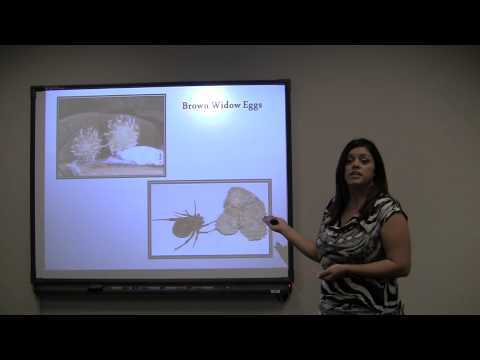
[0:06]As some of you may have noticed, coming up with a purely informative speech topic, well, it made my skin crawl. After many sleepless nights with Halloween quickly approaching, it finally came to me one fateful October morning, spiders. Now, as human beings, we can all relate to a fear of the unknown. Especially when the unknown pertains to the venomous bite of a sly spider. But with proper identification and knowledge, not only can we prevent against deadly bites, but we can ease fears. In addition to the research I've done specifically for this topic, I've also been studying the species in detail in a biology course this semester. Today, in this spider synopsis, I'm going to lead you through the only five known venomous spiders in Florida. Which will include the northern and southern Black Widow, the Red Widow, the Brown Widow, and the Recluse. Now that I've got you on all late legs, let's go ahead and take a quick look at the Southern Black Widow. The southern black is the epitome of a widow spider. It's got a jet black glossy body and a complete red hourglass shape on the underside of the abdomen. It's actually the most common widow found throughout Florida, and it likes to make it homes in and around buildings. Now, the widow bite and venom is the same for all the widows, so it will apply to the other widows we'll discuss, and we will revisit this information throughout the presentation. The bite itself is much like a pinprick, with little to no pain and is barely felt, until the venom takes effect. Now, the venom contains a neurotoxin, which affects the central nervous system, and bite victims could feel the effects in as little as 15 minutes to three hours. They may feel nauseous and sweaty, have high blood pressure and body temperature, or tightness in the chest and muscles. Now, according to Dr. Whitney, author of Priceless Florida: Natural Ecosystems, uh natural ecosystems and native species, widows are typically not aggressive and only bite if disturbed. And according to Die, no pun intended, death occurs in less than 5% of all reported widow bites. Nonetheless, know your arachnids. Let's take a quick look at the southern, Northern Black Widow next. The Northern Black Widow is similar to the Southern Black in appearance. You'll notice the only difference is the incomplete red hourglass shape on the underside of the abdomen. Now, the Northern Black is found in the panhandle, west of Tallahassee, and it actually prefers wooded habitats, making its webs up to 20 ft off the ground. The Northern Black Widow bite and venom is similar to that of the Southern Black and would have the same physiological side effects. Now, according to Whitney, a secluded habitat and limited range makes bites less likely to occur. Nonetheless, know your arachnids. Keeping it in the Widow family, let's move on to the Red Widow next. The Red Widow varies greatly from the Northern and Southern Black. It actually has a reddish orange head and legs with a shiny black abdomen. You'll notice there's no hourglass shape on the underside, uh usually just one or two small red marks. Now, the Red Widow is endemic to Florida. Can anybody tell me what endemic means? It actually means it's only found here, it's specific to our region. It ranges all the way from Ocala to Port St. Lucy, and it prefers to make its homes in the bushes of scrubland habitats. Now, the Red Widow's bite and venom has the same physiological side effects as the other widows. And according to Dr. Whitney, preferred habitat and limited range makes bites less likely to occur. Nonetheless, know your arachnids. Moving on to our final Widow, we're going to take a look at the Brown Widow next. Now, this Widow varies greatly in appearance. It can range anywhere from almost black as the Black Widows, to almost white, but usually brown with some white markings along the sides. You'll notice the full hourglass shape, however, in the case of the Brown Widow, it is orange. And the best way to identify this Widow is if the egg sacks are present. Raise your hand if you've ever seen these curious looking objects in or around your home. If so, it's certain that you do have a Brown Widow present. Now, the Brown Widow is actually not native to Florida, it was introduced, but it's the most adapted to humans, and that's why it comfortably makes its homes on screen enclosures, guard rails, and fences. The Brown Widow's bite and venom is similar to all of the other Widows and would have the same physiological side effects. Now, according to the Department of Agriculture, Brown Widows are very timid and bites are rarely reported. And let's not forget, according to Die, death occurs in less than 5% of all reported Widow bites. Nonetheless, know your arachnids. Now, before we take a look at the final player in our Fab Five, take a quick look at this inkblot here. Does anybody have any visions? How about now? What you're looking at is actually the best way to identify our final spider, and that is the Recluse. Now, the Recluse has three sets of two eyes, resulting in six total, typically most spiders have eight eyes. They're a medium-sized spider, light to dark brown in color. Now, you'll notice another way to identify this spider is the violin shaped marking on its head. However, it's also the cause of some confusion. Let's take a quick look at some of the commonly confused, the Huntsman, the Wolf, and the Crab Spider. Since the Recluse does have so many imposters, it's all the more important to be able to properly identify this spider. Now, it's not native to Florida and no breeding populations have been found, however, three species have been collected. The Mediterranean Recluse, found in the Florida Panhandle and all the way to Dade County, the Chilean Recluse, found only in Polk County up to this point, and the Brown Recluse, found in North Florida and as far south as Gainesville. Now, the Recluse actually makes its homes in sheds and garages, and in the arms and legs of hanging clothing. Now, the Recluse bite is similar to the Widow in that the bite itself is rarely felt with little to no pain, but the venom is where it'll get you. The venom contains a cytotoxin, and that actually attacks the cell tissue. Bite victims could feel effects in as little as 2 to 6 hours, they may feel headache and nausea, high fever, or severe stomach cramps and joint pain. Usually the bite will have a red blister at the site, and then a telltale bluish circle, bullseye pattern will appear around the bite. Now, the Recluse bite actually makes you have a necrotic wound. You're going to know if that wound is necrotic with if it turns purple within 12 to 24 hours, and essentially the skin turns black and dies off. Now, according to Die, if left untreated, a Recluse bite could result in kidney failure. However, Edwards of the Florida Department of Agriculture states that, like the Widow, the Recluse only bites when disturbed or trapped against human skin. I say though, when it comes to the Recluse bite, never mind, nonetheless, just know your arachnids. So, what can we conclude in this web of information? We now know that Florida only has five venomous spiders. We can identify them, we know where they're located, and we know their threat level. The central idea here is that most of the spiders we encounter every day are a harmless part of our working environment. Now that you can properly identify the five venomous species that pose a threat, you can ease fears as well as prevent deadly bites. So, what will you do the next time you encounter one of these eight-legged creatures? I encourage you to know your arachnids. And in inclusion, no spiders were harmed in the making of this presentation. Thank you.
Spider Informative Speech. Good attention getter.
Ann Eastman
7m 24s1,360 words~7 min read
AI audio transcription
Transcript source
AI audio transcription
This transcript was generated from the video's audio because no usable YouTube caption track was available. The transcript below is server-rendered so it can be read, searched, cited, and shared without opening the original YouTube player.
Pull quotes
[0:06]As some of you may have noticed, coming up with a purely informative speech topic, well, it made my skin crawl.
[0:06]After many sleepless nights with Halloween quickly approaching, it finally came to me one fateful October morning, spiders.
[0:06]But with proper identification and knowledge, not only can we prevent against deadly bites, but we can ease fears.
[0:06]In addition to the research I've done specifically for this topic, I've also been studying the species in detail in a biology course this semester.
Use this transcript
Related transcript hubs
Watch on YouTube
Share
MORE TRANSCRIPTS


