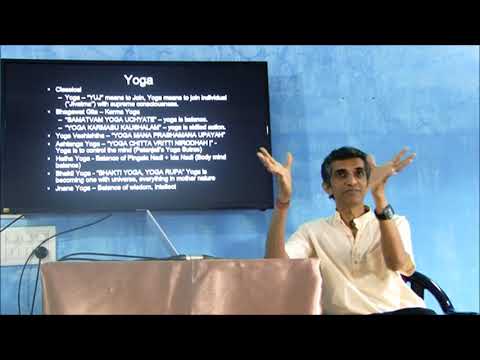
[0:08]I'm going to discuss different types of yoga with you. But before we go to this different types of yoga, it is important that we understand what is yoga. So, today's session is about what is yoga.
[0:30]Many people think yoga is a set of exercises where you do physical movements. Some people think that it is a lifestyle. Some people say yoga is spiritual science. Some people say yoga is to join, say, body-mind. Some people say yoga is to lose weight. Some people say yoga is a wonderful technique. When you have a backache, go to yoga class. Once the backache is healed, no need of yoga. People have different understanding of what is yoga. Today I'm going to discuss with you the classical definitions of yoga, that have been studied for thousands of years in different traditions of yoga, different types of yoga. And this will open up a little different understanding about yoga to you. When I started compiling this definitions from different types of yoga, I was surprised to see such an interesting thinking that's gone into this science of yoga. And how it is coming all together. So, let's discuss it one by one. The word yoga, it's not yoga. The word is yoga. It, the word yoga comes from a Sanskrit verb called yuj, yuj. Yujati. Yuj is to join.
[2:29]What do you need to join? You need two or more objects to join. And when you join these two or more objects, what happens to those objects? They become one, correct. So, yoga is that idea of oneness.
[2:57]I have this individual consciousness, where I identify myself. I, me, myself. This I and there is outside. So, there's two identities, me and outside. When these two become one, that is yoga. So, when I experience that oneness, that is yoga. The first clear definition of yoga, which is much more practical definition, an applied definition you can call, is given in the text of Bhagavad Gita. A very important text on yoga. In fact, the most powerful text on yoga is Bhagavad Gita. Bhagavad Gita is a dialogue between Shri Krishna and his friend and disciple King Arjun. Krishna is also King, Arjuna is also King. They are cousins and very good friends. Arjuna has some problems, so he's talking to Krishna and he's asking for solutions. Not just some problems, but he has the highest problem that anyone can imagine in his or her life. It's a question of life and death. And it's a decision that he has to make. It's very emotional, very sad, depressing state for Arjun. And Krishna gives him a solution, and what is the solution? Yoga. So, Arjuna asks him, what is yoga? And Krishna answers to that is, Samatvam Yoga Uchyate, yoga is balance. See, very simple definition, yoga is balance. Balance of what? Yoga is balance of my body and mind. Yoga is balance of my emotions. Yoga is balance of my thoughts. Yoga is balance of my actions. Yoga is balance of my intellect. Do we have all these things in balance? Emotions, do we have balance of emotions? I don't even know what is balance. Because I never, never ever been in that balanced state. I'm always either on this side or either on that side. Either I am too excited, wow, or I am so stressed or depressed. Never balanced.
[6:04]Thoughts, are my thoughts balanced? Most of the times my thoughts are negative, useless, random. There's no balance of thoughts, there is no harmony of thoughts. My intellect, again, there's a problem with harmony and balance.
[6:33]This definition talks about it. Balance of emotions. I'll tell you a quick story of Buddha. Buddha was sitting under a tree in one of the towns he was visiting. Some young boys came there and started blaming him. They they didn't like him, they thought he's a cheat. So, they wanted him out of their town. So, they started blaming him. But he was very quiet, calm and quiet. No reaction. They got angry. When you don't give any reaction to the person, then the person gets angry. You all know this. But again, Buddha was quiet. This went on for an hour or so. And, one of the boys said to his friends, hey wait, let me check if this man can hear us. Let me make sure that he can talk and he can hear. The boy said, okay. Check. The boy went up to Buddha and said, hello. Can you hear me? Buddha opened his eyes, smiled and he said, yes. What can I do for you, my friend? The boy was surprised. He said, hey, you can talk, you can hear. He said, yes. So, did you get what we gave you for last one hour? Buddha smiled and he said, what you wanted to give was your choice. Whether to want it or not, whether to take it or not is my choice. So, the boy was surprised. He said, so you're not angry? He says, what for? No reason for me to get angry. This is that harmony of emotional mind, balance of emotional mind. Answer Buddha gave was unique. He said that what you thought is your opinion. I don't think I'm like that. I'm just disagreeing with you. There's no reason why my emotions should be disturbed. This is balance of mind. And this is what this definition talks about. Yoga, Samatvam Yoga Uchyate. Yoga is that balance of mind. And the mind has everything. Thoughts, intellect, emotions, even actions start from the mind. Everything is in the mind. The second definition of yoga again comes from Bhagavad Gita. Yoga Karma Su Kaushalam, yoga is skilled action. in any action. And what is the skill? To bring yourself to harmony, to bring yourself to that state of balance and harmony. I'll tell you a quick story of a great yoga master. His name was Swami Vivekananda. In 1897 he went from India to US. He was one of the first yoga masters to travel to the United States and then Europe.
[10:07]And he talked about yoga there. He gave the definition of yoga, he gave what this yoga has to offer to the humanity. And that lecture became hit. Everyone loved it. So, this is a story from Swami Vivekananda's stay in US. One day he was taking a walk on the beach, early morning, in some beautiful city of US. And while taking a walk, he saw some young boys playing some sport. Now, he never saw that kind of sport before. The boys were actually having a gun in their hand and they're trying to shoot at the floating balloons in the water. It's quite hard. Water was choppy and the balloons moving. And anyway, it's very hard to aim, if you, if you know the shooting game. It's very difficult to aim and shoot. And now, Swami Vivekananda was very interested in knowing what they are doing. So, he went up to the boys. He watched them for a while. Then he went up to them and he asked them what are you doing? The boys said that this is a game of shooting and it's very difficult game. Why are you asking? It's not a cup of tea for you. He said, but it looks so interesting. Can I try just once? The boy said, okay, just give him one and let's see. Anyway, he'll not be able to shoot anywhere. So, they gave him the gun and he asked them how to do it. There was a boy who is quite, like, honest and he explained things to him. And then exactly as he explained, Swami Vivekananda focused the gun on the balloon without moving the hand, he pulled the trigger slowly. And to the surprise, the first balloon was blown. So, the bullet hit the balloon properly. So, the boys said, hey, good shot. But they were surprised. They said, this is the first time he's trying. So, how can he get a first shot correct? Maybe it's by chance. So, the boys asked him, do you want to try another one? They just wanted to make sure that it was by chance. So, he said this, this is very, like, quite a good fun. Please, I want to try again. They put another bullet, he again fired. Second balloon was blown. Ten bullets, ten balloons blown. The boys were really, really surprised.
[12:47]They said, you are the best shooter we have seen. How can you do it? Who taught you? He said, you guys taught me. So, you must be good. Otherwise, how I would be able to shoot? So, he understood their question. And what he answered to them is this second definition, Yoga Karma Su Kaushalam. Skill in any action that I can bring. And what is that skill? The skill is harmony and balance within me.
[13:28]When I am standing up and shooting at the objects, my body and mind are not in harmony. And it's a skill to bring the body and mind in harmony. When you're sitting here for lecture, huh? The body is here, where's the mind? In the kitchen, the snacks, or maybe back home, what my partner has done, has he made a mess of my apartment? Or in future, when I go back, I have to pay these bills. Mind is somewhere. So, I am not there because my body is here, but my mind is there. And I'm not here. Only body is here, mind is not there here. So, I don't get what is going on here and I can't help what is going on there. You understand my point? I'll explain it another way. Bhagavad Gita says, we have three basic energies in us. Three energies in us. You can write down and remember. First type of energy is Gyan Shakti. Gyan Shakti. Gyan is intellect, wisdom, knowledge. Gyan is actually wisdom. You get it through intellectual process. Intelligence you can say, knowledge, wisdom. The first energy that we have. The second energy that we have is Bhakti. Bhakti. Bhakti is emotions, emotional energy or will power you can say. Will power, emotional energy, or will power. Feelings.
[15:40]And third, karma, your action, your behavior.
[16:13]Now, these three energies, do they work in harmony inside me? Do they work in balance inside me? The answer is straight, no. I give you example, you must have come across some of your friend, who smokes. So common these days. The person who smokes, let's analyze the three energies in him. What is the intellectual energy that he has or she has tells him or her when the person smokes? What is the intellectual energy telling him or her?
[17:03]Stressed, action. What is written on the pack?
[17:11]Smoking is injurious to health. So, his intelligence knows, if I smoke, it's bad for me. Right? Intellectually he knows smoking is injurious to health. These days they put such a big pictures on the cigarette packs. You've seen the pictures? They look so horrible. And there's this always fight going on between the tobacco companies and the government. The government says the whole cigarette pack should have disgusting pictures. So that people will have more intellect awakened. And their intellect will tell them that this is really bad. The tobacco companies say, no, no, we don't want that, we want them to smoke more, because we can make money out of their death. That's why they make it smaller and smaller and smaller and smaller. But understand, we are not interested in government and these companies. We are interested in the person. His own intellect says, this is not good. What is his emotions say? I need it. It doesn't matter. If I have to die, I will die. Let me just smoke. And action is following emotions. Not always, actions follow emotions. Sometimes actions follow intellect. We all, everyone like sugar. But these days, because the intellect has become stronger, we read so much why white sugar is not good. Just eating white sugar in large proportions is quite bad for health. So, what people started doing? Green tea. They avoid white sugar. See, when you see a white sugar kept there on the table, there's a lot of, lot of things in the Ashram, ki, dining, for you. There's so many little small bottles with so many herbal things that you can mix and make tea into. White sugar, very few people touch. When they go close, what is their emotional being telling them? Emotion says, no, no, white sugar. Sweet, nice, take it. Intellect says, no.
[19:40]Action says, I follow intellect. So, actions don't always follow intellect or emotions. They follow either of it. Sometimes the actions don't follow both of them.
[19:54]I'll tell you. I have got a lot of subjects written, and many subjects related to yoga. I have to still write. If I make it into a book, it will be a nice thing for you guys. Now, intellectually, I agree. Intellectually, no problem. Intellectually, I accept and agree that this is important. Emotionally also I feel that yes, I should do this. Because it's good for everyone. But in last two years, I haven't done it. Lazy. Sometimes, some people, intellectually they know, that, okay, I am feeling sick. So, I should not eat this stuff that's going to make me more sick. Emotionally also they don't want to get sick. Still they eat and get more sick. So, actions do not always follow intellect and emotions. Yoga, this definition, yoga Karma Su Kaushalam, yoga is that skill where I can bring all these three things together. The intellect, the emotions and actions. Gyan in Sanskrit, Bhakti and Karma. Bringing these three things in harmony is yoga. And where are these three things? They are in my mind. The intellect is a part of my mind, the emotions is a part of my mind, and action also starts in my mind. Expression is outside, but action starts inside my mind.
[22:02]So, this is again like the first definition, balance of mind. The next definition of yoga comes from another text, very important text called Yoga Vasistha. Rishi Vasistha was the guru of King Ram. There's a great epic of Ramayan. The more you get into yoga, you will understand this epic of Ramayan, which is a story of Lord Ram. And an epic of Mahabharat, which is a story of Krishna. If you understand these two epics, you will understand the whole of yoga. So, this Yoga Vasistha is a dialogue between Rishi Vasistha, the guru of Ram, and Ram himself. And Ram is asking him the definition of yoga, and Rishi Vasistha tells him, Mana Prashamana Upaya. Yoga is the technique to bring Prashaman. Shaman is calm down, Prashaman is absolute stillness. Mana mind. Yoga is a technique to achieve absolute, peaceful and calm state of your consciousness. Mind is again a very important aspect. In this definition as well. The first definition is centered around mind.
[23:40]Second definition is again talking about mind, consciousness. The third definition of yoga is in Ashtanga yoga. Patanjali has defined yoga in the second verse of Yoga Sutras. There are only 197 verses called Yoga Sutras in the book of Patanjali. The book name is Yoga Sutras. The second sutra, the second line of that book says, Yogas Chitta Vritti Nirodha. Chitta is again on a gross level, it's mind.
[24:19]Chitta is a much deeper word. Chitta is the entire domain of consciousness that we have. The entirety, the totality of our consciousness. But here, you can understand it as mind. Vritti is functioning of the mind. There are five Vritti, five ways the mind functions, but we will not get into the Vritti. Right now, Vritti is nothing but you can understand as functioning. Functioning of the mind. Chitta is mind, Vritti is functioning of the mind. Nirodha is control. So, Patanjali defines yoga as, yoga is to control the functioning of the mind. See, the definition of Ashtanga yoga, definition of yoga in Ashtanga yoga is again talking about Yogas Chitta Vritti Nirodha.
[25:22]Can you control your mind? What you tell your mind, the mind never listens.
[25:36]I told you what not to think about. First day, did I tell you that? What did I tell you? Pink elephant. In the first lecture, it's like almost ten days back. I told you not to think about pink elephant, and now I ask you, what are you, what I told you? You're saying pink elephant. See, mind is quite funny. When you say to mind, don't do this, the mind will deliberately do it. See, the people who get depressed, no one, no person likes these depressing thoughts. But the mind doesn't listen to that person. The person is telling the mind, I don't like this depressing thoughts. Please, don't have these depressing thoughts. Or the person who is stressed, the person tries, oh I don't want to have this thoughts, because they are stressing me. But the mind is not controlling. You cannot control the mind because mind doesn't listen to you. That is a big problem. Emotions, when you get emotional, when you're getting angry, if someone tries to tell you, see, getting angry is not good, if you get angry, your heart is going to get damaged.
[26:56]What the angry person will do? Don't teach me all these things. Go check your heart, it's already damaged.
[27:10]So, the mind doesn't want any control and the mind controls us. We think we are really powerful people. What is the power? One thought of stress destroys my entire day. One thought of depression destroys my months. One thought of anxiety and fear makes me go to that doctor and get anti-anxiety pills so many times. See, how strong I am. That is why, these definitions of yoga are centered around body. Sorry, mind. Why? Because yoga says the body is nothing but a result of what is your mind. If you change your mind, the body is going to change. If you control your emotions, the functions of your body will be under control. Right now if, if you get stressed, the blood pressure is out of control, the sugar is out of control.
[28:28]So, if you control, if you control your mind, the sugar will be controlled. If you control your mind, the blood pressure will be controlled because the body will be controlled. So, it's a very important definition, Yogas Chitta Vritti Nirodha. Yoga is to control the functioning of the mind which gives me power to control my body. So, the entire focus of all these definitions of yoga are about mind. Mind that.
[29:12]The next definition of yoga comes from Hatha Yoga Pradipika. Hatha Yoga, the tradition of Hatha Yoga. The word Hatha. Ha and Tha. Ha means Pingala Nadi. Sun principle, or physical energy, or body. And Tha word is Ida Nadi. Moon principle, mental energy, or mind. So, the word Hatha is again talking about balance of body and mind. Is my body and mind balanced? No. My mind is also not balanced and my body is also not balanced. Is my body and mind in harmony? They are not in harmony at all. What my mind says, my body never listens. And what my body wants, my mind never gives. We had this little discussion in the first lecture. You remember that? So, there is a lack of harmony in this body-mind aspect as well. Hatha Yoga says, if you can balance the body mind, then this monkey will calm down. And this monkey can sit and meditate.
[30:54]It's hard for this monkey to meditate, I'm telling you that. And that's why path of meditation is quite hard. Anyway, this is the definition of yoga in Hatha Yoga. Harmony of body-mind. So, mind is again there. Then comes the definition of Bhakti Yoga. Just slightly, a deeper understanding. Bhakti Yoga says, when I become one with everything around on emotional level, this experience of oneness is yoga.
[31:45]Have I experienced this oneness on emotional level? I have. When my friend had some problem, and when he was crying, when I had tears in my eyes for him, or for her, I became one emotionally with her or him. That is Bhakti Yoga.
[32:38]Oneness. Emotional oneness.
[32:47]You understand the yoga idea. And last is Gnana Yoga. Gnana Yoga also says oneness. Understand it on intellectual level. Can you understand it on intellectual level? We can. Intellectually, now we know as a human society, if some part of the world, some people are suffering, I feel bad. So, I say, my duty is to go and help them there. Or I should contribute in this way or that way. In our society, inequalities always existed. Every society, there are inequalities. Higher, lower, white, dark. All these inequalities, castes in India, higher castes, lower castes. All inequalities exist. But intellectually, now we understand that these inequalities are not correct. And we try and have one system for everyone. This is also that oneness we are trying to implement through our intellectual process, analytical mind. This is also a process of yoga. So, this is all the idea of what is yoga as per the different traditions and types of yoga. The only point I would like to highlight here is yoga starts with mind and ends with mind. Mind is the bottom line, the focus of yoga. Body is a tool. Emotions are a tool. Thoughts are a tool. Breath is a tool. Meditation is a tool. Mantras is a tool. For what? To achieve that state of mind which is experiencing oneness. And that state of mind which is experiencing oneness is peaceful, evolved, balanced, positive state of mind. And that is yoga. So, I'm going to stop here. If you have any questions, you can definitely ask. Hari Om.


