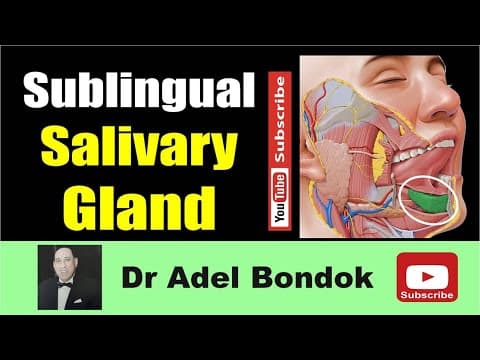
[0:16]Hello everyone. This is Dr. Adel Bondok, Professor of Anatomy and Neuroscience, Mansoura University, Egypt. I am going to talk about the anatomy of the sublingual salivary gland. I will talk about the position, the relations, arterial supply, nerve supply, and the sublingual ducts. Start by the position. This is again, this is the sublingual salivary gland. This is the mucous membrane of the mouse. This is the mylohyoid muscle, and this is the sublingual fossa of the mandible. And the sublingual fossa is above the mylohyoid line. So the sublingual salivary gland is located in the floor of the mouth. It is located below the mucous membrane, above the mylohyoid muscle, in the sublingual fossa of the mandible. So you have to remember three facts. Below the mylohyoid, the mucous membrane, above the mylohyoid, in the sublingual fossa of the mandible. Okay? So when we talk about the relations of the sublingual gland, what is superior? What is inferior? What is medial? And what is lateral? Superior, it is the mucous membrane of the floor of the mouth. Inferior, it is the mylohyoid muscle. Medially, three structures. This is the first one, muscle, genioglossus muscle. Okay? So genioglossus muscle, lingual nerve, and submandibular duct. And laterally, it is the sublingual fossa of the mandible. And the sublingual fossa is located above the mylohyoid line.
[2:22]This is the mylohyoid line. Again, relations of the sublingual salivary gland. This is the sublingual salivary gland. The four relations, superior, it is the mucous membrane of the floor of the mouth. Inferior, it is the mylohyoid muscle. Then medial and lateral. Medially, it is the genioglossus muscle, lingual nerve, and submandibular duct. Laterally, it is the sublingual fossa of the mandible. Let us put the roof again. This is the roof. So the sublingual gland is located here. Sublingual salivary gland is located here. The roof is the mucous membrane. The floor is the mylohyoid muscle. The medial wall is genioglossus, lingual nerve, and submandibular duct. Laterally, it is the sublingual fossa of the mandible. Regarding the arterial supply, it is the lingual artery, branch from the lingual artery, which is the sublingual branch. And the sublingual branch is from the third part of the lingual artery. Regarding the nerve supply, we have parasympathetic secretomotor, sympathetic vasomotor, and sensory. The parasympathetic nerve supply from the facial nerve through the chorda tympani branch. So it's parasympathetic. Facial nerve, chorda tympani branch. Regarding the sympathetic, superior cervical sympathetic ganglion, okay, through plexus around the lingual artery. And the sensory is from the lingual nerve. So the three nerves supplying the sublingual gland, parasympathetic, facial nerve, chorda tympani branch. Okay? Let us follow the parasympathetic fibers from its origin. Origin, superior salivatory nucleus in the pons. Fibers enter the facial nerve. Leave the facial nerve through the chorda tympani. The chorda tympani joins the lingual nerve, and the fibers synapse in the submandibular ganglion. And from the submandibular ganglion, the postganglionic fibers reach the sublingual gland, either directly or with the lingual nerve. Sympathetic fibers from the superior cervical sympathetic ganglion. Fibers form a plexus around the external carotid artery. Then from the plexus around the lingual artery, the fibers reach the blood vessels of the sublingual gland. The sensory is from the lingual nerve. Again, this is the parasympathetic innervation of the sublingual gland. Parasympathetic fibers to the sublingual gland. Start from the superior salivatory nucleus in the pons, then facial nerve, then the chorda tympani, this is the chorda tympani. Fibers join the lingual nerve, and then the fibers synapse in the submandibular ganglion, and the postganglionic fibers reach the sublingual salivary gland. Either directly or with the lingual nerve. Actually, regarding the chorda tympani branch, the chorda tympani branch of the facial nerve contains two types of fibers. The blue fibers are the parasympathetic fibers. The green fibers are the taste fibers from the anterior two thirds of the tongue. Okay? So, superior salivatory nucleus, facial nerve, chorda tympani, lingual nerve, submandibular salivary submandibular ganglion, and then the postganglionic fibers reach the sublingual salivary gland. Regarding the histology of the sublingual gland. The sublingual gland contains seromucous acini, but mostly mucous acini. This is a serous assinus, serous acini, and these are the mucous acini. Okay? So serous and mucous, but mostly mucous. So the sublingual gland contains seromucous acini, but mostly mucous acini. Therefore, the secretion of the sublingual gland is mostly mucous. Okay? Unlike the submandibular salivary gland, where the secretion is mostly serous. The secretion of the sublingual gland is mostly mucous. Regarding the sublingual ducts, these are the openings of the sublingual ducts. And this is the sublingual papilla. Sublingual papilla formed by the sublingual gland. So the sublingual ducts are many, from 10 to 20 ducts. Okay? From 10 to 20 ducts. They are very short. Okay? The termination, they open directly into the floor of the mouth. Okay? Some of some of them may join the submandibular duct. This is the opening of the submandibular duct. So the sublingual ducts, from 10 to 20, they open directly into the floor of the mouth. Some of them may join the submandibular duct. And thank you very much, best wishes, and good luck.


