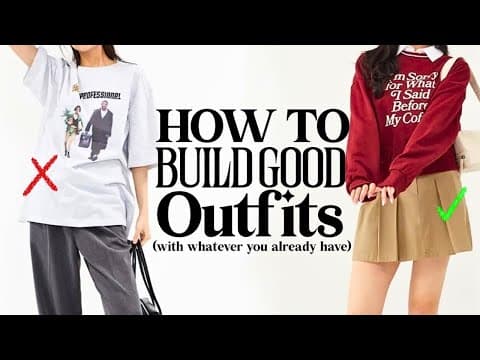
[0:00]Your closet is full of clothes, but you don't really have anything to wear. So, what do we do? Ladies, take a seat and watch me teach you how to take your basic outfits from this to this. Putting together an outfit that works for you is down to four key points. Firstly, there are two types of colors, neutrals and everything else. Well, neutrals about neutrals. They are not just good. They are the white. They're the easiest to work with. It is so much easier to mix and match different pieces to create multi-dimensional outfits with neutrals, because, you know, they pretty much go with anything and everything. So, yeah, neutrals are great, but what if you want some real colors in your outfit? The key is to know which colors go well together. So, let me tell you about this little thing called a color wheel. Colors that are directly opposite one another are complementary colors and when put together, they help create a bolder look and give contrast to your outfits. And colors that are next to each other on the color wheel are analogous and match well together to create a very subtle and cohesive. So, how do you go about this? You could use two neutrals, that is one neutral with another neutral. You could use one neutral with a non-neutral, or you could use three neutrals together. But, but, but, but, there's a catch to it. The key to wearing color is to figure out which colors you love wearing the most and which ones flatter your skin tone the best. Wearing the right colors will make you look more radiant and glowing. The wrong ones will make you look like a half cooked egg. So, how do you find your underlying skin tone? The first method is to just check your veins. If there are more of blue and purple veins, you have cool undertone. If there's more of green and olive veins, then that means you have a warm undertone. And if it's a mix of both, then you have a neutral undertone and the world is nicer for you in terms of fashion. So, once you find your underlying skin tone, the first thing you want to do is to avoid the colors that are too close to your skin tone. But that's not it. You also need to find out what colors actually flatter your skin tone. So, these are some of the colors that flatter warm skin undertones and these are some of the colors that flatter cool undertones. Second, second chapter, playing with the proportions and the silhouette. If you've ever looked at your outfit and felt like something is off, then chances are that the proportions of your outfits are crusty dusty. In outfit terms, we can use the rule of thirds to break our outfit into three or more aesthetically pleasing parts. Now, your clothes have the ability to completely change the way you look, but only if you know how. Look at these high-waisted pants. What can they do? They create an illusion by making your legs look longer and slimmer. The high-fitted waist not only makes your waist look narrower, but also adds a solid vertical column, which makes your legs look longer. In general, wearing high-waisted pants in ankle or floor length pants will make you look taller and leaner. Pairing these with cropped, fitted and tuck tops or highlighting your waistline using a belt would only make it better. You can always tuck your top the way you think it will flatter you. Fully on one side or just at the front. You can use contrasting colors for better results. A monochromatic outfit creates a cohesive look which keeps the eye running up and down. It's basically the column logic all over again. Try playing with the textures to contrast between the top half and the bottom half. By the way, pro tip, if your shoes are the same color as whatever is covering your legs, it will basically create a seamless flow from your waist to toes, and that will make you look taller. Now, you might have seen yourself complaining that oversized clothes don't look good on me. Baggy on baggy can make you look like a balloon and tight on tight is just awkward. So, baggy with tight clothes is just perfect. A baggy top with a tight bottom or a tight top with a baggy bottom. The importance of the fabric. Now, watch this closely. At the first glance, there is nothing wrong with this outfit, but if you look closely, it's thin and it looks cheap. Thicker and softer fabrics are more sturdy and have more structure to them, thus giving you a more clean and sharper look. Hard and stiff fabric can create the illusion by adding extra weight and stiffness to your silhouette. So, you should just generally avoid those fabrics. Everything until now was just the base of the pizza. Adding that final extra level of depth and dimension to your outfits will make them look more finished and cohesive. Accessorizing could mean using anything from bags, belts, blazers, coats, vests, watches, jewelry, a hat, shoes or even headphones nowadays. There's no limit to how much they can spice up your outfit. If you have pieces like these that can go with the majority of the other pieces in your outfits, girl, you're sad. For garnish, add a bit of confidence and sass to your outfits and it's complete. Oh. What is that? Is that- is that... Is that my love for you? *laughs in first hand embarrassment* Subscribe.
How To Make Your Outfits BETTER | Elevate Your Style ✨️
Claire's Monologue
5m 13s946 words~5 min read
YouTube auto captions
Transcript source
YouTube auto captions
This transcript was extracted from YouTube's auto-generated caption track. The transcript below is server-rendered so it can be read, searched, cited, and shared without opening the original YouTube player.
Pull quotes
[0:00]Ladies, take a seat and watch me teach you how to take your basic outfits from this to this.
[0:00]It is so much easier to mix and match different pieces to create multi-dimensional outfits with neutrals, because, you know, they pretty much go with anything and everything.
[0:00]So, yeah, neutrals are great, but what if you want some real colors in your outfit?
[0:00]Colors that are directly opposite one another are complementary colors and when put together, they help create a bolder look and give contrast to your outfits.
Use this transcript
Related transcript hubs
Watch on YouTube
Share
MORE TRANSCRIPTS


