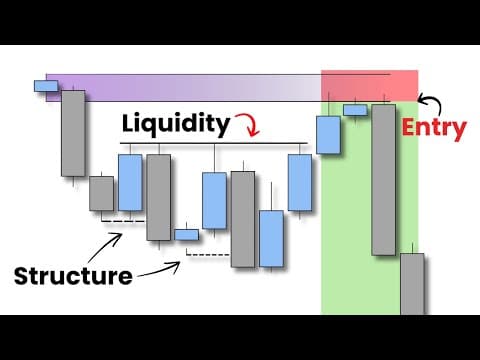
[0:00]There are two different price action trading concepts that when combined create one of my personal favorite entry models.
[0:06]And these concepts actually build up the backbone of the majority of my trading strategy.
[0:11]They are liquidity and market structure. In this class, I want to give you a deep understanding of both and share with you an entry model and a trading system that you can start to apply to make some good trades and make some profits.
[0:22]So with that said and done, let's get into the learning.
[0:25]Market structure theory suggests that markets move in three phases. We have uptrends, we have downtrends, and we have consolidation.
[0:33]Now, an uptrend is simply a phase where a market is continually moving to the upside, and through an uptrend, we only want to buy a market.
[0:40]A downtrend is the opposite, where a market is continually moving to the downside, and through these markets, we only want to sell.
[0:46]Now, a consolidation is generally where we just move sideways.
[0:49]There's no real trading opportunities most of the time inside of consolidation ranges, so we pretty much want to eliminate this and just focus on uptrends and downtrends.
[0:58]To determine whether a market is in an uptrend or a downtrend, we want to look at the highs and the lows in price.
[1:05]So, we can see in the uptrend, we form higher highs and higher lows.
[1:10]A market that is forming new highs and lows, higher than the previous highs and lows, is an uptrend.
[1:16]Okay? We can see the market's clearly moving up, but we define that by the fact that the market is continuing to push past these previous highs, right?
[1:25]So this here is what we call a break of structure.
[1:29]It's this push upwards past the higher high. This as well is a break of structure, and the actual break of structure we talk about is taking place at these points.
[1:38]Because we get these breaks in structure that continue pushing the market higher, this is indeed an uptrend.
[1:42]A downtrend is pretty much the same but flipped upside down. So in a downtrend, we are forming lower lows and lower highs.
[1:49]And what that simply means is every low and every high that forms in the market is lower than the previous.
[1:54]Once again, we indicate the continuation of a downtrend with these breaks of structure, which is when the market pushes past a previous low.
[2:03]The next thing you need to know is that a trending movement is made up of two main parts.
[2:08]We have impulsive movements, and we have corrective movements, so impulses and corrections.
[2:13]Now, an impulse is a pro-trend movement. It's the movement that breaks the structure.
[2:18]So, in an uptrend, after we form a higher high, a corrective move will pull down to form a higher low.
[2:24]And then the impulsive move is defined by the movement that breaks through the previous higher high, forming a new higher high.
[2:31]So, those are the impulsive moves, the pro-trend larger movements that break structure. Corrective moves are just pullbacks that don't really break any significant structure, but they allow the formation of new higher lows to keep us understanding which way the market is going.
[2:45]Now, eventually, trends come to an end.
[2:48]We can define when they're coming to an end by looking at the higher lows.
[2:52]So here we have this impulsive bullish trend. We have an uptrend, in this market, we only want to buy.
[2:58]But what happens if the market comes down and breaks through this low like this?
[3:03]Well, now, we would get a new impulsive move, this movement here, but this would be a bearish impulse.
[3:10]The reason we know this is an impulse is because it's broken through the previous higher low, which breaks this higher high, higher low formation, and breaks the uptrend.
[3:18]So, from this point onwards, we would instead now be expecting the market to make a lower high, and then a new lower low, and the new lower highs and lower lows to continue this market in a downtrending fashion.
[3:31]Where we basically shift from this bullish trend into a bearish one.
[3:36]So here is a view of that full piece of trending structure.
[3:39]We have bullish impulses and corrections, where the market is continually breaking through new higher highs and making new structural higher highs and lows.
[3:47]Then we have that break, which is a bearish impulse that pushes past the higher low, forming a lower low.
[3:52]Then we get a pullback corrective move forming a lower high. Then we break more structure into new lower lows and lower highs and so on.
[3:58]So that is how a trend works, and it pretty much runs like this all of the time.
[4:02]The majority of the time in the market, the market's going to be trending one way or the other, except for, of course, those consolidation moves that we said we don't want to trade.
[4:09]Now, let's talk about liquidity. Liquidity refers to orders or money.
[4:14]Now, markets move due to orders and money and transactions taking place and passing hands in the market.
[4:19]Now, to understand liquidity, we just want to think about where people are generally buying and selling from.
[4:24]So if we know in this trending movement here, we have a low, a swing low, and we have a swing high, and these are formed in the market already.
[4:32]We know there's going to be some level of buyers down here. We know there's going to be some level of sellers at the high.
[4:38]Okay? People trade different strategies. Generally, once the markets make highs and lows, whether it's based on supply and demand, support and resistance, or any other concept.
[4:50]People will be buying above lows, selling above highs.
[4:53]Now, these traders generally follow simple advice. The majority of them do. Any trader who buys at a swing low or just after a swing low is formed, will generally have stop losses underneath the low.
[5:02]Anyone who sells will generally have stop losses just above the high.
[5:06]It's rare that you buy somewhere in a trend and then just put your stop loss in that trending movement as well.
[5:10]Generally, you want to clear highs and lows.
[5:13]It's common education. Yes, it works, but it also creates a lot of liquidity.
[5:16]So these areas that we've just marked become liquidity.
[5:22]Okay? There's liquidity here, there's liquidity here. Now, why is that? Well, that is because there's a significant number of orders at either of these levels, and markets react to orders.
[5:30]The reason markets move is because of injections of buying orders and selling orders.
[5:34]Now, if we know that multiple buyers have been taken place here, potentially thousands by different traders, well, now we know there's a collection of thousands of different orders waiting here in the form of stop losses.
[5:44]As well as this, we have breakout traders who would have sell stop orders here, thinking if the market comes and breaks through this low, I want to be triggered into a sell to take the market lower.
[5:52]So we have stop losses, and we have sell stop orders under here in the thousands, which creates liquidity.
[5:59]We have the same up here at the top, but we have stop losses for sellers, and then we have buy stops as well.
[6:06]So there's a whole lot of orders, transactions awaiting at the highs and the lows.
[6:09]Now, because we know that markets react to orders, where is the market most likely to react now? Somewhere randomly in the middle of this area?
[6:16]Well, probably not. It's more likely to see significant reactions once highs or lows have been taken because that is where the orders are going to be that could potentially drive the new movements in the market.
[6:27]So we may hit the swing high and then see a significant sell lower, hit the swing low, see a significant move higher.
[6:34]That is the kind of premise of liquidity, forming above swing highs and swing lows.
[6:38]It's simply the market reacting to areas where the majority of the orders are situated.
[6:43]Okay? Now, as we discussed, there are ways to understand where this is likely to take place.
[6:48]So, looking over here now, we have a market that's formed a bearish impulse. Then we have two highs which are level with one another, and we have two, almost three lows which are level with one another.
[6:58]Now, from a support and resistance approach, which the majority of traders or beginners are actually looking at, we have a support and a resistance.
[7:07]Okay? What are traders looking to do at support and resistance?
[7:11]Well, generally, what we've just discussed, right? Traders want to buy above support. So there will be buy orders placed here, hoping the market moves higher.
[7:18]And traders want to sell below resistance. So we know from this, there are going to be stop losses down here. There are going to be stop losses up here.
[7:28]And we also get those sell stops and buy stops, as we discussed, okay?
[7:31]So up here we have stop losses from buyers, but we also have buy stops from breakout traders who are looking for a new high to form.
[7:38]Down here, we have the stop losses and the sell stops from traders looking for the opposite.
[7:42]We have the stop losses for buyers, but we also have sell stops for breakout traders who are expecting to see a kind of break retest scenario in the market.
[7:50]And remember, these are very, very common concepts to trade.
[7:53]Sometimes you get stuck in the bubble of kind of price action concepts on YouTube, but you'd be underestimating how many people around the world are trading with support and resistance and these basic similar concepts.
[8:02]Where is the liquidity then? Is it sitting in the middle of this slow-moving range?
[8:07]No, it's at the highs and the lows. It's above here, it's below here.
[8:12]This is where the liquidity is, this is where those major reactions are likely to take place.
[8:17]So what we would be looking for as traders is for the low to go, and then to look for some opportunity to trade higher.
[8:24]Or for the market to trade above this high, and then this is where we would look for opportunities to trade lower.
[8:29]So when we understand the liquidity here, what we actually do is get two beneficial things.
[8:33]We get potential targets at these highs and lows because if we know that the market is likely to attack these highs and lows, well then we can find opportunities to trade towards those levels.
[8:42]For example, if the market swept this low, well, now, if we saw a reaction, a reversal in the price, we could look for a long opportunity back up towards this high.
[8:52]Because we know it's likely the market's going to come and attack this liquidity as well, and if the structure then agrees with us, the structure being what we've just discussed and don't worry, we'll elaborate on this more.
[9:01]Then we have good means for getting into a position and tackling the other points of liquidity.
[9:05]Now, as you can imagine, the other thing it's good for is entries, as I've just highlighted.
[9:09]If the market was to come all the way up here, and we know there's more liquidity down here, we can use this area now that it's been swept to find an opportunity to sell down.
[9:20]So we would actually look for that structural change, so just like this, a market that's changing from higher highs and higher lows into lower lows and lower highs, we could sell there, and we could look to tackle the next point of liquidity.
[9:33]And probably now you can see how we're starting to formulate a trading setup.
[9:37]So, this is the entry model that I want to show you in this video, using structure and liquidity together.
[9:43]Let me break it down. What we've got is a bearish market. We have bearish impulses and then we have the small corrective moves as discussed.
[9:51]Now, in a bearish market, we are seeing these lower lows and lower highs form.
[9:55]We then want to identify points of liquidity in the form of those equal highs, as we just discussed.
[10:00]So where we saw the resistance level, we know there's stop losses and buy stops above this level. That's what we want to identify.
[10:07]Now, sometimes this is going to formulate inside of a bearish movement, and when you see this, this becomes a very high probability setup.
[10:15]So we are looking for a market that is bearish, forming a notable trend of lower lows and lower highs.
[10:20]Then we want to identify that liquidity in the form of equal highs or a resistance.
[10:27]And then, once the market breaks those equal highs or breaks that resistance level, comes into the area where the liquidity is, we will use a final tip called supply and demand to find our entry.
[10:37]Now, this zone here is a supply zone.
[10:40]So it is basically a area just before a large bearish impulsive movement down.
[10:46]And the concept is, once the market comes into this level again, we would then look to sell.
[10:49]So after we come up into it, we see this is a high probability area to sell from because we've seen significant selling taking place from this level before, which shows that this is a level that sellers accept as a premium price to sell from.
[11:04]It's a good level to sell from. The market gets back here, it's seen as a good premium to sell from again.
[11:08]So just to recap this one more time before I show you an actual example, we are looking for a bearish trend.
[11:15]We want to make sure the market is forming notable lower lows and lower highs.
[11:18]When it does, we are then looking for the formation of some equal highs, some resistance.
[11:23]Then once that resistance is taken, we are looking to sell using that final tip, the supply zone that we just discussed.
[11:31]Okay? Now this can work on any timeframe, and don't worry if this is a little bit confusing now.
[11:35]You will see it in real markets in just one moment.
[11:38]Now, one final question you might have about this entry model is how is this not a break of structure?
[11:43]Right? As we said, when the market breaks through a previous high or low, this should be seen as a break in structure.
[11:48]So why are we now looking to sell even though we've had what we could call a break of structure?
[11:53]Why don't we look instead for a continuation into new buys?
[11:58]Well, the reason for that is because of how the market reacts to liquidity, right?
[12:01]If this wasn't equal highs, if this wasn't a resistance, and this didn't have a significant amount of liquidity above it, then we would indeed see this break as a break in structure.
[12:10]But because it's equal highs, because the resistance is still here, the stop losses, the buy stops, all of this stuff is here, and the remainder of this bearish trend is still intact.
[12:19]Then it remains possible and highly likely that this will be a false break of structure, where instead of breaking and then continuing, we break just to sweep liquidity above the equal highs.
[12:30]So if there wasn't any equal highs here, and the market looked like this instead, then yes, we would look to buy.
[12:36]But because we have that resistance, because we have those equal highs, it becomes high probability to sell.
[12:41]So when you're trying to work out whether it's a break in structure or a sweep of liquidity, just consider that.
[12:46]Do we have a point of significant liquidity like equal highs or a resistance level?
[12:51]If we do, then it's likely the break will actually fail and actually just sweep liquidity before continuing the sell-off.
[12:57]Now, let's get to an example of this on the charts.
[13:00]Take a look at this price structure here. We have a large upward move, forming a higher high, pull back to form a higher low, a push up to form a new higher high.
[13:09]Then we have a higher low, a higher high, and then we have this break in structure here, which brings us into lower lows, okay?
[13:16]So we've just made that shift from bullish into bearish, right?
[13:21]We've seen this structure shifting down. Now we have a bearish impulse. This becomes a bearish trend, a bearish market.
[13:28]So this is our high, this is our low. The market then comes back and forms this lower high before coming down to make this lower low.
[13:37]Now, the reason that we don't really want to consider this intermediate structure is because this is what we call the consolidation that we looked at, right?
[13:44]We said there's three phases. Consolidations, we don't really want to trade. But we can see that this area here, the market didn't really make any movements other than sideways.
[13:54]It's only when we broke through into the next low at this level here, that we continued with the bearish trend.
[14:00]So, that's kind of just a pause in the trend, where the market does nothing but go sideways.
[14:04]So, at this point, we have a bearish trend. We've got the impulses that we want to see, we've got the smaller corrections, and then we've got this messy consolidation.
[14:11]Now, what forms during a consolidation?
[14:14]Well, consolidation areas is where we are going to get these equal highs that we just discussed.
[14:20]So here we can see one, two pushes up, and then a little bit lower down we've got a bunch of other pushes as well.
[14:25]We could pretty safely say that this area here as a whole, or if we wanted to get really refined, it would be this area that I've just marked out, is seen as a resistance in price.
[14:37]So there are going to be sellers somewhere within this range.
[14:40]There will be breakout traders at this point, now looking for a break above this high.
[14:44]So traders who are expecting if this happens, their buy stops will trigger them into buys for a break retest continuation.
[14:50]And there will also be sellers taking place anywhere inside of this range.
[14:54]Could be here, could be even where we are now, could have been previous at this resistance retest, whatever.
[15:00]But these sellers are going to generally, in mass at least, a lot of them, as a generalization, have stop losses above these equal highs and above this high.
[15:09]So this creates an area where there is a significant amount of liquidity, orders, or transactions, which means if the market reaches back into this point, such as a sweep above the swing high, we would then look for a continuation lower.
[15:21]That's what we would expect to see, okay? If we then consider the final thing we discussed, which was a supply zone.
[15:28]I said a supply zone was a consolidation area before a large downward move.
[15:33]Now, this candle here is a huge wick where we opened and closed at the same level.
[15:37]So this is what we consider as a consolidation area.
[15:41]We are looking for what I call the last candle before the impulse.
[15:44]This is the last candle before the bearish impulse that broke structure.
[15:48]So this here, that large candle, that large bearish candle, is our supply zone, okay?
[15:53]So now we've got a few things. Let me annotate, we've got our low which indicates a new bearish trend.
[15:59]We've got our supply zone, which indicates a solid level to sell from, once the market reacts to it once again, because it was seen as a premium to sell from before.
[16:08]And we've got our equal high liquidity, just above the consolidation, which is going to be pretty much this level here, right?
[16:17]We can draw this out. It is relative equal highs at this time, so we're missing it by about one pip, but we can clearly see this is a resistance level.
[16:25]Uh, they don't have to be to the pip direct equal highs, don't, but they have to be very, very close to the point that, you know, when we take a look at this, you can see how refined and how close together these levels truly are.
[16:35]So with what we can see here on the chart, let me map out the entry model once again that we just discussed.
[16:40]So we have our bearish trend. We have the formation of equal highs within that bearish trend.
[16:47]We then sweep above the equal highs, and then sell back below.
[16:52]So the equal high is just here, the supply zone just here, and this has to be taking place in a bearish trend, right?
[16:59]So we see bearish, so we see bearish impulses, equal highs, sell from supply once equal highs have been swept, bearish impulse, equal highs, sell from supply once equal highs have been swept, and target further down in the trend.
[17:10]So how do we approach this then for an actual trade position?
[17:14]Well, what we're now looking for as traders, if you haven't already guessed it, is for the market to sweep equal highs, trade into supply, and then we will be looking to sell the market down from there.
[17:23]So at this point, we can go ahead and place an order.
[17:26]So our sell limit would be at this level here.
[17:29]The best way to get into these trades is going to be a sell limit because a sell limit just triggers you in once the market reaches that level.
[17:34]You'll get triggered into a sell, and then if the market reverses, as we expect it to, you will then profit.
[17:39]For the stop loss, I like to keep it above the high, right?
[17:42]We could put it above the supply zone, that would be fine.
[17:45]Simply because we're so close to the high here, I'd actually put it just above the high, just in case the market decides to wick or anything.
[17:52]That is going to make your trade a little bit safer if you just always clear the highs.
[17:55]You don't need to kind of push your luck for the biggest possible risk reward. That's going to be fine.
[18:00]Now, targets wise, what we can do, because we are now in a bearish trend, is just look for open areas below.
[18:06]For targets, I like to use, once again, either points of liquidity, so swing lows, or just areas of demand, which would be basically the opposite for a supply zone, a consolidation before a large upward move.
[18:16]So if we go take a look at the bottom of this movement, we have here our area of consolidation before this large upward move.
[18:22]We could use this as a target, okay? That is our demand zone. Trade would look like this, and that would be the entry model pretty much prepped out.
[18:30]So this would be a solid trade. We now have this price range and this demand that we can trade through. So what we would do at this point is simply place a sell limit order and then allow the market to run through.
[18:41]What we're looking for is for the market to trade into the area of supply, as we've just seen happen, and then sell off from there, towards wherever our target may be in this new bearish trend.
[18:51]Now, you would have been safe with your stop above the zone.
[18:54]We went a little bit higher and put it above the high, which is completely fine.
[18:59]This would be 4.69% return for every 1% risk.
[19:02]And it followed that entry model perfectly. We have bearish impulses, equal highs, sweep equal highs, sell from supply, and target further down in the trend.
[19:11]And by the way, just to highlight it, yes, you can trade this the other way.
[19:14]If we were in a bearish trend that shifted into a bullish trend, we could actually trade this using equal lows and demand.
[19:21]It works exactly the same both ways.
[19:25]Doesn't matter if you're buying or selling, you just need to be following the correct trend.
[19:28]So if we begin a new uptrend, you can use equal lows and demand zones to buy instead of sell, using the exact same entry model.
[19:35]So that is a simplistic entry model that you can use to start putting liquidity and market structure together into action in the markets to make profits from your trading.
[19:44]What you should do next is go to the top link in the description of this video and sign up to my completely free system building course.
[19:50]I show you how to turn this into a trading strategy, then how to backtest it, journal it and validate it so you can trade it live with an understanding of the win rates and other important metrics.
[20:00]If you don't have a system, you won't win at trading. So take advantage of it, it's completely free.
[20:05]And with that said and done, I'll see you in the next video.


