[0:01]After swallowing an aspirin tablet, it will go on a journey through your digestive system. Absorption. The tablet will travel down the esophagus into the stomach, where it is dissolved into much smaller particles. These particles will continue their journey into the small intestine, where most of them will be absorbed into the blood. The small intestine walls, also called lumen, are lined with tiny villi which stick out to provide a large surface area for the nutrients inside the food to be absorbed. Looking closer at these villi, you can see they have a rich blood supply and they are covered in a thin layer of epithelial cells. The aspirin molecules will work their way through the epithelial cells and into the bloodstream, where they are carried around the body. Distribution. Blood plasma contains complex molecules called albumin. Albumin is a protein made by the liver which transports nutrients around the body. Albumin also binds to drugs that enter the bloodstream. Here you can see some of the aspirin molecules binding to the albumin. All the aspirin particles that have been bound will be filtered out as they pass through the liver, and only the remaining aspirin molecules will get through and have any effect on the body. Different drugs will bind to albumin in different amounts depending on their affinity for plasma protein. The next stop on the journey is the liver. The aspirin-rich blood will enter the liver through the hepatic portal vein at the bottom, and it will exit at the top via the hepatic vein. At this stage, even more of the aspirin will be removed through a process called first pass metabolism. The liver's job is a bit like a filter. It will metabolize drugs before they reach the rest of the body. It does this in a few steps. Phase I Metabolism. First, aspirin is hydrolyzed, breaking off ethanoic acid and leaving behind salicylic acid. This salicylic acid isn't water soluble, so it can't be excreted in urine yet. Phase II Metabolism. An ionized group is then added to the salicylic acid, forming glucoronide, which is water soluble and can be excreted in urine. A lot less of the aspirin will continue its journey onto the rest of the body, including the site of the pain. Only 68% of orally taken aspirin will have any effect at all, because of all the filtering that the body has done. This percentage is called the drug's oral bioavailability. If drugs are not administered orally, e.g. intravenously or buccally, then they can bypass the small intestine and liver, so none of this filtering takes place and they have 100% bioavailability. We are now at the site of some skin tissue damage. Tissues in the skin are creating prostaglandins, which are causing inflammation. The prostaglandins are sending messages to the nerves in the skin responsible for the sensation of pain. Once the aspirin arrives in the blood supply at the site, it prevents the production of prostaglandins in the tissue, which will reduce the swelling and stop the messages being sent to the nerves that are perceived as pain. Excretion. Any remaining aspirin in the blood will go round and round the blood supply, going back through the liver several times until it is all used up or filtered out of the body. It travels into the kidneys and then into the bladder for excretion.
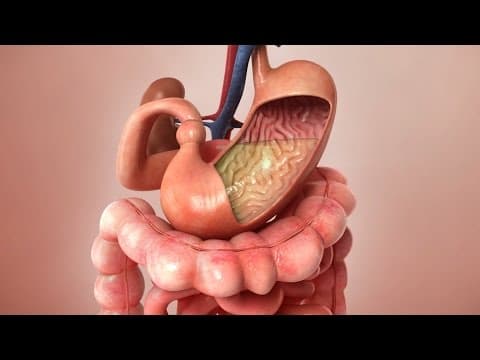
Aspirin Journey through the body - 3D Animation
3D Steve
3m 42s568 words~3 min read
YouTube auto captions
Transcript source
YouTube auto captions
This transcript was extracted from YouTube's auto-generated caption track. The transcript below is server-rendered so it can be read, searched, cited, and shared without opening the original YouTube player.
Pull quotes
[0:01]After swallowing an aspirin tablet, it will go on a journey through your digestive system.
[0:01]The tablet will travel down the esophagus into the stomach, where it is dissolved into much smaller particles.
[0:01]These particles will continue their journey into the small intestine, where most of them will be absorbed into the blood.
[0:01]The small intestine walls, also called lumen, are lined with tiny villi which stick out to provide a large surface area for the nutrients inside the food to be absorbed.
Use this transcript
Related transcript hubs
Watch on YouTube
Share
MORE TRANSCRIPTS


