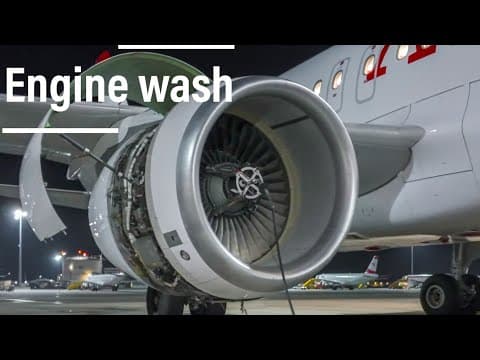
[0:00]Okay, today we need to perform engine wash on one of our A320 aircrafts with the CFM engines. And for that, we're going to use this cyclean machine.
[0:13]What does this machine doing? Basically, we will fill it with a certain amount of water.
[0:20]And then we're going to pre-heat it to 70 degrees. We're going to wash it only with a pure water, not with a solution. So, we pre-heat the water.
[0:30]And it will going to provide certain pressure to inject the water inside of the compressor.
[0:40]It can be completely independent, it will have its own generator, but in the hangar, of course, we plug it always to a socket.
[0:50]And yeah, you can basically, you can basically perform this engine wash everywhere. We have blankets up there.
[1:05]The adapters, we have in the hangar. So depends which engine you want to wash, that adapt those adapters we're going to take.
[1:13]We can wash every engine which Austrian have in the fleet. And yeah, this is an exhaust from the generator if you want to perform engine wash outside.
[1:27]But yeah, everything is inside.
[1:31]Now, we're going to fill it with a water and yeah, we'll wait until the airplane arrived. Meanwhile, I'll show you the adapters which supposed to be here.
[1:41]Okay, since I've been talking about adapters, here we have adapters for our short-haul fleet.
[1:48]Here, you can see one for Embraer, this is for CFM-34. Next to it, those are for CFM-56. Actually, those will going to use today.
[2:00]And this is the nozzle through which the water will going to be sprayed into the engine.
[2:11]And yeah, it holds on the engine thanks to these four hooks all the way around and it's attached to the spinner.
[2:22]It holds on it on this rubber. So you don't need to be afraid then it will be damaged somehow. And on this, we're going to connect our hose.
[2:34]And the last one from short-haul fleet or mid-range is this one. This is for PV 1000G, this is for our Neo fleet.
[2:45]And of course, the diameter is big bigger. And yeah, nozzle.
[2:57]And thanks to those devices we are cleaning, as I said, our short and mid-range fleet. And now we're going to take a look on the other hangar on the one for long-range. So let's take a look at it.
[3:11]Okay, behind me you can see Boeing 767 which is equipped with the PV4000 engines.
[3:20]And here in front of me, you can see adapters for this engine. And as you can see, they are huge.
[3:31]But those underneath, they're for GE-90, which we have on our 777s. And as you can see, those probes are huge.
[3:44]Of course, the cyclean unit which is there, have a special program for each of those engines, but we're going to use this one for our CFM-56. So let's prepare the equipment.
[4:00]Okay, and why do we actually need to perform engine wash? When airplanes are flying quite often through the rain, right? That should do the job as well.
[4:09]Well, it's not really true. And reason behind it is that those huge fans are basically centrifuges.
[4:19]And what does it mean? Water is heavier than air. And that means that whenever water hits the fan is pushed out to the cold stream.
[4:30]Which means that almost no water will get to the hot section in that inner smaller circle. And basically, that's why we need to perform engine wash.
[4:44]To get water into the core in certain pressure and certain amount, of course. And by that, we're going to remove all the oil, grease, dust, burn oil, everything what sticks to the blades of the compressor, of the turbine and all the internal parts.
[5:07]With this water or with water with solution, we will clean the blades. And that way we will increase efficiency and we will allow engine to run on lower temperatures and burn less fuel. And that's what we want.
[5:24]We want to reduce the consumption. So, we cleared that and now let's prepare the equipment.
[5:45]Okay, so we reached 200 liters. So let me close and we can switch on the engine.
[6:01]Okay, airplane is here. The device is heated up. So we need to move it to our aircraft and yeah, later on when everybody going to be finished, we will plug it into our plane and we'll perform the engine wash. I'll just pack everything and we'll go there. Good. So.
[6:31]Let's go. So, as part of the preparation on each engine we need to remove anti-ice muscle air hose. So the water will not going to get inside of the anti-ice valve.
[6:55]And one more tube. That's one and then the second one is BS BS3, which is over here.
[7:11]That one, and then we can proceed with engine wash itself, which means installation of all equipment. And yeah, after that, we can perform engine wash.
[7:32]The thing is that since our hangar is connect to a special switch system, we don't need to boot the blankets under the engine, uh, because the the dirt from the engine will going to be separated in that place where the sewage goes. Yeah. That's a real advantage of our hangar.
[8:15]Okay, now quick test. So let's perform the first one. 20 seconds flush circle for each device.
[8:44]Okay, system is properly washed. So we can install the spray adapters on the engine. You need to fit in between.
[8:58]There, then here it can touch, then you go over the blade. One, and then open. You need to lock it always.
[9:23]And then two on the bottom. Open and engage. One and the other one.
[9:38]Okay, so as you can see, it holds on the spinner, thanks to this two rings. And you have rubber protection on it. And then it holds, thanks to this pads, which are secured against the blades. And it's locked thanks to spring.
[10:00]And then the important part are nozzles which pointing into the hot section. And of course, that way we will spray water only there.
[10:13]And that's what we want.
[10:16]Engine wash adapters are installed on both engines. Now, basically, we'll install water supply this one. After this one we'll move to to the other one.
[10:33]And yeah, we can perform our engine wash. I'll just set the program for our aircraft. Yep.
[10:49]And basically, we are good to go. So whenever everybody's finished with their work, uh, we will start the APU and we'll perform engine wash.
[11:01]As you can hear APU is already running and I give signal to my colleague in the cockpit that he can perform dry crank. Of course, I need to inform all the people around that we going to rotate the engine.
[11:15]And what actually does it mean dry crank? We will rotate the engine, but without fuel and ignition. And only thanks to starter, we are able to reach speed around 30% of N2, which is more than enough to distribute water through the whole hot section.
[11:33]As you can see, I didn't switch on program immediately because I need to wait 10 seconds after motoring started. And of course, I need to see positive fan rotation. And only then I can start injecting water into the core.
[11:48]The whole process will take 2 minutes, during which Cyclan will perform its program. After that, we will going to leave the water soaking for 5 minutes. And then we'll repeat whole process again. And since we need to wait, we'll move to engine number one.
[12:08]Perform engine wash there. And then, as I said, we'll return back. Each procedure should ensure efficient cleaning of the core section.
[12:13]Wash number two on this engine has been performed. And meanwhile, I'm waiting till 5 minutes pass on engine number one. I'll start with the removal of the adapter on this engine. And then, of course, we'll perform engine wash again on engine number one.
[12:30]All what's remaining is dry crank on this engine. And again, dry crank on the other one.
[12:37]Engine wash on both engine has been performed. You can start packing everything. And yeah, as I said, last dry crank is remaining. But for that, of course, we don't need equipment.
[13:03]What is this last dry crank good for? Basically, we try to blow out all unwanted water from the core. And from PS3 line and anti-ice valve line. Because we don't want water in EEC or in anti-ice valve. This can cause corrosion.
[13:20]So whenever we are sure that there is no water left in these pipes, we can install everything back. Now, we just need to return aircraft back to serviceable condition, which means to install BS3 and anti-ice valve. So, anti-ice valve connection.
[13:49]So, I will start with the PS3. Good. So PS3. Good. That's done. Now, we need to secure it with a looking cable. Uh-huh. That's tight.
[15:16]Now, we can move to anti-ice valve. What I want to also show you guys, this is our safety cable kit. Yeah, it's still here on the table. But it comes together with like a manual how to properly install the cables. And this is quite interesting thing. So, if you're struggling, here you have a little bit of help. Yeah. And of course, yeah, the manual for the tool, which is cool. Yeah. That's all what I want to show you. So, the anti-ice valve tight. And basically, that's it.
[16:17]If if there will going to be engine start in next 12 hours, we don't need to perform engine run-up which actually will going to be. So, our job is done. We just need to close both engines. But yeah, then we close van coves, see ducts. And yeah, that's it.
[16:38]Okay, this is all what I want to tell you about engine wash. Hopefully, you enjoyed this video. As always, I would like to ask you to don't use this as a replacement for the maintenance manual. But always use latest documentation released by manufacturer. Thank you for your time. My name is Tomash. This was Aircraft Maintenance with Zetor. And I'll see you next one. Bye.


