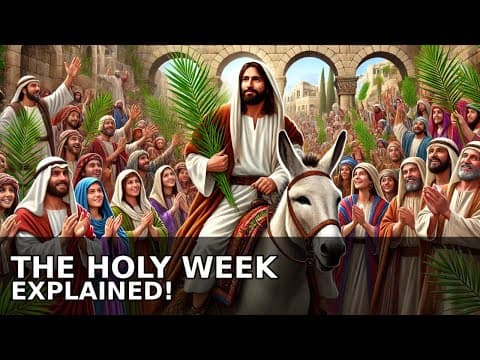
[0:00]Holy Week is one of the most meaningful periods in the Christian calendar. It's a sacred time when we remember the final days of Jesus's earthly life, leading up to his ultimate sacrifice on the cross and his victorious resurrection. Each day carries a depth of emotion, truth and lessons that have inspired and guided believers for centuries. The events of Holy Week are not just history. They are a living testament of God's love for humanity, inviting us to reflect on his grace and the price he paid for our redemption. Understanding this week is crucial because it holds the heart of the Christian faith, showing us the lengths to which God would go to bring us back to him. For many, the story of Holy Week is familiar. We know the scenes of Jesus entering Jerusalem on a donkey, the last supper with his disciples, and the agony in the garden of Yosemite. Yet, when we pause to truly meditate on these events, new layers of meaning emerge, every conversation, every action, and every word spoken by Jesus during these days were intentional and filled with purpose. Holy Week is not just a series of tragic events, it is a powerful narrative of hope and renewal. As we walk through these events together, we'll see how each day reveals more about God's character and his desire to draw us closer to him. Before we move on, I want to encourage you to take a moment and subscribe to this channel. If you appreciate biblical content that goes deeper and offers thoughtful insights into the word, then subscribing will help you stay connected with our upcoming videos. Your support means so much and allows us to continue creating meaningful content that nurtures our faith. Don't forget to hit the like button and share your thoughts in the comments as we go through this journey together. Holy Week is unique because it brings us face to face with the most challenging and inspiring moments in the life of Jesus. The week begins with the celebration and anticipation of Palm Sunday, yet quickly transitions into the solemn and contemplative tone of the last supper, followed by the heartbreaking events of Good Friday. Each scene unfolds like chapters in a story, leading us to the climax of Jesus crucifixion and the empty tomb on Easter morning. These are more than just events to remember, they are lessons to live by, offering us hope, peace and a deeper understanding of God's love. So, as we move forward, I encourage you to set aside any distractions and open your heart to what the Holy Spirit may be speaking to you through these events. Reflect deeply on the scenes will cover and think about how they apply to your own faith journey. Whether you're reflecting on Jesus humility as he washed his disciples' feet or his courage as he faced the cross, there is something here that will resonate with you. This is more than just a story. It's an invitation to draw closer to the one who gave his life so that we could live. Join me as we begin this journey of faith, reflection and transformation. Palm Sunday. Palm Sunday marks the beginning of Holy Week. It's a day filled with symbolism and deep meaning, commemorating the moment when Jesus entered Jerusalem riding on a humble donkey. This event was not just a casual entrance, it was a deliberate fulfillment of the ancient prophecy found in Zechariah 99, which states, rejoiced greatly Daughter Zion, shout, daughter Jerusalem, see your king comes to you, righteous and victorious lowly and riding on a donkey. By choosing to ride on a donkey rather than a horse, Jesus communicated something profound about the nature of his kingship. He came not as a warrior seeking conquest, but as a humble king bringing peace. The people who witnessed this entry celebrated by laying down their cloaks and waving palm branches. The crowd shouted, Hosanna to the Son of David, Blessed is he who comes in the name of the Lord. Matthew 21 verse 9. The word Hosanna is a plea that means save us. In that joyful moment, the people recognized Jesus as the promised Messiah, the one who would bring salvation. However, their understanding of salvation was very different from what Jesus came to offer. They longed for a political savior, someone who would liberate them from Roman oppression and restore Israel's glory. But Jesus came to provide a much deeper freedom, one that extends far beyond political boundaries. The entrance of Jesus into Jerusalem was more than a declaration of his identity. It was the beginning of his path to the cross. He knew that the same crowd that now welcomed him with praise would in just a few days cry out for his crucifixion. Yet he did not waver. His focus was on fulfilling the will of the Father, regardless of the cost as he entered the city, his heart was heavy with sorrow. The gospel of Luke tells us that when Jesus saw Jerusalem, he wept over it and said, if you, even you had only known on this day what would bring you peace, but now it is hidden from your eyes. Luke 19:42. These tears were not for himself, but for the people who failed to see the true purpose of his coming. Palm Sunday is a day of stark contrasts. On one hand, it is a day of celebration and hope, as the people acknowledge Jesus as king. On the other hand, it foreshadows the coming pain and betrayal. The same voices that shouted Hosanna would soon shout, crucify him. This sudden shift is a reminder of how fleeting human approval can be and how quickly people turn when their expectations are not met. But Jesus remained steadfast. His purpose was not to win the approval of men, but to accomplish the mission set before him, to lay down his life for the salvation of the world. As we think about Palm Sunday, we are invited to reflect on our own view of Jesus. Do we, like the crowd, want a savior who fits our desires and expectations? Do we hope for a Messiah who will solve our problems and give us what we want, or are we willing to accept him as he truly is, the humble king who offers us peace and calls us to surrender? This day challenges us to look beyond our circumstances and recognize the deeper work that God is doing in our lives. It calls us to trust his plan, even when it doesn't align with our own. The image of Jesus riding on a donkey speaks volumes about the nature of his kingship. He did not come with force or with displays of power, but in humility and peace. In a world that often values strength and dominance, Jesus shows us a different way, the way of gentleness and surrender. His kingdom operates on principles that are completely different from those of this world. His power is made perfect in weakness, and his victory comes through his willing sacrifice. This is the paradox of Palm Sunday. The king who conquers through love, not through war. For the people who laid their cloaks and palm branches on the road, it was an expression of honor and reverence. In ancient times, laying once garment in the path of a king was a sign of submission and respect. Yet, while their actions seem to acknowledge Jesus as king, their understanding of his kingship was incomplete. They wanted a king who would change their outward circumstances, but Jesus came to change their hearts. This is the true message of Palm Sunday, that transformation begins from within. It's not about changing the world around us, but allowing God to change us from the inside out. As we reflect on this day, we are reminded that Jesus sees beyond our outward actions. He sees our hearts. He knows our deepest desires, our fears and our hidden motives. Like the crowd, we may come to him with our own agendas, hoping he will meet our expectations. But Jesus gently calls us to lay down our plans and trust in his greater purpose. He calls us to recognize him as the true king, the one who reigns not just over nations, but over our very lives. Palm Sunday is an invitation to surrender, to lay down not just our cloaks and branches, but our pride, our ambitions and our self-reliance. This day also reminds us that true kingship is not about dominance, but about servanthood. Jesus, the king of kings chose to come in humility and peace. He did not demand submission, but invited people to follow him in love. He showed us that the greatest leaders are those who serve, and the strongest are those who are willing to become weak for the sake of others. As he rode into Jerusalem, he was setting an example for us to follow, an example of what it means to lead through love and to conquer through surrender. The lesson of Palm Sunday is one of perspective. It calls us to see beyond the immediate and look at the bigger picture. The people who welcomed Jesus were focused on the here and now, they wanted a solution to their present problems, but Jesus came to address the root issue, the problem of sin and separation from God. His entry into Jerusalem was not about political change, but about spiritual restoration. It was about bringing people back into a relationship with God, and that is the true victory of Palm Sunday, a victory that comes through the cross. Holy Monday. Holy Monday is often overlooked, but it holds a powerful message that is crucial to understanding the heart of Jesus' ministry. On this day, Jesus entered the temple in Jerusalem and found something deeply troubling. The place that was supposed to be a house of prayer, a sacred space, dedicated to worship and connecting with God, had turned into a marketplace. The temple courts were filled with merchants and money changes, all focused on profit rather than prayer. With righteous anger, Jesus began to drive them out, overturning the tables and declaring, it is written, my house will be called a house of prayer, but you are making it a den of robbers. Matthew 21:13. This dramatic scene is not just about cleansing a physical space, but about a much deeper spiritual truth. Jesus' actions on Holy Monday reveal his passion for pure worship and true devotion. The temple was the center of Jewish religious life, a place where people came to seek God, offer sacrifices and experience his presence. But over time, the focus had shifted. The religious leaders allowed the temple to become a place of business, where money and transactions overshadowed genuine worship.
[11:14]Jesus' anger was not random. It was a reflection of his deep love for his people. He wanted them to return to the heart of worship, to rediscover what it means to truly honor God. This moment speaks to us as well, reminding us that worship is not about outward acts, but about an inner posture of surrender and reverence. After clearing the temple, Jesus began teaching the people. It was in these final days that he poured out some of his most important lessons, knowing that his time on earth was short. He spoke with authority and urgency, addressing issues of faith, justice and the true nature of God's kingdom. The religious leaders, threatened by his popularity and power, began plotting even more aggressively against him. Holy Monday marks a turning point where the opposition against Jesus grew stronger, setting the stage for the events that would unfold in the coming days. But amid the tension and conflict, we see Jesus' unwavering commitment to his mission. He knew that speaking out would lead to his arrest and death, yet he did not hold back. His courage and resolve should inspire us, especially when we face opposition or pressure to compromise our faith. Holy Monday reminds us that standing up for what is right often comes at a cost. Jesus was willing to pay that price because his eyes were set on something far greater, the redemption of humanity. The cleansing of the temple is also a call for personal reflection. In 1st Corinthians 6:19, Paul writes, do you not know that your bodies are temples of the Holy Spirit, who is in you, whom you have received from God? Just as Jesus cleanse the temple in Jerusalem, he wants to cleanse the temples of our hearts. He desires to remove anything that hinders our relationship with him, anything that distracts us from true worship. This process can be uncomfortable. It may involve letting go of habits, attitudes, or even relationships that are not aligned with God's will. But it is a necessary step if we want to experience the fullness of his presence. When Jesus overturned the tables, he disrupted the normal flow of the temple. People were used to coming and going, conducting business and carrying out their routines. But that day, everything stopped. The noise of buying and selling was replaced by the sound of tables crashing in, coins scattering. Imagine the shock and confusion of those who were there. Jesus' actions were bold and confrontational, but they were also filled with love. He was not content to let people continue in a state of false worship. He wanted them to see the truth, that God deserves more than our leftovers and that his house should be a place of purity and prayer. This moment on Holy Monday challenges us to ask ourselves some tough questions. Are there areas of our lives where we have become complacent? Have we allowed business or distractions to take the place of time spent with God? Jesus cleansing of the temple is a wake up call. It's a reminder that true worship requires more than just going through the motions. It requires a heart that is fully engaged and wholly devoted to God. As we reflect on this day, let's invite Jesus to cleanse the temples of our own hearts, asking him to remove anything that does not honor him. Holy Monday also highlights the tension between true worship and empty religion. The religious leaders were offended by Jesus' actions because he exposed their hypocrisy. They were more concerned with maintaining their positions and traditions than with seeking God's will. In driving out the money changers, Jesus was not just clearing space, he was making a statement. True worship is not about appearances or external rituals, it's about a sincere relationship with God. This truth is as relevant today as it was then. We too can fall into the trap of valuing form over substance, of prioritizing tradition over transformation. But Holy Monday is not just about judgment, it's about grace. Jesus did not cleanse the temple to condemn, he cleansed it to restore. He wanted to create a space where people could encounter God without barriers. He wanted to strip away everything that was false and bring people back to the heart of worship. This is what he desires for each of us, to draw us into a deeper, more authentic relationship with him. His actions, though intense, were motivated by love. He was willing to disrupt the status quo to help people see the truth. As we continue our narrative, let's take time on this Holy Monday to reflect on our own hearts. What tables need to be overturned? What distractions need to be driven out? Are there areas where we have allowed the noise of life to drown out the voice of God? Let's invite Jesus to cleanse our hearts, to remove anything that does not honor him, and to restore us to a place of true worship. May we, like the temple in Jerusalem, become houses of prayer, places where God's presence is welcomed and his name is glorified. Holy Tuesday. Holy Tuesday is a day filled with lessons and confrontations that reveal the true nature of faith, authority and the kingdom of God. After the cleansing of the temple on Monday, Jesus returned to the temple courts on Tuesday, knowing that his time was running short. He began teaching the people, and his words on this day were some of the most profound and challenging of his entire ministry. The religious leaders, feeling threatened by his popularity and authority, sought to trap him with difficult questions, hoping to discredit him in front of the crowd. But every attempt they made only served to reveal his wisdom and the depth of his understanding. The tension was palpable. The chief priests, scribes and elders demanded to know by what authority he was doing these things. They wanted to expose him as a false teacher, someone who had no right to speak in the name of God. But Jesus responded in a way that left them speechless. He asked them a question of his own. Was the baptism of John from heaven or from man? Matthew 21 verse 25. This put the religious leaders in a dilemma. If they said it was from heaven, they would have to explain why they didn't believe in John's message. If they said it was from man, they feared the reaction of the people, who saw John as a prophet. So they answered, we don't know. With that, Jesus refused to answer their question saying, neither will I tell you by what authority I am doing these things. This exchange reveals something important about the heart of unbelief. The religious leaders were not interested in finding the truth. They were only interested in protecting their power and position. They were unwilling to consider the possibility that Jesus was truly sent by God because it would mean acknowledging that their own authority was flawed. Holy Tuesday challenges us to examine our own hearts and ask whether we are truly open to God's truth, even when it confronts our assumptions and desires. Are we willing to surrender our own authority and submit to his, even when it's uncomfortable? After silencing his opponents, Jesus continued to teach in parables. One of the most striking is the parable of the tenants, Matthew 21:33 to 46. In this story, a landowner rents out his vineyard to some tenants and goes on a journey. When the harvest time comes, he sends his servants to collect the fruit. But instead of honoring their agreement, the tenants beat, stone and kill the servants. Finally, the landowner sends his son, thinking they will respect my son. But the tenants plot to kill the son, hoping to take his inheritance. Jesus ends the parable by asking, what will the owner of the Vineyard do to those tenants? The crowd responds, he will bring those wretches to a wretched end and rent the Vineyard to other tenants, who will give him his share of the crop at harvest time. This parable is a clear indictment of the religious leaders. The Vineyard represents Israel, the tenants are the leaders, and the servants are the prophets sent by God. The son, of course, is Jesus himself. By rejecting the son, the tenants seal their own fate. Jesus was warning the religious leaders that their refusal to accept him would lead to judgment, and the kingdom would be taken from them and given to others who would produce its fruit. This message is not just for the leaders of Jesus' day, it speaks to all of us. Are we producing the fruit of the kingdom? Are we living lives that honor the king, or are we holding back, clinging to control over our own lives? The parable struck a nerve. The religious leaders realized that Jesus was speaking about them, and they wanted to arrest him on the spot. But they feared the crowd, who saw Jesus as a prophet, so they left plotting how to trap him with his words. This led to a series of questions meant to entangle Jesus in controversy. They asked him whether it was right to pay taxes to Caesar, hoping to catch him between offending the people or angering the Roman authorities. But Jesus' response was both simple and profound. Give to Caesar what is Caesar's and to God what is God's. Matthew 22 verse 21. With this answer, Jesus sidestep their trap and pointed to a greater truth, that while we may have obligations in this world, our ultimate allegiance belongs to God. Holy Tuesday reminds us that our loyalty must always be to the one who created us, not to the shifting powers and pressures of this world. No matter what situations we face, we are called to honor God above all else. The challenges continued. The Sadducees, who did not believe in the resurrection, posed a hypothetical question about marriage in the afterlife, hoping to ridicule the idea of eternal life. But Jesus saw through their motives and replied, you are in error because you do not know the scriptures or the power of God. Matthew 22 verse 29. He explained that in the resurrection, people would not marry, but would be like the angels in heaven. Then he silenced them by quoting from the book of Exodus, saying, have you not read what God said to you, I am the God of Abraham, the God of Isaac, and the God of Jacob? He is not the God of the dead, but of the living. Matthew 22 verse 32. With this, he demonstrated that even the scriptures they claimed to know pointed to the reality of resurrection life. The questions ended, but Jesus' teaching did not. He turned to the crowd and his disciples, and began to warn them about the hypocrisy of the religious leaders. He spoke against their love of titles, their desire for recognition, and their tendency to burden people with heavy loads, while neglecting the heart of the law, justice, mercy and faithfulness. Woe to you, teachers of the law and Pharisees, you hypocrites, he cried. You are like whitewash tombs, which look beautiful on the outside, but on the inside are full of the bones of the dead and everything unclean. Matthew 23:27. His words were sharp, but they were spoken out of love and a desire to call people back to true righteousness. Holy Tuesday is a day that confronts us with the question of authority. Who has the final say in our lives? Are we like the religious leaders clinging to our own power and resisting God's call to surrender, or are we willing to recognize Jesus as the true king, even when it means letting go of our pride and our plans? This day is also a reminder of the urgency of Jesus' message. He knew his time was short, and he did not mince words. He spoke with clarity and conviction, calling people to repentance and faith.
[23:16]Holy Wednesday. Holy Wednesday is often known as Spy Wednesday because it marks the day when Judah scary at it, one of Jesus's own disciples, made the decision to betray him. The events of this day remind us of the painful reality of betrayal and the tragic consequences of rejecting grace. Holy Wednesday is a day that stirs a mix of emotions, sorrow, reflection and a sober realization of human weakness. It's a day that shows us the darker side of the human heart. Yet, it also highlights the unwavering commitment of Jesus to fulfill his mission, no matter the cost. Judas had been with Jesus for three years. He saw the miracles, heard the teachings, and experienced first hand the love and grace of the Messiah. Yet, despite all he witnessed, Judas chose to betray Jesus. The Gospels tell us that he went to the chief priests and asked, what are you willing to give me if I deliver him over to you? Matthew 26:15. They counted out 30 pieces of silver, the price of a slave. And from that moment on, Judas began looking for an opportunity to hand Jesus over. This decision was more than a momentary lapse in judgment. It was a tragic culmination of choices, attitudes and desires that Judas had allowed to take root in his heart. The Bible hints at Judas's struggle with greed and disillusionment. He was the treasurer for the group, and in John 12:6, it's noted that he would sometimes steal from the money bag. Judas might have initially followed Jesus with hope and excitement, believing that Jesus would become a powerful political leader. But as time went on, and Jesus spoke more about suffering, servanthood and self-sacrifice, Judas' expectations were shattered. He wanted a kingdom of power, but Jesus offered a kingdom of humility. Betrayal is one of the deepest wounds a person can experience, it's not just about broken trust, it's about being rejected by someone you love. For Jesus, the betrayal of Judas was not a surprise, but it was still painful. He knew what Judas would do, yet he still washed his feet at the last supper, shared bread with him, and even called him friend in the garden. Matthew 26:50. This is a picture of grace beyond our understanding, to love and serve someone, even when you know they will turn against you. Holy Wednesday asks us to reflect on our hearts. Are there areas where we have allowed bitterness, greed or disappointment to take root? Are there times when we have been tempted to betray Jesus, even in small ways, by choosing our desires over his will? Judas' story is a warning, but it's also a reminder of Jesus' mercy. Until the very end, Jesus gave Judas opportunities to turn back, repent and receive forgiveness. But Judas chose a different path, one that led to regret and destruction. The contrast between Judas and the other disciples is striking. They too struggled with fear, doubt and misunderstanding, but they remained open to Jesus' correction and grace. Judas, however, closed his heart. Holy Wednesday teaches us that the condition of our hearts matters more than our outward actions. We can be close to Jesus physically as Judas was, but far from him spiritually. The tragedy of Judas is that he was so close to grace, yet he rejected it. This day also challenges us to consider how we respond when God's plans don't align with our expectations. Judas wanted a savior who would overthrow Rome and establish a powerful kingdom. When it became clear that Jesus' path led to the cross, Judas became disillusioned and ultimately turned away. How do we respond when God's ways don't match our desires? Do we trust him or do we, like Judas, become bitter and turn our backs? Holy Wednesday calls us to surrender our expectations and trust in the wisdom and goodness of God, even when his ways are hard to understand.
[27:15]Maundy Thursday. Maundy Thursday, also known as Holy Thursday, is one of the most significant days in Holy Week. It's the day when Jesus gathered with his disciples to celebrate the Passover meal, a meal that would become known as the last supper. It was during this meal that Jesus established the sacrament of communion, wash the feet of his disciples, and gave them a new commandment, to love one another as he has loved them. The word Maundy comes from the Latin word mandatum, meaning commandment, and refers to this new command of love. The scene in the upper room is one of intimacy and deep emotion. Jesus knew that his hour had come. He knew that in just a few short hours, he would be arrested, tried and sentenced to death. Yet, rather than focusing on his own suffering, he turned his attention to his disciples. He wanted to prepare them for what was to come and to give them a lasting reminder of his love and sacrifice. The gospel of John tells us that Jesus, having loved his own who were in the world, loved them to the end. John 13 verse 1. The first act Jesus performed that evening was shocking to the disciples. He rose from the table, took off his outer clothing, and wrapped a towel around his waist. Then he began to wash their feet, a task usually reserved for the lowest servant in the household. Peter in disbelief protested saying, Lord, are you going to wash my feet? John 13:6. Jesus replied, you do not realize now what I am doing, but later you will understand. Peter still not comprehending said, no, you shall never wash my feet. But Jesus answered, unless I wash you, you have no part with me. John 13:78. This act of footwashing was more than just a demonstration of humility. It was a symbolic cleansing. Jesus was showing his disciples that in order to be part of his kingdom, they needed to be washed, not just their feet, but their hearts. It was a foreshadowing of the greater cleansing that would come through his death and resurrection. As he washed their feet, Jesus said, now that I, your Lord and teacher, have washed your feet, you also should wash one another's feet. John 13:14. He was calling them to follow his example of servanthood, to love and serve others in humility. After washing their feet, Jesus returned to the table and took bread. He gave thanks, broke it and gave it to his disciples, saying, this is my body given for you, do this in remembrance of me. Luke 22:19. Then he took the cup, saying, this cup is the new covenant in my blood, which is poured out for you. Luke 22:20. With these simple elements, bread and wine, Jesus instituted the Lord's supper, a sacrament that Christians have observed for centuries as a reminder of his sacrifice and a symbol of the new covenant between God and humanity. Maundy Thursday is a night filled with both sorrow and hope. It is a reminder of the depth of Jesus' love and the cost of our redemption. In the breaking of bread and the sharing of the cup, we see his willingness to give everything for our sake. And in the washing of feet, we see his call to serve others with the same love and humility that he showed. But Maundy Thursday is also a night of betrayal. As Jesus sat with his disciples, he revealed that one of them would betray him. The atmosphere in the room shifted as each disciple, one by one asked, is it I, Lord? Even Judas, who had already made arrangements to betray Jesus, asked the question. Jesus' response was heartbreaking. The one who has dipped his hand into the bowl with me will betray me. Matthew 26:23. Despite knowing what Judas was about to do, Jesus offered him the bread, a final gesture of friendship and grace. As we reflect on Maundy Thursday, let us remember that Jesus' love is a love that serves, sacrifices and extends grace, even in the face of betrayal. It's a love that calls us to go and do likewise, to love one another as he has loved us. This is the commandment of Maundy Thursday, to live a life marked by selfless sacrificial love. Good Friday. Good Friday stands as the most solemn and heart-wrenching day of Holy Week. It is the day when Jesus, the sinless lamb of God, was betrayed, falsely accused, brutally beaten and ultimately nailed to a cross to die a shameful and agonizing death. For believers, Good Friday is a day of deep sorrow, but also profound gratitude. As we reflect on the immense love and sacrifice that Jesus willingly made for the redemption of humanity. It is called good not because of what happened, but because of what it accomplished, the reconciliation of sinners to a holy God. The events of Good Friday begin in the early hours after Jesus was arrested in the Garden of Yosemite, betrayed by a kiss from Judas. He was taken away under cover of darkness, subjected to a series of unlawful trials before the religious leaders and Roman authorities. The Jewish leaders accused him of blasphemy for claiming to be the son of God. But knowing that such a charge would not sway the Romans, they twisted the accusation, framing him as a rebel claiming to be king, which was a threat to Caesar. Pilot, the Roman governor, found no basis for a charge against Jesus and sought to release him. But the crowd, stirred by the chief priests, shouted, crucify him. Mark 15:13. In a tragic display of political expediency, pilot washed his hands, symbolically distancing himself from responsibility, and handed Jesus over to be crucified. Yet, the irony of Good Friday is that in reality, it was not the Jewish leaders or pilot who put Jesus on the cross. It was love. Jesus went to the cross willingly, fully aware of the suffering he would endure, because his love for humanity was greater than the pain he would face. As he was led away, Roman soldiers mocked and beat him. They placed a crown of thorns on his head, struck him and spit on him. He was forced to carry his own cross to a place called Galgatha, which means place of the skull. The weight of the wooden cross beam, combined with the exhaustion and blood loss from the flogging, was overwhelming, and Jesus stumbled under its burden. Simon of Cyrene, a passerby, was compelled to carry the cross for him. Arriving at Galgartha, they stripped him of his garments and nailed him to the cross, a nail through each wrist and one through his feet. Then they lifted the cross and left him hanging between two thieves, as the crowd cheered and taunted. The physical agony Jesus endured is unimaginable. Crucifixion was a torturous method of execution designed to maximize pain and prolonged suffering. Every breath was a struggle, as he had to push himself up against the nails just to exhale. Yet, even in his suffering, Jesus did not curse or cry out in anger. Instead, he spoke words of forgiveness. Father, forgive them, for they do not know what they are doing. Luke 23. It is difficult to comprehend such grace. Jesus was in excruciating pain, yet his heart was still filled with compassion for those who mocked and tortured him. The Gospels record seven statements Jesus made from the cross, each carrying deep significance. One of the most pointed is his cry, My God, my God, why have you forsaken me? Matthew 27 verse 46. In that moment, Jesus experienced the full weight of human sin and the separation from God that sin causes. He who knew no sin became sin for us, so that in him we might become the righteousness of God. Second Corinthians 5:21. It is this moment of forsakenness that makes Good Friday good. Because Jesus took on our sin and its penalty, we can be reconciled to God. As the hours passed, the sky grew dark from noon until 3 in the afternoon, darkness covered the land, a supernatural sign of the gravity of what was happening. And then with a loud voice, Jesus cried out, it is finished. John 19:30. This was not a cry of defeat, but a victory. The debt of sin had been paid in full. The work of redemption was complete. With that, Jesus bowed his head and gave up his spirit. At that moment, the earth shook and the curtain in the temple was torn in two, from top to bottom. Matthew 27:51. This was no ordinary curtain. It was a heavy veil that separated the Holy of Holies, the innermost and most sacred part of the temple, from the rest of the sanctuary. Its tearing symbolized that through Jesus' death, the barrier between God and humanity was removed. No longer would people be separated from God by sin. Through Jesus, we now have direct access to the Father. Good Friday is a day that confronts us with the reality of sin and its consequences. It's a day that calls us to repentance and gratitude. But more than that, it's a day that reveals the depth of God's love. As we gaze upon the cross, we see the cost of our redemption and the lengths to which God would go to save us. We are reminded that we are loved, not because of anything we have done, but because of who he is. Good Friday invites us to stand in awe, to kneel in humility and to respond in worship. Holy Saturday. Holy Saturday is a day of silence, waiting and uncertainty. After the intensity and anguish of Good Friday, Holy Saturday feels empty and still. It's a day when hope seems lost and the future is unclear. Jesus' lifeless body lay in the tomb, sealed behind a heavy stone and guarded by Roman soldiers. His disciples scattered and afraid, were hiding confused and filled with grief. For them, everything seemed to have failed. The one they believed to be the Messiah, the one who spoke of life and resurrection, was now dead. This day is often overlooked, but it holds a powerful place in the story of Holy Week. It represents the in between, the time between death and resurrection, between despair and hope. Holy Saturday teaches us about waiting, trusting and holding on to faith when God seems silent. For the disciples, it was a day of questions. Was it all for nothing? Had they misunderstood everything? Would they be next to be arrested and killed? Holy Saturday is the day when faith is tested, when we are called to trust in what God has promised, even when we cannot see it. But amid the silence and waiting, God was at work. The disciples couldn't see it, but the story was not over. On the surface, it seemed like nothing was happening, but in the unseen realm, victory was being prepared. Jesus had declared from the cross, it is finished. But the fullness of what that meant was still unfolding. Holy Saturday is a reminder that God is always at work, even when we can't see it. His plans are not thwarted by human failure or death. Though it was a day of mourning, it was also the beginning of something new. As we reflect on Holy Saturday, we are invited to sit in the tension of already but not yet. We know that Jesus will rise and that victory is coming, but we must also recognize the reality of waiting and the pain of not yet seeing the promise fulfilled. It's a day that mirrors our own experiences of waiting on God, trusting him amid silence, and believing in his goodness when everything around us says otherwise. Holy Saturday teaches us that silence is not the same as absence. God's delays are not his denials. The darkest night will give way to the dawn. As we sit in the stillness of this day, may we hold on to hope, knowing that Sunday is coming. The grave is not the end. Life will triumph over death, and God's promises will be fulfilled. Let us wait in hope and trust, believing that even in the silence, God is working out his perfect plan for our redemption. Easter Sunday. Easter Sunday is the glorious climax of Holy Week and the foundation of the Christian faith. It is the day that transformed despair into hope, mourning into joy and death into life. On this day, everything changed. Jesus, who was crucified, dead and buried, rose from the grave, conquering sin and death once and for all. His resurrection is not just a historical event, it is the cornerstone of the gospel and the source of eternal hope for every believer. Because he lives, we too can have life, life abundant, life eternal and life victorious. The story of Easter begins early in the morning, just as dawn is breaking. Mary Magdalene, along with several other women, went to the tomb where Jesus had been laid. They brought spices and ointments to anoint his body, a final act of love and devotion. As they approached, they worried about who would roll away the massive stone that sealed the entrance. But when they arrived, they found the stone had already been rolled away. Confused and alarmed, they entered the tomb, only to discover that the body of Jesus was not there. Suddenly, two angels appeared, their clothes shining like lightning. The women were terrified and bowed down, but the angel said, why do you look for the living among the dead? He is not here. He has risen. Luke 24 or 5 to 6. These words echoed through history, the first proclamation of the resurrection. He is not here. He has risen. The women ran back to tell the disciples, their hearts racing with both fear and joy. The disciples, skeptical at first, ran to the tomb themselves. Peter and John found it just as the women had said, empty, except for the linen grave clothes neatly folded and lying there. But it was Mary Magdalen who had the first personal encounter with the Risen Lord. Standing outside the tomb weeping, she saw a man she thought was the gardener. Through her tears, she pleaded, sir, if you have carried him away, tell me where you have put him and I will get him. John 20:15. Then the man spoke her name, Mary. In that one word, Mary recognized the voice of Jesus. She turned and cried out, Rabboni, which means teacher. It was Jesus alive, standing before her. Overwhelmed, she fell at his feet, clinging to him in awe and adoration. But Jesus gently told her, do not hold on to me, for I have not yet ascended to the Father. Go instead to my brothers and tell them. John 20 verse 17. Mary became the first to spread the Good News. I have seen the Lord. John 20:18. This moment is significant. In a culture where a woman's testimony was often disregarded, Jesus chose Mary, a woman who had been redeemed and restored by his grace, to be the first witness of his resurrection. It's a powerful reminder that the message of Easter is for everyone, regardless of background, status or gender. The resurrection of Jesus changes everything and breaks down every barrier. Later that evening, as the disciples were gathered together behind locked doors for fear of the Jews, Jesus suddenly stood among them and said, peace be with you. John 20:19. Startled and afraid, they thought they were seeing a ghost. But Jesus reassured them, look at my hands and my feet. It is I myself, touch me and see. A ghost does not have flesh and bones, as you see I have. Luke 24 verse 39. Then he showed them his wounds, the scars in his hands, inside. Proof that he was indeed the same Jesus who had been crucified. Joy and wonder filled the room as they realized the truth. Jesus was alive. He had defeated death and risen just as he had promised. But Thomas, one of the twelve, was not there. When the others told him, he doubted saying, unless I see the nail marks in his hands and put my finger where the nails were, and put my hand into his side, I will not believe. John 20:25. A week later, Jesus appeared again, and invited Thomas to do exactly that. Thomas, overwhelmed, could only exclaim, my Lord and my God. John 20:28. Jesus responded, because you have seen me, you have believed. Blessed are those who have not seen and yet have believed. John 20:29. The resurrection appearances continued. Jesus met his disciples on the shore of the Sea of Galilee, where he prepared breakfast for them and restored Peter, who had denied him three times. He gave them a new command and a new mission, go and make disciples of all nations, baptizing them in the name of the Father and of the Son and of the Holy Spirit, and teaching them to obey everything I have commanded you. Matthew 28:19 to 20. This was the Great Commission, the charge to spread the good news of his resurrection to the ends of the Earth. Easter Sunday is not just about an empty tomb, it is about a living Savior. The resurrection of Jesus is the ultimate victory, the victory over sin, death and every power of darkness. Because he lives, we have hope that death is not the end. Because he lives, we know that every promise of God is true. The resurrection validates everything Jesus said and did. It proves that he is who he claimed to be, the son of God, the Messiah, the savior of the world. For believers, Easter is more than historical fact, it is a living reality. The same power that raised Jesus from the dead is at work in us, who believe. Ephesians 1 verse 19 to 20. Easter calls us to live in the light of that power, to walk in the newness of life, free from the chains of sin and fear. The resurrection is not just a past event, it is the present source of our hope and strength. As we celebrate Easter, let us rejoice in the victory of our risen Lord. Let us proclaim like Mary, I have seen the Lord. Let us walk in the joy and freedom of his resurrection, knowing that because he lives, we too shall live. And let us share this good news with the world that desperately needs to hear it. Death has been defeated, the grave has lost its sting. Christ is risen. He is risen indeed. Hallelujah.


