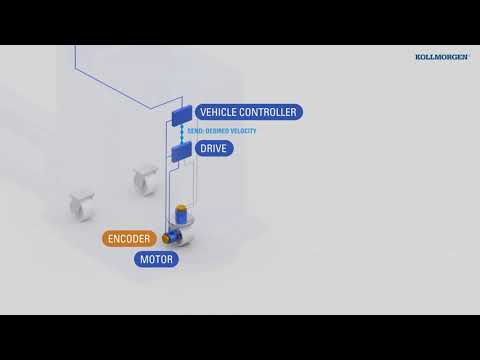
[0:01]How does an AGV execute steering and driving commands?
[0:09]When an AGV receives a command, it passes through a control loop.
[0:16]The control loop consists of a navigation sensor, vehicle controller, drive, encoder, and motor. A command is sent to the vehicle controller, along with navigation data feed from the navigation sensor. The vehicle controller calculates desired velocity to execute the command.
[0:47]This desired velocity is sent to the drive which translates the desired velocity into current. This current is then sent to the motor, which starts moving the vehicle.
[1:03]The encoder then reads the actual velocity and sends the feedback to the vehicle controller. The drive compares the actual velocity with the desired velocity and sends adjustments to compensate deviation to the drive. The same principle is applied to the steering control loop, where the vehicle controller compares the actual position with desired position and send adjustments to desired velocity to the drive.
[1:42]Control loops maintain accurate motion regardless of load weight or floor inclination. This enables AGVs to operate with precision and stability.


