[0:00]So I'd like to talk about three infinite series. So sums of infinitely many numbers. So here's the first one. One plus a half plus a fourth plus an eighth plus blah, blah, blah. What's that? And the answer is, it's two. This is the problem of Achilles and the tortoise. Achilles is two stadio or whatever the unit of length is in ancient Greece from the tortoise. Well, after a while Achilles gains on the tortoise one unit and so the remaining distance is only one. Then after a while, Achilles gains half of the distance to the tortoise and now the distance to the tortoise is a half. After a little while, Achilles gains another one quarter of the distance to the tortoise and so on and so on and so on. The story according to Zeno's paradoxes is that Achilles never catches the tortoise. Well, of course Achilles never catches the tortoise at any of these times, but if you just wait a little longer, Achilles will have caught the tortoise. The total length that Achilles gains on the tortoise is two and that's why this is true. Now let's look at one plus a half plus a third plus a fourth plus a fifth plus a sixth plus a seventh plus an eighth and so on and this never ends. How big is that? What is that? And what I mean is if I stop after many, many, many terms, so I can, so I'm adding some huge finite list of numbers. How big is that and what happens when I add more and more and more of them? And the answer is, this is infinity. Why? Well, let me group the terms. Here's the first one. Here are the next two. Here are the next four. The next eight would end with one over 15 and this goes on forever. I don't want to mark up my desk. Professor, you said infinity, but I'm always taught that's not a number. Well, so what exactly does this mean? You give me any number at all. 50 trillion. And I can stop this series and say, okay, I will only go this far. I'm adding only a finite number of numbers together. But that sum will be more than 50 trillion. That's true not only for 50 trillion, but for any number you name, no matter how big. And that's what it means that the sum of this series is infinity. So it's blowing up. It's like, it's getting, it's getting away from us. Exactly, we say that the series diverges. So, let's look at the first term. Well, it's one. Thank you. Uh, how about these next two terms? Well, you know what? This one is bigger than a half. Each one of these terms is bigger than a quarter. A half is bigger than a quarter, a third is bigger than a quarter, and there are two terms, so this is bigger than two quarters, which is again, a half. How about these four terms? They're all bigger than one eighth and there are four of them. So if I add these guys, it's bigger than four eights, which is a half. If I look at the next eight terms, they're all bigger than one sixteenth and there are eight of them. So the sum is bigger than eight sixteenths, which is a half. If I stop far enough, this sum will be more than a half plus a half plus a half plus a half plus a half plus a half. And I can go on as many times as I like, accumulating one halfs until I get to more than 50 trillion. So sooner or later, uh, the sum of these numbers will be more than 50 trillion. The catch is that I have to go enormously far out in order to do it. But let's not worry about that now. Okay, never mind just how enormous. That's, let's leave it there for this sum, which has a name, it's called the harmonic series. I'd like to explain how to use the harmonic series to stack dominoes. Well, actually, I don't have dominoes in my office, but I have lots of issues of the Annals of Mathematics. Yes, lots that you got out, oh, yes, I have lots and lots and lots. So we're going to use copies of the Annals of Mathematics as dominoes. Let's just take two of them first. If I move this one here, it's going to collapse. But if I move it so that its center of gravity is, let's see if that works. I'm being a little conservative. The center of gravity of this guy is sitting over that guy and so it does not collapse. Now, let's take these two and put them very carefully on top of a third one, taking care that the center of gravity of this whole guy is above this issue of the Annals of Mathematics. And therefore, looks precarious. Okay, there. It does not collapse. And now perhaps I could put these three on top of a fourth and if I succeed in doing that, I will not tempt fate, I will just declare that, uh, that we have succeeded. So let's see, how are we doing? It hasn't collapsed. looks a little flaky. It hasn't collapsed. How far can we make this guy stick out? Suppose that I have all those copies of the Annals of Mathematics, or perhaps all the copies of the Annals of Mathematics ever printed from the beginning of time to the end of time. Wonder how many that will be. Anyway, we have all of them, and we stack them up and we demand that the pile cannot collapse. Well, this is merely paper, so sooner or later if there's too much of a load, it will be crushed, but never mind these are imaginary rigid dominoes. Can we ever make the top guy so far out that it is not resting on the bottom guy at all, that this edge is not lying at all over this book, but has come out farther? Further out than the bottom book. Exactly. And the answer is, oh, yes, in fact, you can make this this pile come out in that direction, as far as you like. Because if you look at it, if you have n copies of the Annals of Mathematics and you do an absolutely perfect job in an ideal world, the distances that they are slid out from one another are in the proportions one to a half, to a third, to a fourth, to a fifth, to a sixth and so on to one over N, if there are N copies of the Annals of Math, or maybe N plus one copies of the Annals of Math. And so the fact that the harmonic series diverges tells you that you can eventually make this pile come out as far as you like. Because 1 plus a half plus a third plus a fourth plus and so on, if you stop way, way far out after a gazillion for a large enough value of a gazillion, will be more than 50 billion. And therefore this distance out there will be more than 50 billion times the height of the Annals of Mathematics. All right, let's put the Annals of Mathematics aside. Now let's do the same thing to the series one plus one half squared plus one third squared plus one fourth squared plus, let me keep going, fifth squared. blah, blah, Now, let's try to do the same thing. We're going to take the first term. All right, so that's one. Thank you. Let's look at the next two terms. Now, this is one over a half squared. This is smaller than one over a half squared. So we've got two terms and they're each smaller than one half times one half. So that's smaller than two times a half times a half. That's smaller than a half. Let's look at the next four terms. Here they are. They're all one over four squared or smaller. So they're smaller than one fourth squared plus one fourth squared plus one fourth squared plus one fourth squared. There are four terms there, and so these guys together are no bigger than four times one fourth squared. That's four times one fourth times one fourth, and that's one fourth. So this whole thing is less than one fourth. If I looked at the next eight terms and played the same game, I would find that that's less than one eighth and so on. So now look if I go out to a gazillion terms, I'm guaranteed that what I've got is less than one plus a half plus a fourth plus an eighth plus a sixteenth plus something or other. I stop at one over some power of two. Hey, wait a minute. Remember our first result? This series never, I mean, the sum of these guys is never more than two. The sum of all these numbers is two and the sum of the first gazillion numbers will be slightly less than two. So therefore I'm guaranteed that no matter how many terms of this guy I take, it will be less than two. So it doesn't run off to infinity the way the harmonic series does, and in fact, you could wonder what is the value of the sum of all of these terms? And that was a famous unsolved problem of the eighteenth century, and the answer is pi squared over six. Pi creeps in where you would least expect it. that you're gonna get the medal. I was exactly here, this place, and I was having an interview and then the phone rings. Hello. And the voice was saying, hello. This is Laszlo Lovasz from
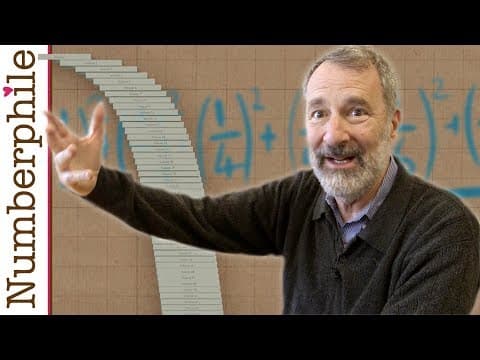
Infinite Series - Numberphile
Numberphile
9m 31s1,655 words~9 min read
YouTube auto captions
Transcript source
YouTube auto captions
This transcript was extracted from YouTube's auto-generated caption track. The transcript below is server-rendered so it can be read, searched, cited, and shared without opening the original YouTube player.
Pull quotes
[0:00]Achilles is two stadio or whatever the unit of length is in ancient Greece from the tortoise.
[0:00]Well, after a while Achilles gains on the tortoise one unit and so the remaining distance is only one.
[0:00]Then after a while, Achilles gains half of the distance to the tortoise and now the distance to the tortoise is a half.
[0:00]After a little while, Achilles gains another one quarter of the distance to the tortoise and so on and so on and so on.
Use this transcript
Related transcript hubs
Watch on YouTube
Share
MORE TRANSCRIPTS


