[0:08]Hello, everyone, and welcome back to Mr. English Channel, where learning English is easy and fun. I'm Emily. Hi, Emily. It is so wonderful to be here with you today, and hello to all our amazing listeners at home. It is great to see you too, Paul. I am feeling very happy and full of energy today. How are you doing? I am doing really well. Thank you. The weather is beautiful today, so I walked to the studio. It was very relaxing and peaceful. Oh, that sounds lovely, Paul. Walking in the sun always puts me in a great mood too. Did you get your morning coffee yet? Oh, you know me so well. Yes, I have my big cup of coffee right here. It is extra delicious today, hot and sweet. Perfect. You will need that energy because we have a fantastic topic for our listeners today. I am really excited to share it with everyone. Awesome. I love our topics because they are always so useful. What are we talking about today, Emily? Today, we are going to talk about a very common phrase in English. It is the phrase, "I don't know." Ah, I don't know. That is one of the very first phrases every English student learns. It is simple and useful. It is very useful, Paul, but sometimes saying, "I don't know" all the time can sound a little repetitive. It can even sound a bit cold or distant. Hmm. Let me think about that for a second Yes, I suppose you are right. If someone asks me a question and I just say, "I don't know," it can sound like I don't want to talk to them. Exactly. It can sound like you are not interested in the conversation at all. So today, we want to share some natural and friendly alternatives. That is a wonderful idea, Emily. It will help our listeners sound more natural, just like native speakers. Where should we start? Let's start with a small story from my morning today. It's a perfect example of what we mean. Oh, a story. You know I love your morning stories, Emily. Please tell me everything that happened. Well, this morning, I went to that new bakery near my house to get a croissant. I was standing in line waiting for my turn to order. Mm, croissants. They have the best chocolate croissants there. They are so warm and fresh. But go on. What happened in the line? Yes, they do. Anyway, a tourist walked into the bakery. He looked very confused and held a big paper map in his hands. Oh, a tourist with a map. He was probably looking for a famous place and got lost. Did he ask for help? Yes, he did. He went up to the young lady working at the counter. He asked her, "Excuse me, is the central train station near here?" Ah, the train station. That is tricky because it is actually a bit far from that bakery. Did she know where it was? No, she didn't know because she just started working at the bakery this week. But she didn't say, "I don't know." Really? What did she say instead? I am very curious now to hear her words. She smiled warmly and said, "I'm not really sure. Let me check my phone map for you." It sounded so nice and helpful. Wow. "I'm not really sure." That sounds very polite and kind. Yes, exactly. By adding "really sure" and offering to check, she sounded very sweet. The tourist felt happy and relaxed immediately. That is a great phrase to use: "I'm not really sure." I feel like it is perfect for shops, restaurants, or when talking to people we don't know very well. You are completely right, Paul. It's a soft phrase. It shows you want to help even if you don't have the answer right away. That is beautiful. You know, a very similar thing happened to me at work last Tuesday. It's a good adult experience to share with our friends. Oh, really? Tell me about it. What happened at the office? Well, I was sitting at my desk working on a big report for the week. Suddenly, my boss, Mr. Davis, walked into the room very quickly. Oh, the boss. Was he looking for something important or urgent? Yes, he looked very stressed and worried. He looked at me and asked, "Paul, do you know where the yellow marketing folders are?" Oh no. The yellow folders are always very important for the big meetings. Did you know where they were? Honestly, Emily, I had no idea. Someone else moved them the day before, so my mind was completely blank. That is a scary moment with the boss. So what did you say to him? Did you say, "I don't know"? No. I remembered that "I don't know" can sound a bit lazy to a boss, so I used a variation of your phrase. Oh, what did you say? Tell our listeners. I want to hear. I stood up, smiled, and said, "I'm not quite sure, Mr. Davis. Let me ask Sarah from the marketing team for you." That is fantastic, Paul. Good job. "I'm not quite sure" is perfect for the workplace. Yes, it worked perfectly. Mr. Davis smiled, said, "Thank you, Paul," and waited calmly. It saved the day and made me look good. It really did. It shows that you are responsible and active. You don't just stop the conversation with a dead end. Exactly. It keeps the communication open and positive. So now we have two great phrases: "I'm not really sure" and "I'm not quite sure." Yes, they are both wonderful and safe for formal or polite situations. Excellent. But what about when we are in a more relaxed situation, like talking to our friends or family at home? Oh, for casual situations we have some really fun phrases. One of my favorites is, "I have no idea." "I have no idea." Oh, yes, I hear this one in American movies all the time. It is very popular, right? Yes, it is incredibly common. We use it when we have absolutely zero knowledge about something. Can you give us an example of how a friend might use it in daily life? Sure. Imagine you and I are watching TV at home, and I ask you, "Hey, Paul, what time does the grocery store close tonight?" Ah, if it is the weekend, the hours change all the time. So if I don't know, I can say: I have no idea, Emily. Let's check online. Yes, exactly. It sounds totally natural and fits a relaxed friendship perfectly. That is so easy to use. I have no idea. I will definitely start using that with my friends this weekend. It is a great one to practice. It flows very smoothly when you say it quickly in a conversation. Wow, this conversation is going so fast today. I'm really enjoying learning these new options with you, Emily. Me too, Paul. And hey, looking at the time, we are right in the middle of our episode. Let's say something to our friends watching. Oh yes. If you're enjoying this conversation, don't forget to like the video, subscribe to the channel, and share it with a friend who is learning English. Yes, please do. Your support helps us create more free episodes for everyone around the world. We love our global community so much. We really do. It's amazing to see comments from so many different countries every week. It is beautiful. Okay, let's get back to our casual phrases. I have another great one for you, Paul. Awesome, what is it? I'm ready for the next one. The next phrase is: I have no clue. Wait, I have no glue? Like the sticky white glue we use for paper in school? No, Paul, not glue with a G, clue with a C. C-L-U-E. Ah. Clue. Oh my goodness, I was so confused for a second. I thought, "Why does Emily need glue for a question? Are we doing an art project?" No art project today, Paul. A clue is a piece of information or a hint that helps you solve a mystery or find an answer. Oh, like a detective story, like Sherlock Holmes looking for clues with a magnifying glass in the street. Yes, exactly. So when you say, "I have no clue," it means you don't even have a small hint. You know nothing at all about the topic. Ah, that makes so much sense now. Wow, I feel silly, but I learned something new. I have no clue. Let me try to use it. Go ahead. Try it out. Hmm If you ask me, "Paul, do you know who won the football match last night?" and I didn't watch the game, I can say, "I have no clue." Yes, that is perfect. You see, you used it correctly on the first try. That's great. Thank you. It feels very natural and fun to say. I actually have a small story about this phrase from last weekend. Oh? Tell me, what happened last weekend? Well, I was walking in the big city park near my house. It was a lovely Sunday afternoon, and I was just enjoying the trees and the fresh air. Sounds very peaceful, Paul. Did someone stop you to talk? Yes. A man came up to me. He was holding a very strange electronic device, like a little black box with lots of buttons. Oh, what a mystery. What was it? He looked at me and asked me, "Excuse me, sir, do you know how to change the battery on this specific model?" Wow, what a strange question to ask a stranger in a public park. Did you know how to fix it? No, I had never seen that machine in my life, so I smiled, shrugged my shoulders, and said, "I am sorry, I have no clue about electronics." That is a wonderful real-life example, Paul. I have no clue was the perfect response for a random question like that. Yes. He laughed and said, "No problem. Thank you anyway." It was a very pleasant and easy interaction. See? You don't need to feel bad when you don't know something. Using these phrases makes the interaction light and friendly. It really does. It takes away the pressure of needing to know everything in the world. Exactly. Now, I have one more phrase for you today. This one is very informal and very common among native speakers. Ooh, I love the informal ones. What is the phrase, Emily? The phrase is: beats me. Wait, beats me? Like hitting someone in a fight? No, no, no, Paul, please don't look so scared. Nobody is hitting anyone here today. Phew, thank goodness, because I was thinking, wow, English speakers are very aggressive when they don't know something. No, not at all. It is just an old idiom. It means the question is too difficult for you, like the question beat your brain in a game. Ah, like a game of chess or a football match. The question won and my brain lost, so it beat me. Yes, exactly. You can think of it just like that. It means this question has defeated me. I don't have the answer. Wow, that is a very cool expression, beats me. Let me practice the pronunciation. Beats me. Perfect pronunciation, Paul. Just remember, it is very casual, so you only use it with close friends, family, or colleagues you know well. Right. So I should definitely not say, "Beats me," to my boss, Mr. Davis, when he asks for the monthly financial report. Oh, definitely not. If he asks for the report and you say, "Beats me," he might think you don't care about your job at all. Yes, that would be a big mistake. I will save beats me for when we are talking about casual things like movies, music or food. Yes, that is the best way to use it. For example, if I ask you, Paul, why do cats sleep so much during the day? I can just shrug my shoulders and say, "Beats me. Maybe they're just lazy." Yes, that is a perfect response. It sounds super natural and relaxed. I love how much variety we can have in English. It's not just about rigid grammar rules. It's about how people really speak in real life. Yes, exactly. That is what we love to teach on this channel, real English for real people. By the way, friends, if you're still listening, comment "no clue" below. Oh, I love that idea, Paul. Yes, everyone, go down to the comment section right now and type "no clue." It's a great way to show us that you are part of our secret club of listeners who watch until this part of the video. Yes, our wonderful English learning club. It's so much fun to see who stays with us until the end. It really is. You know, Emily, learning these phrases makes me feel much more confident about having everyday conversations. That makes me so happy to hear. Confidence is the most important thing when you're learning a new language. Yes, because when you only know "I don't know," you feel very limited. Now I feel like I have options depending on the situation. Exactly. You can choose to be professional, polite, friendly, or super casual. You have the control now. It is a very good feeling. I am going to try to use at least one of these new phrases this week with my friends. That is the best way to practice. Don't just listen to us. Go out and use the words in your real life. Yes. Go to a coffee shop, talk to a coworker, or practice with a friend. Wow, Paul, look at the clock on the wall. Our time is running out for today's episode. We should probably start wrapping things up. Oh, wow, you were right. Time really flies when we are having fun and talking about English. It really does. Let's do a quick natural recap of what we talked about today just to keep it fresh in our minds. Sounds good. So today we started with your bakery story and learned, "I'm not really sure", which is very polite for strangers. Yes, and then you shared your office story with your boss where you used, "I'm not quite sure" to be professional. Right. And then we moved to casual phrases like, "I have no idea" for everyday conversations with friends. Then we had that funny misunderstanding about glue and learned, "I have no clue" which is great for when you have zero information. And finally, we talked about, "Beats me" which is the super casual phrase for close friends, and it doesn't mean hitting anyone. Yes. No violence here. You remembered everything perfectly, Paul. Excellent job. Thank you, Emily. This was a fantastic conversation today. I learned a lot. Yes, a great conversation. And now for our listeners, here's a very quick bonus tip for today. Ooh, a bonus tip. I love these. What is it, Emily? When you learn new phrases like this, try to write them down on a small piece of paper and put it on your fridge or your computer screen. Oh, like a sticky note. That is a great idea. Why does that help? Because when you see the phrases every day while making coffee or working, your brain remembers them much faster without studying hard. Wow, that is a simple and brilliant tip. It is easy to do and very effective for learning. Yes, just a small trick to help your memory. Try it out this week, everyone. Absolutely. Well, friends, that is all for today's episode of Mr. English Channel. Thank you so much for watching and listening to us today. We hope you had as much fun as we did. Please don't forget to subscribe to the channel, give this video a big like, and share it with someone who's learning English. And remember to leave your comment below with the words, "No clue", and tell us which phrase you liked the best today. Have a wonderful week, stay confident, and see you in the next episode. Bye for now. Goodbye.
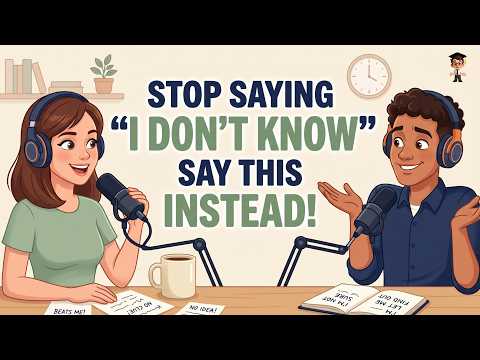
Stop Saying “I DON’T KNOW” | 5 Natural English Phrases Native Speakers Use | Easy English Podcast
Mr. English Channel
17m 39s2,737 words~14 min read
AI audio transcription
Transcript source
AI audio transcription
This transcript was generated from the video's audio because no usable YouTube caption track was available. The transcript below is server-rendered so it can be read, searched, cited, and shared without opening the original YouTube player.
Pull quotes
[0:08]It is so wonderful to be here with you today, and hello to all our amazing listeners at home.
[0:08]You will need that energy because we have a fantastic topic for our listeners today.
[0:08]It is very useful, Paul, but sometimes saying, "I don't know" all the time can sound a little repetitive.
[0:08]If someone asks me a question and I just say, "I don't know," it can sound like I don't want to talk to them.
Use this transcript
Related transcript hubs
Watch on YouTube
Share
MORE TRANSCRIPTS


