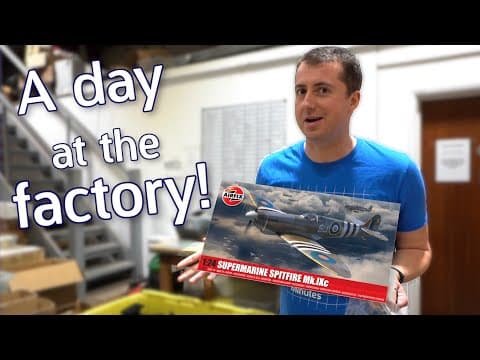
[0:00]On a cold, wet and windy day in the middle of November, I headed to an industrial state in the south of England. to spend a day at the factory which manufactures Airfix kits in the UK. I'm Matt, this is Model Minutes and join me as I take a look at how plastic models are actually made.
[0:21]Um, as you can tell, uh the site is not set up for uh presentations like this. So obviously I'm I'm the head of brand for Airfix. Who are you, Chris? I'm Chris. Uh, I'm one of the designers at Airfix and um, got to do the design for this Spitfire. And I'm Luke, I am Chris's glamorous assistant or more so glamorous. I'm the research for, so I do all the back background stuff so hopefully make it an accurate model. After a presentation from Luke who went through the research process, we had a presentation from Chris who went through how he physically designs the model. This covered various elements such as taking things from the initial drawings, adding them into the design software, then 3D printing prototypes and then finally sending off for the final production versions. It really struck me how time consuming the design process was for creating a model of this complexity. It was also very impressive the amount of detail that these guys would go into in order to achieve the finished product. Anyways, after those presentations, we were fortunate enough to be shown around the actual factory whilst it was working. Let's just give you a little bit of history about Plas-Tech. So Plas-Tech was formed in 1983. primarily as a tool maker. So it was an injection tool maker before it did any injection molding. So, Plas-Tech has the ability to work with the customer from an initial concept. So, you can come in here with an idea, so for say you wanted to make your own model outside of Airfix, you know, we could design it, develop it, produce it, tool it, mold it, and deliver it. So, the whole idea is that it's offer the complete supply chain under one roof, so from tooling through to a finished end product, we can do the whole lot. Will you make tooling here as well? We make tooling here as well. Yeah, we make tooling offshore in China as well. Obviously, tooling is very expensive, as you're as you're aware in the UK. Tooling is usually the bit that kills all models, you know, and decides whether it's going to move forward or not. It's not the actual production, production costs are relatively low, but obviously tooling is where the investment is. But we've tried to um on this particular project work with local suppliers. So, so the leaflet to printed in the local local town Seaford, just down the road. The boxes are produced um furthest away and then we've got another guy that producing the base boxes in Uppfield. So, within that sort of 50-60 mile radius, everything is produced around us and we are producing and making a whole product. So, the tooling when it arrives with us from China comes in freight. We'll uncrate it, we'll open it, we'll decrease it, it's all grease for shipping. We don't want any corrosion in transit. We'll then take those tools, strip them as we are with this tool here, inspect them. Test the water. We want to make sure it's got a water flow through. Water is key for our process, and key to the process and molding the product. You know, it's like an engine. We don't want it too hot, we don't want it too cold. We want it as a stable consistent processing temperature. The material requires that because if we try and inject hot plastic into a cold mold, it will affect the flow rate and affect the feel. But what you'll find is it doesn't it it won't glue as well, it won't behave as well. So that is a complete tool frames molded. You'll notice we have a central sprew. There we are. You're feeling very slightly warm. Yeah, yeah. You'll feel it the thick section, if you felt the thick section. Oh, yeah. That holds the heat more. Oh, yeah. That was at 235 degrees less than 60 seconds ago. And then just cooled. Yeah, it's cool. So the mold is the mold has a water system to maintain it at a constant temperature. So we're not trying to keep it too hot, we're not trying to keep it too cold. We have a fixed half and a moving half. One half of the mold is retained on the on the fixed half plan. This is where the injection point is. So we have the the feed system, the sprew, that's where it feeds into, then drops into a runner. And the runner is basically a road system, so it's like a series of blocks that you see here. So this is a road network and the road network here is purely to distribute the plastic into the correct positions of the mold. fill it. So it's important that when we're filling it, a part that's very fragile like that, is filling at the same rate and a part of the same size. So that mass might be a thousand times greater than that part there. So we've balanced the run the runner system, the feet system, so at the same point that, this should be filling. You don't want to fill that one too much because you'll over pack it before you fill that. There we are. Part will eject. We'll then open the door. We will then go in and we will the part comes off. We don't pull it off or force it against anyway, but it doesn't want to go. There's the tool in its raw state with the ejector forward. Yeah. mould what mould I like consistency. Yeah. I won't stop it for too long. No, yeah, okay. But uh So then what we do there, we shut the door. We make sure the mold is in a single cycle. push the blue button. Pins come back, mold comes in. Next stage is lock over. toggle goes on. clamp force, 380 tons of clamp force. We then get injection, you hear it? That's the plastic going in. The track is purely mechanical movement, as that plastic force its way in there. Yeah. Very, very accurate. Who wants to who wants to take one off? Oh, okay. If that's enough there. Yeah, it's just you just feel it come off. Oh, yeah.
[5:43]That's it. You see the pins go back. Mold closing, locks over. Process starts again. Wow. Yeah, probably for a day or night.
[6:01]Yeah. What we try, you know, we're running a 24-hour shift. So, typically, you know, it's it's a very, very simple. If it's 30 seconds, it's 120 now. If it's 60 seconds, it's 60. So you just you just multiply up. So 45 seconds, what's it 90 on the hour, isn't it? So you're running 90 parts an hour and as long as you can open and close that, as long as you keep the plastic coming in, yeah, 10 hours is 900. Yeah. But again, what we what we are doing at the moment to try and hit the delivery performance targets is rather than put that in and run that for a batch of 10,000, we'll put it in, run a thousand, pull it, put the next one in, run another thousand. So, the idea is build up the stock so we can keep flowing out a thousand of 1500 units per week. These are the inspection panels that we make up. So this is a these are test shots that are approved that they're then painted green. So you can then lay over the top these to inspect against the to give you an instant visual three-dimensional view as to there we are, straight away. Are we missing a part? You know, what's correct, what's not correct? Because obviously when you're running these for multiple hours, obviously you'll notice, you know, you can't always get to see, you can almost blind to the parts. So this is a visual queue. So straight away, if there's a if there's one stuck in the tool, obviously you don't be running the tool for hours and hours of the part stuck in there because obviously you're just producing scrap. So, these are some of the issues that well see we're that one's obviously got the complete set in there. So, we've got a correct part. What to look for is correct and we've got one that's incorrect. And obviously coupled with that, and we're checking those obviously anything everything's anything that's rejected. So that's your that's a reject then. That's the reject that this particular tool. Yeah, this will all be reground. Not necessarily back into the kit. We can usually add regrind back in at around about 10%. very low ratio. You go too high, so then we've got down here, we'll have here. These are the approved ones and they'll have a continued inspection report all the way through. So we're signing off 21 21 10 13 so all the way through there and and we're making notes if anything's been problematic, anything that has been an issue with the part sticking, anything that's stressing, anything that's not quite right. We'll have a note on there. So, and then at the end of each run, what we'll do is we'll highlight any potential issues for the tool to go back into the tool department and have any major any major faults, any corrections, any adjustments, anything that we need. Because obviously what happens with what happens with the tooling when the tooling's new, it will start to bed in. So obviously we're opening and closing the tool. That that mold there has got 600 tons of clamp force holding it closed. Yeah, that's not. There's a lot of material wants to flow like water. So all the way through what we'll do is we'll be checking, inspecting, signing off. So this so this is a 24-hour operation. When we're up and running on on 24 hours, 24 set, 24/7, we've been on this. Wow. So, and then against the limitations, there's only one set of tooling. So obviously when you're running a batch of 10,000 product, that mold has got right and closed, 10,000 times, and it's two people, they open, you take the parts out, you know, you inspect them, you pay. There's a lot of there's a lot of human interaction. It's not it's not just a switch it on and the bits drop out and drop into a box at the other end. This is this is a very hands-on approach. So that's the actual tool in the machine. That is the tool in the machine. So these are the two halves. These are two halves. You've got fixed half and you've got moving half. So this is the fixed half. This one on the right, it's the fixed half. Yeah, that's the moving half of the tool. That's the moving half. The mold will open, you'll see it obviously next door but the part will eject. We've got a water cooling system on there to it's actually a heating system on this one because we're maintaining the tour at around about 45 degrees. You see if it picks up dust out the atmosphere. So what we do is we bag it straight away because it's because it's electrostatic, anything that's in the atmosphere will be drawn to it. So it creates a thing. But so all we're looking for is is firstly, is it a full shot? In other words, has everything on that frame filled? Yes, sir. Yeah, to avoid any short shots. Yeah. The other thing of course we're looking for is flash if we put too much pressure in. You see there, got tiny little bits of flash. Yeah. See that. But now that's not on a molding face, that's not we're not too worried about that. It's too bad. I've seen kits of a lot worse. Yeah, that's that's it. So we're looking the whole time to make sure that it's not flash. So what would you what was the specific error on this one? Can you spot it? Uh, I don't know. There's there's something not happy with something whether it's that one that's come off. Oh, they're missing a bit. They're missing a bit. So whether that's got stuck in the tool. But again, we're not you're quite you'll see quite often other manufacturers will produce something, put it in a bag, and the one that's got stuck in there, they'll pull it off and you'll see a pair of marks on it. drop it in the bag.


