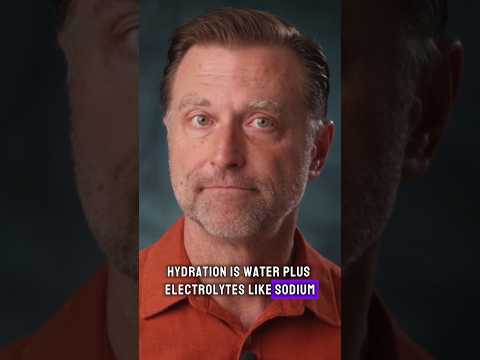
[0:00]Did our ancestors walk around all day with water bottles, sipping non-stop? Now, they didn't. Yet, today, everywhere you go, someone's pushing water on you at restaurants, meetings, social events. We're told, drink, drink, drink all day long, eight glasses minimum, regardless if you're thirsty or not. Don't get me wrong. I'm not against water. We need water. We can't live without it. But here's the point that rarely anyone is talking about. We can actually drink too much water. That's right, too much. What happens when you drink too much water, especially after exercise, is you're going to dilute sodium. And not just sodium, other electrolytes as well. This condition has a very specific name called hyponatremia. At first, you're going to feel tired, weak, and kind of foggy, and then the symptoms can actually get worse. It could be very, very dangerous. In your mind, you might think, "I'm drinking water. I'm becoming more hydrated." Hydration is water plus electrolytes like sodium.
Drinking Too Much Water Can Be Dangerous
Dr. Eric Berg DC
52s164 words~1 min read
YouTube auto captions
Transcript source
YouTube auto captions
This transcript was extracted from YouTube's auto-generated caption track. The transcript below is server-rendered so it can be read, searched, cited, and shared without opening the original YouTube player.
Pull quotes
[0:00]Yet, today, everywhere you go, someone's pushing water on you at restaurants, meetings, social events.
[0:00]We're told, drink, drink, drink all day long, eight glasses minimum, regardless if you're thirsty or not.
[0:00]What happens when you drink too much water, especially after exercise, is you're going to dilute sodium.
[0:00]At first, you're going to feel tired, weak, and kind of foggy, and then the symptoms can actually get worse.
Use this transcript
Related transcript hubs
Watch on YouTube
Share
MORE TRANSCRIPTS


