[0:00]So basically, the motivation for contributing in education came naturally, when we're teaching 25 kids in our campus in BITS Pilani, Rajasthan, and one of the girls dropped out of education, that's what triggered us to do something. And we could see the first success, after 3 to 5 years, we've seen that that particular school from 18 percentage pass percentage in 10th grade, all the way 84% it has come. Wow.
[0:31]Hello everyone, welcome to Design Darshan at BITS Design School. Today we are here at the Care Value Place Week. I'm Nitiesh, this is Sia, and today we are sitting with Mayur Patnala. Hello sir, would you like to give us a brief introduction of who you are and what you do? So, I'm a practicing volunteer, just like you're all practicing designers. That's been 20 years I have been practicing this volunteer ship. Currently I serve the position of responsibility of founder and global CEO of Nirmaan.org. It's a social impact org and we are designing it to be a real good corporation for social impact.
[1:11]So, it's a non-profit organization. We have founded this way back in BITS Pilani. When we were studying and we continued the journey. We majorly work in five areas. Education for the underprivileged, then economic empowerment for the underprivileged, health, environment and rural development. That is wonderful. So, let's start with education because that's something that I'm very, very interested in. How are you helping further education in rural areas specifically? So basically, the motivation for contributing in education came naturally because we are all from, when we started, we are all from middle class backgrounds and of other farmers or teachers or sons and daughters. And we have seen, when we are teaching 25 kids in our campus in BITS pilani, Rajasthan and one of the girl child dropped out of education that's what triggered us to do something. We felt we need to build a society where education, no child especially girls drop out of education. So we started with 2-3 point intervention wherein we figured out that either we should start our own schools or we should already work with existing schools, we figured out that we will work with government schools. So the first intervention that we did, the first design that we did is we started working with a government school, adopt the school, build the infrastructure, establish good academic curriculum, complement the curriculum which is happening etc. And we could see the first success. After three to five years, we have seen that that particular school from 18% pass percentage in 10th grade, all the way 84% it has come. Wow. And then 300 enrollments to 1200 enrollments. So that's how we started with one school. When we met with success, then we went to almost 100 schools. So similarly, we contribute to career guidance of the children. We contribute to digital education, now artificial intelligence, etc. So you don't just stop at one thing, you keep on continuing to... Yes, including sports. Sports also we feel this is education format. Yeah, for sure. How did you feel when you got your first success after those years? It's awesome. I mean, you're feeling like the problem versus the solution, it's awesome. So the problem is when we got campus placements in Hyderabad, and we're in IBM, and it's made of cyber bath. And in midst of that, the much like Silicon Valley, like you have USA, that much, we saw this school where only 18 kids are passing out of 10. What a great problem. And you feel a platter of emotions, sadness, helplessness, etc. For 3 to 5 years, you work as a community of volunteers and you succeed in something, the feeling is super high. Definitely. So you mentioned about infrastructure changes. Was those infrastructure changes alone enough to see this drastic of a change? There are three important things that we observed and we implemented in the design itself. One infrastructure, the basic infrastructure of having basic toilets because many girls shouldn't drop out of just because there are no functional toilets at eighth grade, sixth grade, etc. No. 2, you should have a safe drinking water and no. 3, you should have a good playground, not even classrooms. No. 4, good classrooms and like this basic infrastructure is important. Once we set up that we go into academic excellence. So, academics may, there are official reports that in 8th grade or in a government school sometimes don't have 2nd or 3rd grade basics. So, while the teachers teach a regular syllabus, we used to teach the foundational competencies that's academic excellence part. The third is holistic education. So we have a class framework C L A S S, C stands for career and computers, L stands for language and library, A stands for arts, S stands for science, S stands for sports. This is a holistic education. So when you work on infrastructure, academic excellence and also holistic education, then naturally the schools will turn around. There are many government schools are getting shut. And this today is a very good example. So they are getting shut because of the lower percentage of students. Naturally. It becomes unviable. So, obviously when you go in and then you show them this holistic education, you still need to have the government teachers that continue this after you're done and you leave, right? So how are you training teachers and how are the teachers able to continue this kind of ideology? So basically whichever school that we take up, we work with the community with the teachers from the beginning. So there is infrastructure based maintenance. Once we build the CAPEX of the entire thing, the OPEX operational expenditure part, we also take donations from the local community, we train the teachers and do it. So we are able to succeed relatively well in terms of sustainability, but education is not something which when you leave, I will not agree that 100% your change will be lasting because there are gaps in the policies.
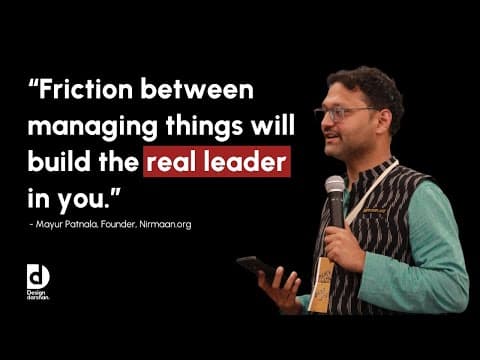
[6:47]So for that, youth have to enter into politics and have to really do that. Yeah, for sure. So like talking about you, you were a student yourself and you started this out. So how did you manage to balance both your studies and working for this? One step back, so while we close out on education, for your viewers, I would like to say that If you have an idea of, if any of the viewers have the idea of adopting a girl child, working, seeing that a child pass through all the phases or you want, you have some some school in Gujarat or your own Janmabhoomi wherever you want to develop, there is a call for action from global give back movement. If all of us can take one school, one child at a time and give back to our Janmabhoomi, I think it will be awesome. Nirmaan.org is ready to partner with all of you across the world. There are several people. I want to close out by saying one example. From our own BITS Pilani on BITS campuses, there is one person called Santosh Kasavajjala. So this gentleman has gone for Masters in Stanford and then he went to Apple and currently working. He lives in Bay Area, but when we visited and you know signed up, he signed up as a give back champion. And do you know where he is from? He is from a Telugu medium, regional tribal school called Dammagoda Government School. So, now with him we partnered and he provided the necessary funding for it and we are developing one school. So, imagine power of many, right? So, that's the moment that we need to be in. There's so much there. Each one of us have to do. Then India will be definitely on the developed India path. And for your question, how did you balance your academics? In our Pilani campus we have something called 0% attendance. So that means that you need not attend classes, you can do whatever you want and it believes that you have your own learning style. So that gave us opportunity to pursue several things. What it was really difficult, really difficult to manage both academics and also this because we are also like. Our parents are having aspiration, we have lot of education loans to pay and even though some of the subjects you don't like it, still you have to work on it. It was really difficult during leadership tenure. And you were not making it on a small scale. But when doing the friction between managing two things, will build the real leader in you. That's it. So you take multiple responsibilities, your podcasting team along with your academics, several things that are happening. Still you need to do this. What happens is the leader within you comes out. Later I realized, many of us realized, it's okay to drop one to CGPA then, but yeah. So I focused on my future career where I want to. I focused on those subjects and then that. I see, okay. So how big is Nirmaan right now? Um, you, I attended your talk below. I'm sure it started out small and now it's definitely larger, right? Can you give us a number? First I want to mention about non-profit space. Yeah, sure. Non-profit space, every micro, even as an individual, people do acts of care and giving. And there's small non-profits which cater to ten mentally retarded children or intellectually disabled or intellectually slow children. The pride or the greatness that we should attribute to that versus the large scale is the same, because each are unique. So, I want to tell that and on basis of it, now I will tell how large it is. I am also proud about, of course about the scale at which we are operating. The scale is, we started with 10 volunteers, just like you guys are studying, we started 20 years back. Now we are 10,000+ volunteers operating in both in India and USA. And we have 660 full time positions right now which are there in Nirmaan including me. I am a full timer, people who have come with me are full timers and you know we have social impact careers at all. I see. Um, so obviously having this many people and you guys are doing great things obviously. How were you able to fund, you know? The funding comes in three different ways. One is through individual social responsibility, ISR giving we call it and then two CSR giving that is cartridge social responsibility, three is global giving, people across the world will start giving to various campaigns that you raise. Okay. So, how do you think we as designers and BITS Design can contribute or help out? So I feel that in two ways you can contribute and help out. One is as a general volunteers, and building a volunteering chapter which takes up social impact projects and social impact events in the campus and we have lot of good examples of other BITS campuses and also different colleges and schools where we run around 10 chapters. That is one regular thing and secondly also on your core competency that is design itself. So you can start contributing as a student volunteer, you can practice design in social impact space. And you can take up summer internships and also remote internships and also practice school you can do with us. And lastly, we will be able to also enable social impact careers. So, we are also planning by the time you complete your four years, the first batch will come for campus recruitment. Because we want social impact space to be any such space where people really crave for. I think talking to people like you and obviously the other people we've had on the podcast, a lot of them are focused in the social impact space and I for one am getting very, very inspired and hopefully, you know the audience of the... I have one more call for action is give back to schools and also villages. Yeah. We have to adopt villages that to tribal villages across the country to your viewers and to all of you. I feel that just imagine this concept of every person taking one village at a time. Not only building our own house, doing a marriage and raising the kids, but also take one village as a thing. It will be an awesome proceeding activity for a political movement. People movement should proceed political movement. Yeah, for sure, for sure. Okay, so thank you for coming on. We really, really appreciate it. I for one, again, I am very, very inspired and hopefully we inspire all of our audience and everything as well. Thank you for coming on. Thank you. It's awesome interacting with you. Thank you. Thank you.