[0:01]If you want to feed the world in 2050 then the next 40 years we need to produce the same amount of food as we did over the last 8000 years.
[0:12]And that gives a little bit an indication of the pressure on the food system.
[0:19]We just face a huge challenge with the growing population with the changing consumption behavior with the climate crisis.
[0:27]How do you secure your food production? is the sustainable production.
[0:32]It should be with less inputs, less fertilizer, less pesticides, less water, needs to be sustainable.
[0:38]Otherwise we will destroy our planet. Yeah.
[0:46]The security of the food system is one of the world's most pressing challenges.
[0:50]But the story of how this small country became an unexpected food superpower might just have some answers for how we tackle it.
[0:57]Consider this, if everyone on earth ate the diet of the average American, that would require all the habitable land to be used for agriculture and we'd still be 38% short.
[1:06]And that's right now. What do we do in there are two billion more people?
[1:10]Well, the key is more exciting than it sounds and that's efficiency.
[1:15]Basically, how do we produce a lot more on the land we're already using and do it using a lot fewer natural resources.
[1:21]When it comes to sustainable agriculture, one country has seemed to crack the code.
[1:27]Bolder by a national commitment to produce twice the amount of food with half the resources. The Netherlands has become the world's number two food exporter.
[1:38]It was a very close collaboration between the government, science organizations and the industry.
[1:43]And they started out of a common interest. So they say, okay, we we want to go for sustainable production, but everybody was aligned.
[1:49]Everyone involved in the system was aligned and embraced innovation to reach that shared goal.
[1:54]And that has driven efficiency on a level unmatched anywhere else in the world.
[1:59]If there's one place that approaches most It's in their unriven greenhouse growing operations.
[2:04]There's a very nice example about tomato which really gives a good insight in how we want to produce our food in a sustainable way.
[2:11]So if you produce tomatoes in an open field situation in Spain, then you will end up at the end of the growing season with 4 kg per square meter.
[2:20]If you do this in a high tech greenhouse in the Netherlands at the moment, you will end up with 80 kg per square meter which is 20 times more.
[2:28]But the best part of the story is that the 80 kg of tomatoes we do it with four times less water compared to a no field situation.
[2:35]water is one of the big challenges that we face. Just had a cup of coffee.
[2:40]Do you know how many liters of water were needed to produce that cup of coffee?
[2:46]Rough gas. 10 150.
[2:51]So high technology offers really a possibility of producing a lot of food per square meter in a sustainable way.
[3:00]The Dutch lead the world in tomato yield while using a fraction of the water that other countries use, but it's not just tomatoes.
[3:05]Meated by yield per square mile, they're the world leader in the production of chili, and green peppers and cucumbers.
[3:12]Number five, for potatoes, onions and carrots, the list goes on, but the bottom line is they've been able to get so much out of so little.
[3:19]If we are able to produce 80 times more with four times less water, that's that's great. That's great news, I think.
[3:26]Most people know that greenhouse is allow a grower to tweak every little thing.
[3:31]But the Netherlands is taking it to the next level.
[3:34]They've perfected the greenhouse as the ideal environment to continuously test and implement all kinds of ways to optimize growth.
[3:40]From things as simple as testing what heat of LED lights can increase pest resistance and improve nutritional value.
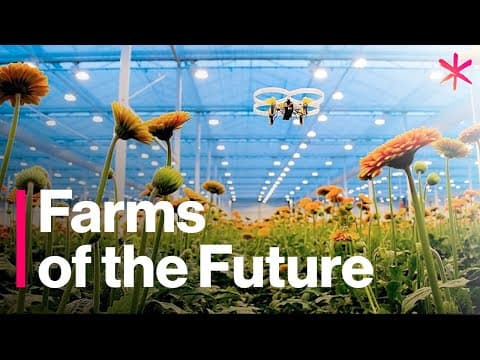
[3:46]So things as crazy as moth killing drones.
[3:49]So we're at the moment we don't have any products who can control actually the the moth and finally they will produce catpillars and those catpillars they will can do a lot of harm to many different crops.
[3:58]Well that drone is to detect the map, also to see how how it's flying and then with his wings, it just will just crush actually did the map. Wow.
[4:11]There's a relentless drive towards innovation to create better and more efficient growing techniques.
[4:15]They've even started taking the human touch completely out of it.
[4:20]Some of the latest tech relies on AI to learn plant behavior in constantly adjust conditions without any input from a farmer.
[4:26]For example, what we're testing in this compartment is a climate computer.
[4:30]So we have different sensors and it's actually we measure the plant activity.
[4:35]And based on the plant activity, the computer is actually controlling the whole climate by itself.
[4:42]Ultimately, the key to solving our global food challenge isn't just in relying on super efficient food producers to carry the weight for everyone else.
[4:49]It's learning from and adopting that technology.
[4:52]At the World Heritage Center, you see that effort firsthand in an ongoing experiment.
[4:57]They've built basically a greenhouse within a greenhouse.
[5:01]Inside the structure, they're able to replicate any climate on earth to figure out what modifications need to be made to realize the same yield they're getting in the Netherlands in any other country on earth.
[5:10]We have a cooperative project going on with Colombia and we can in fact, we can emulate the climate the current climate conditions in in Colombia put their crop in and see how crop behave under the circumstances that we have in in Colombia.
[5:28]We can totally flip the seas we can make it a sunny day on Christmas.
[5:34]We can close the curtains on a sunny day and make it completely dark.
[5:39]I think in the long run, the future of the Netherlands should not be to be a producer for the rest of the world.
[5:46]We should be a developer for the rest of the world.
[5:50]We are the country that will export our knowledge on creating production facilities all over the world.
[5:56]Innovation starts really by bringing all these networks together in the world we live nowadays, you need to link up with other people.
[6:04]You can't do it on your own. We need to produce more, we need to do it with less inputs and we need to do it better.
[6:12]Thanks for watching. If you like the future of food, stay tuned for our new series Future of cities. Subscribe to free think now to be the first to see new episodes.