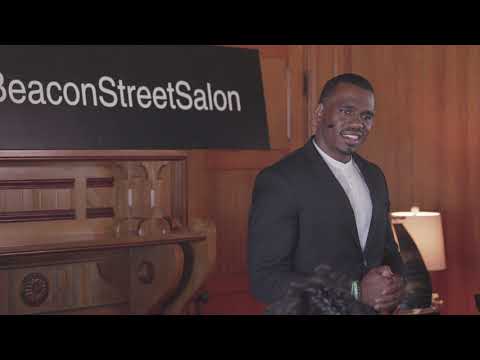
[0:13]Today we're going to talk about labels. Labels are used to describe people and things. As y'all can see, my first label that I want to introduce to you is that I'm black.
[0:31]But then also, I'm a man. And along with those two labels, when you put them together, you find some unique stressors. Um as I think about whenever I step outside of the house, I have to think about how am I going to talk to someone. I had to think about how I'm dressed. I even had to think about just my interactions with the individuals that I may meet in passing. And I think we can all agree when you constantly thinking about things like that, it it could be very stressful. But in 2006, I gained a new label. Bipolar one disorder, as I sat in the psychiatric ward of a hospital doing my sophomore year of college. My family escorted me to the hospital after they recognized my first psychotic break. During this time period, I lost about 25 pounds over a matter of six weeks. I went through a period where I wouldn't leave my dorm room. And I went through a period where I didn't sleep for two weeks. But the deciding factor for them was the three distinct voices that I would hear. And those three distinct voices got me the specific label of bipolar one disorder with psychotic features. Now, outside of all of the symptoms that I was experiencing, when I received this label, it came with fear and shame. Because I'm a black man from a rural town in Bertie County, North Carolina. Grew up, three sport athlete, graduated near the top of my class. Got a scholarship, an academic scholarship to the University of North Carolina in Chapel Hill. And I walked onto the football team and the track team there. So, long story short, I was a man. And I thought that the man couldn't have this label attached to him. Because once people found out about this label, oh, then comes the label of being crazy. Nobody wants to be called crazy. So, I had to keep that label to my chest, close to my chest. Didn't want to tell anybody. Only people that knew was my close family. Lucky for me, I also got treatment during that period, through the initial stages. Started to see a therapist, started to see a psychiatrist and was taking my medication. I got better. But the ignorance in me told me that I was cured. The ego in me told me that I could thrive without being in treatment. So I stopped. I wanted to get back to being the man. Nobody knew that I was in the hospital, nobody knew I ever took meds, so I can just jump back into the groove. When I got back into that stage, the symptoms came back. But then my ego was talking to me, oh, you don't need to go back to that. You don't need treatment. For me, started to self-medicate with alcohol. I was going through a fifth of tequila every other day. And that went on for years. During this period of trying to ignore this bipolar label, I picked up another label. The label was being a survivor of attempting to die by suicide three times. First two times, attempted overdose on pills. Last time I put a gun in my head and pulled the trigger. And it jammed on me. Now, a lot of people think that suicide is something that's selfish or, you know, they really don't understand it. But doing this time period, I was just trying to end the pain. But then y'all remember those three voices, they were telling me that the world would be better off without me here. That was the lowest point of my life. And after a bunch of tears and a lot of self-reflection, I actually went back to treatment. Got on meds, started to see my therapist again, and I got better this time. But as I got better, I started to look at the world completely different. Started to notice that friends and family were suffering the same way I was. And a lot of times, we weren't talking about it. Even a close friend of mine, I understood that he would smoke all day, every day. Honestly, we were in a dysfunctional household, I would drink all day and he would smoke all day. But I wanted him to get the help that I got. And the only way that I was able to do that was for me to share with him the battle that I dealt with for seven years alone. And actually explain to him my diagnosis. Explain to him my attempts at suicide. And his very first response to that was, well, bro, why ain't you tell me? But I want y'all to think about it. What if your friend comes up to you and say, I've been hearing three voices. They telling me I shouldn't be here anymore. I was diagnosed with bipolar disorder. I was in a psychiatric war and in a straight jacket. What would you do? Since that time, I picked up a few more labels. But honestly, these labels helped me manage the symptoms associated with bipolar disorder. And honestly, y'all may want to pick up these labels as well, because you may benefit from them. Now, I'm not trying to diagnose anybody in here, even though I'm licensed to do so. But we are all, we all go through something at some point in life. So I picked up the label of being a, I would say gym rat or Yogi, an amateur Yogi. Uh because I understand how physical fitness ties directly to my mental health. Also, I picked up the label of being a writer, mostly in my journal. Because this helps me keep track of these racing thoughts that I have going on in my head. Then I picked up the label of being an artist. Now, you won't get any Mona Lisa or anything out of me. But I use coloring books as a form of active meditation. And then one of the final labels that I picked up was, I'm a researcher. Not in the sense of being a PhD student, but in the sense of researching myself. I keep track of everything. Who I talked to, how much time did I sleep that night? All of these things help me learn my protective factors. Help me learn my stressors. Help me learn my triggers. Because I can't change anything unless I know about him. So with all of that, I want to challenge anyone who has the label of any mental health challenge. And embrace your other labels. You are more than just that one particular label. And for anybody that doesn't have a diagnosis, I challenge you to understand what that label means to individuals that you love and care about. It's used to be a framework to find ways to support that individual, not to ostracize them. I learned how to embrace the label of being bipolar. But I also learned to embrace every other label that was given to me or I gave to myself. I'm not a person that suffers from bipolar disorder. My name is Rashaun Miller, I live with and with the help of of healthy supports, I thrive with bipolar disorder. Thank you.


