[0:11]Within the order primates is the super family Hominioidea, which includes the greater apes, the lesser apes, and man. This presentation will include only the non-human hominoids. Unfortunately, all of them are endangered in the wild. Apes have larger brains than monkeys, even in relation to their body size, and they are more intelligent. They have no tails, although it is true that a few species of monkeys are also tailless. Apes differ from monkeys in coming into menstruation rather than estrus. In estrus, a female monkey is sexually active only during her estrus cycle. Within the hominoidia is the family Hylobatidae. These are the lesser apes, which comprise the 16 species of Gibbons. As a group, they are smaller and somewhat less intelligent than the greater apes. They are physically adapted to swinging through the trees with long arms and a hook like hand. This swinging from branch to branch is called brachiating. The largest of the Gibbons is the Siamang from Southeast Asia. Both males and females have an inflatable throat pouch that enables them to make loud calls.
[1:49]The greater apes include the orangutans, the chimpanzees, and the gorillas. These are large brain primates, but they still have well below the cranial capacity and intelligence of humans. This is somewhat surprising in light of the fact that the genetics of great apes are at least 95% identical to the genetics of human beings. The two subspecies of orangutan are found on the islands of Sumatra and Borneo. They are both becoming rare due to habitat loss from the oil palm industry. Their reddish hair is distinctive among the great apes. Unlike the chimps and gorillas, orangutans are completely arboreal and are the largest tree dwelling animals in the world. Males can weigh up to 250 pounds and are extremely powerful. Orangutans' arms are twice as long as their legs, as you might expect from an animal that lives in trees. Orangutans eat mostly fruit. They tend to be solitary in lifestyle and are slow moving. Males live alone. Females wean their juvenile offspring after about four years.
[3:13]You see the intelligence of this primate when rain begins to fall in the jungle. Why get wet if you don't have to?
[3:25]The chimpanzee and related Bonobo are confined to the central part of the continent of Africa. They are highly intelligent and have been observed by Jane Goodall using sticks as tools to extract termites from their nests. Chimps are omnivorous and are the only great apes likely to kill and eat other animals. They are at home on the ground as well as in the trees and get around by knuckle walking. Chimpanzees often live in large communities with a definite social hierarchy. The alpha male who controls the group may not be the largest or strongest of the males, but rather the one who is most politically successful, the one who can make the most allies. Chimps are quite capable of deception. Gorillas are the largest of the primates with dominant males weighing up to 450 pounds in the wild. They all live in the subtropical forests of Africa.
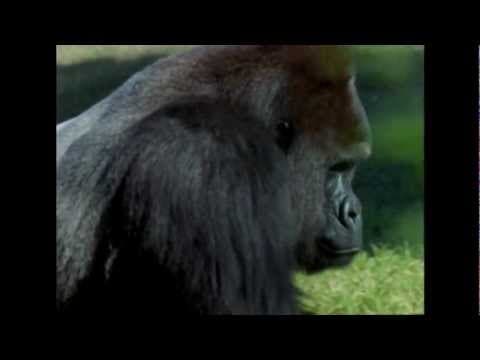
[4:30]Species include the Eastern and Western lowland gorilla and the rare mountain gorilla, which lives high in the Verunga Mountains at the juncture of Rwanda, Uganda, and the Democratic Republic of Congo. There are no mountain gorillas in captivity. All captive gorillas in the US are Western lowland gorillas. Gorilla troops consist of a dominant male silverback and several females with their offspring. Occasionally, a few mature but subordinate males called black backs will also be included. The silverback determines all movements of the troop. Where they feed, where they stop to rest at midday, and where they sleep. Gorillas eat leaves, stems and the pith inside stems. They like bamboo.
[5:30]They eat small amounts of fruit, but rarely drink water because of the high moisture content of their food. Gorillas in captivity have been taught to communicate with people through the use of signs or symbols, a mark of their high intelligence. Being in the presence of gorillas in the wild, such as these mountain gorillas in Rwanda, is an unforgettable experience. You are safe if you do not threaten the troop or stare into the silver backs eyes.


