[0:00]Today, we're diving into stakeholder mapping, a must-know strategy for anyone managing projects or running a business.
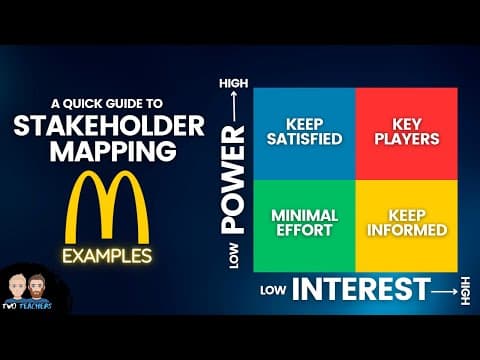
[0:11]So, what is stakeholder mapping? It's like making a relationship map for your business. Stakeholders are all the people who care about or are impacted by what you're doing as a business. The goal is to figure out who these people are and how you should interact with them. Here's why this is super important. Not everyone cares about your project or the decisions your business makes in the same way! Some people are all in, like your investors, while others just want to stay in the loop. Put simply, stakeholder mapping helps you to prioritise, communicate and avoid conflicts. Now, let's break stakeholder mapping into four simple steps. Step one is to identify your stakeholders. Start by making a big list of everyone connected to your project or decision. Think about all the people, groups, or organisations involved, either directly or indirectly. At this stage, no one's too small to consider. Just get everyone on the radar. Moving on to step two, which is to analyse your stakeholders. Once you have your list of stakeholders, it's time to ask two key questions. How interested is each stakeholder in what you're doing? And how much influence or power do they have to shape decisions, help the project succeed, or potentially disrupt it? For example, someone with high influence might be a senior decision-maker whose approval is critical. But if they're not that involved in the details, their interest might be low. On the other hand, people who are highly engaged with the outcome, like your team members or customers, might have high interest but less influence and power over decisions. Now, it's time for the third step, which requires you to categorise your stakeholders using a two-by-two matrix. This is where you sort everyone into one of four categories based on their level of interest and influence. These four categories are key players, keep informed, keep satisfied and minimal effort. The key players are stakeholders with high influence and high interest. They care about the outcome and have the power to shape decisions. So you'll need to keep them closely involved through regular updates and collaboration. Stakeholders in the keep informed category have high interest but low influence. They care about the results but don't have decision-making power. You need to keep these engaged with updates and communication to maintain their enthusiasm and support. Stakeholders who have high influence but low interest are placed in the keep satisfied category. They may not be heavily invested in the details, but their support or approval is essential for the project's success. Focus on meeting their needs and keeping them in the loop without overwhelming them. Finally, stakeholders with low interest and low influence fall into the minimal effort category. These might be people or groups who are only loosely connected to the project. Monitor them lightly to stay aware of any changes, but don't dedicate significant resources to engage with them. The fourth and final step is to engage your stakeholders. Once you've categorised everyone, it's time to create your engagement strategy. You can do this by prioritising your key players by involving them in major decisions. Keep high-interested stakeholders informed and excited. Satisfy high-influence stakeholders by ensuring their needs are met and monitor everyone else lightly, just in case something shifts. By focusing your time and energy where it matters most, you can streamline your efforts and keep your project or decision on track. Let's bring stakeholder mapping to life with a real-world business example using McDonald's. Imagine McDonald's is considering the launch of a new plant-based burger. Who are the stakeholders and where do they fit on the map? Let's break it down. First up, it's the key players. These are the people with high interest and high influence. For McDonald's, that's the customers who've been demanding more sustainable food options. They care a lot about the new burger and their opinions can make or break its success. To keep them on board, McDonald's should engage with them directly. Think regular updates through social media, ads and in-store promotions. Another example of key players would be shareholders and franchise owners. Shareholders want to see how this new product affects the company's profitability, while franchise owners are directly involved in implementing the new menu item. McDonald's might engage with these stakeholders by holding meetings or sending reports to ensure they feel confident in the decision. Next, we've got the keep informed group, people with high interest but low influence. Here, it's the employees in the restaurants who'll be cooking and serving the new burger. They need to know what's coming so they can prepare. McDonald's could run training sessions or share updates through internal communications to make sure that they're ready to go. Another example of a stakeholder in the keep informed group could be loyal customers who love trying new menu items, but don't necessarily influence wider public opinion. Regular newsletters or app notifications can keep them excited and informed. Then there's the keep satisfied stakeholders. These are people with low interest, but high influence. Consider regulators who don't really care about the burger itself, but are critical when it comes to food safety standards. McDonald's would focus on meeting all the necessary compliance rules to keep them happy and avoid any roadblocks. Another example of stakeholders which McDonald's needs to keep satisfied might be local governments in the areas where McDonald's operates. And finally, it's the minimal effort group, people with low interest and low influence. This could include the general public, those who don't usually eat at McDonald's and aren't particularly invested in its menu changes. They might hear about the new plant-based burger, but it doesn't really affect them. McDonald's doesn't need to spend too much time on this group. Just keep an eye on any general reactions or trends. Another example could be competitors with a different market focus. Consider high-end dining establishments or niche restaurants that don't really cater to the same customers as McDonald's. Sure, they're in the same industry, but a plant-based burger at McDonald's isn't likely to impact them much.
[6:05]McDonald's can simply keep an eye on general industry trends without needing to engage directly with these competitors. By identifying and categorising its stakeholders through the stakeholder mapping process, McDonald's can prioritise who to focus on, identify how to communicate with them effectively and ensure the burger's launch is a hit.


